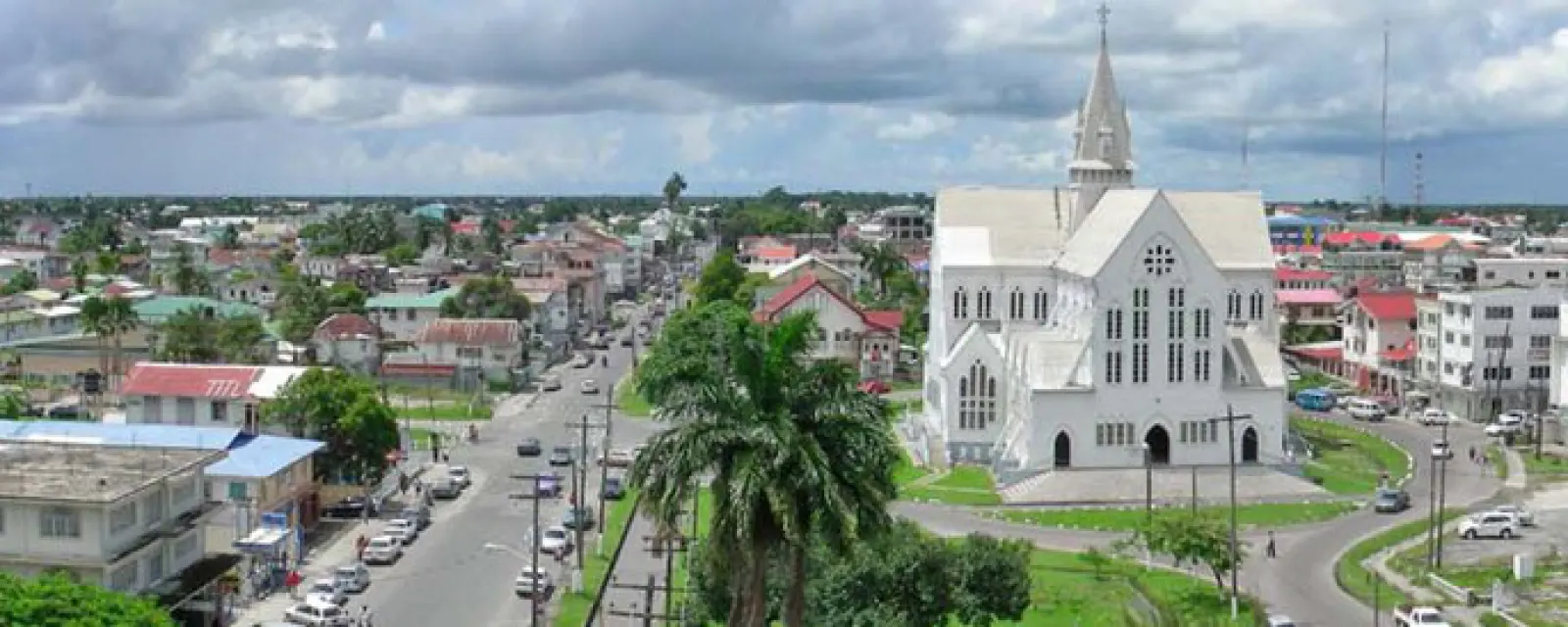
Overview
Guyana holds a rank-49 passport reaching 82 destinations without a prior visa. Its population is around 790,000, the capital is Georgetown, and the currency is the Guyanese dollar (GYD).
Guyana has no citizenship-by-investment programme, but permits dual citizenship.
📌 Guyana is South America's only country with English as its official language, and is culturally Caribbean rather than South American — a member of CARICOM, not Mercosur.
But the reason Guyana most repays reading right now is in the next section.
🔴 An experiment in progress: the world's newest resource-rich country
Throughout this library I have recorded a long sequence on the resource paradox — countries with wealth underground and what followed:
Nauru — phosphate, fund dissipated, nothing left. Venezuela — the world's largest oil reserves, the worst outcome. Papua New Guinea and Mongolia — funds correctly designed on paper but never filled. Turkmenistan and Afghanistan — reserves without a route to market. Iraq — everything present, but almost no other revenue source. ✅ Kuwait 1953 · Kiribati 1956 · Tuvalu 1987 · Norway 1990 · Azerbaijan 1999 · Kazakhstan 2000 — funds still operating.
🔴 Guyana is the newest chapter, and what makes it distinctive is that we are watching it happen, with the outcome unknown.
The sequence, stated as facts:
- In 2015, a major oil discovery was made offshore Guyana in the Stabroek block. Subsequent discoveries indicated reserves very large relative to the country's size.
- Production began in late 2019 and grew rapidly.
- 🔴 The result: Guyana became one of the world's fastest-growing economies for several consecutive years, with annual GDP growth at levels ordinary economies never reach.
- 📌 From among South America's poorest countries, Guyana's income per head rose sharply in less than a decade.
📌 Guyana read the textbook — the question is how far that carries
Notably, Guyana did not discover oil naively. It sits next to Venezuela and could see directly what happens when a country with abundant oil governs badly.
What Guyana has done, stated as facts:
- ✅ Established a Natural Resource Fund in 2019, with the legal framework revised in 2021, setting rules on how much oil revenue transfers to the budget each year and how much is retained.
- ✅ Joined international transparency mechanisms for extractive industries.
- ✅ Published its petroleum contracts — a step many oil-producing countries do not take.
🔴 But here is the necessary honesty, and it is why this article repays reading:
- 🔴 The terms of the original oil contract have been widely debated domestically, with arguments that Guyana's share is low by international norms. Renegotiation, or different terms for new contracts, is a standing political subject.
- 🔴 The withdrawal rules were amended after the fund was created, in the direction of permitting larger transfers to the budget. This is precisely how other funds in this library began to weaken — not through one large wrong decision, but through repeated loosening of the rules.
- 🔴 "Dutch disease": when oil money enters a small economy, the currency strengthens and other sectors — agriculture, processing, tourism — lose competitiveness. Guyana is squarely in that risk phase.
- 🔴 Inequality and social expectations: growth measured in macroeconomic figures does not mean every household sees change.
📌 Why this article is worth following: most resource-paradox articles concern matters already settled — we read the outcome and draw the lesson. Guyana is the only one whose ending has not been written.
🔴 And the real question is not "does Guyana have a fund" — any country can establish one. The question is whether the withdrawal rules survive multiple governments, multiple election cycles and multiple oil price downturns. The Kiribati article shows a 1956 fund still alive but thinned by drawdowns; the Nauru article shows a fund can vanish entirely. The difference between those outcomes is dozens of small decisions across decades.
✅ Dual citizenship — and a rule that brought down a government
Guyana permits dual citizenship, which matters for a country with a very large diaspora.
📌 But there is a notable exception, and it once produced a genuine political crisis:
🔴 Guyana's constitution provides that a person holding another country's nationality is not eligible to sit as a member of the National Assembly.
What happened: in 2018, a no-confidence vote passed in the National Assembly by exactly one vote. It then emerged that the member casting the deciding vote held another nationality, producing a prolonged legal dispute over whether that vote was valid. 📌 The matter reached the highest court and ultimately led to elections, followed by a months-long vote-counting process.
📌 The lesson for readers, applicable in many countries: "this country permits dual citizenship" almost never means "with no restrictions". Most countries permitting dual nationality exclude dual nationals from certain offices — this library recorded the same in Kyrgyzstan.
🔴 If you or your children may enter politics, serve in the military, or hold certain public positions in a country, this is a question to ask before taking an additional nationality — not afterwards.
📌 A diaspora larger than the home population — the third case
This library has recorded two countries whose diasporas exceed their home populations: Armenia and Lebanon.
📌 Guyana is the third, and its emigration rate is among the highest in the world. Large communities exist in the United States (particularly New York), Canada (Toronto), the United Kingdom, and neighbouring Caribbean countries.
🔴 The cause was decades of economic difficulty and political instability before oil. The most serious documented consequence: the emigration rate among university-educated people is among the highest in the world — meaning the country trained many people and then lost them.
📌 This is Guyana's central problem right now: it has oil money to build hospitals, schools and infrastructure, but needs people to run them — and a large share of those people are in New York and Toronto. Attracting the diaspora home is a genuine part of national policy, and dual citizenship is one instrument in it.
🔴 The Essequibo dispute — stated at the level of facts
📌 The Essequibo region comprises roughly two thirds of the territory Guyana administers, and Venezuela claims sovereignty over it.
Stated with dates, without judgment:
- 1899 — an international arbitral award fixed the boundary, assigning the region to British Guiana, Guyana's predecessor.
- 1962 — Venezuela declared it did not recognise the validity of the 1899 award.
- 1966 — the Geneva Agreement between Britain, Venezuela and British Guiana established a framework for seeking a settlement.
- 2018 — Guyana brought the matter before the International Court of Justice; Venezuela contested the court's jurisdiction. 📌 Proceedings are ongoing.
- 🔴 December 2023 — Venezuela held a referendum concerning the region, raising tensions. The two sides subsequently met and issued statements on refraining from force.
📌 This site records the existence of the dispute and draws no conclusion on the merits. 🔴 For readers, what matters is the practical position: this is an active dispute, much of the oil lies in waters connected to the area, and any long-term plan in Guyana must account for it.
📌 For this site's subject, it is also a notable data point: this library has recorded many ways borders get drawn — Afghanistan (the Wakhan Corridor drawn for third parties), Tajikistan (Central Asian boundaries drawn in the 1920s), India and Pakistan (partition in 1947). Essequibo is an example of a boundary drawn by international arbitration and repudiated by one party more than sixty years later.
Geography & climate
Guyana lies on South America's northern coast, bordering Venezuela, Brazil and Suriname, with an Atlantic coastline.
📌 Around 85% of Guyana is tropical forest, and most of the population lives on a narrow coastal plain.
🔴 And this needs knowing: much of that coastal strip lies BELOW SEA LEVEL at high tide, protected by a sea wall and drainage canal system dating from Dutch colonial times. Georgetown sits within it.
📌 The consequence: Guyana is among the most vulnerable countries in the Americas to sea-level rise — not because of mountainous terrain or small islands, but because the capital and most of the population sit behind a wall. Maintaining that system is a permanent fixed cost of this state.
📌 Kaieteur Falls on the Potaro River is among the world's largest single-drop waterfalls by volume — nearly five times the height of Niagara.
📌 The Rupununi in the south is extensive savannah, quite unlike the forest, home to Indigenous communities.
✅ Guyana is among the countries with the highest forest cover and lowest deforestation rates in the world, and has participated in international mechanisms paying for forest retention. 🔴 The open question is whether that holds as oil money creates pressure for infrastructure and mining development.
History & people
The territory passed from Dutch to British control, becoming British Guiana. Independence came in 1966, and it became a republic in 1970.
🔴 Guyana's demographic structure is a direct consequence of colonial labour history, and it must be understood to read the society here:
- After the abolition of slavery, plantation owners sought replacement labour for the sugar estates.
- 📌 Hundreds of thousands of people from India were brought under indenture during the nineteenth and early twentieth centuries — the same system that took Indians to Trinidad, Fiji, Mauritius and South Africa.
- 🔴 The result: Guyana today has two large communities — of Indian and African descent — alongside Indigenous Amerindian communities, and people of Portuguese, Chinese and mixed descent.
📌 People of Indian descent form the largest population group, and Guyana is among the few countries outside South Asia with such a high proportion. The India article in this library discusses the Indian community abroad — Guyana is among its earliest and least-known destinations.
🔴 Guyanese politics has long divided along these two large communities, and this is a necessary factor for reading any political development here. This site states it at the level of facts.
📌 The culture is a rare blend: curry alongside Caribbean dishes; Hindu, Muslim and Christian festivals all public holidays; music mixing chutney, soca and reggae.
English is official, with Guyanese Creole the everyday spoken language. Indigenous Amerindian languages remain in use in the interior.
📌 One common confusion needs clearing: Jonestown, the 1978 event many people know of, occurred at a settlement established by a group of Americans in Guyana's forest. 🔴 It is not part of Guyanese history or society — but since the country's name is attached to it in international memory, it is worth placing correctly.
The Vietnamese community in Guyana is very small.
The economy beyond oil
1. Gold and bauxite. Traditional mining sectors predating oil.
2. Agriculture. Sugar and rice — 📌 Guyana is a rice exporter within the Caribbean — alongside shrimp and timber.
3. Ecotourism. Small in scale but with genuine potential given the primary forest and Kaieteur.
As always: tax obligations here do not replace those in your country of residence.
Immigration routes
No investment programme exchanging for citizenship.
Categories existing in law include employer-sponsored work permits, business and investment visas, and residence through marriage. 📌 Demand for foreign specialists is rising sharply in oil and gas, construction, logistics, healthcare and education — a direct consequence of the skills shortage described above.
📌 Guyana is a CARICOM member, and within that framework a mechanism exists for movement of skilled workers between member states for defined occupational categories. It applies only to CARICOM nationals.
Citizenship
- ✅ Dual citizenship permitted — with the parliamentary eligibility exception noted above.
- By descent and by birth under prescribed conditions.
- Naturalisation requires a statutory residence period and case-by-case assessment.
- 📌 A registration route exists for people of Guyanese descent — the same class of descent mechanism this library recorded in Armenia and Lebanon.
🔴 If anyone offers you "Guyanese citizenship by investment", stop. No such programme exists. 🔴 And exercise particular caution: when a country suddenly becomes wealthy from resources, offers of "passports" and "investment opportunities" around it multiply.
Everyday life
🔴 Living costs in Georgetown have risen sharply since oil, particularly rents — the classic consequence when large numbers of foreign personnel enter a small market. Anyone coming to work should investigate housing costs carefully before signing a contract.
Healthcare: the public system is limited; complex cases typically go to Trinidad, Barbados or the United States. International insurance is necessary.
Education: an English-language public system; international schools operate in Georgetown and are increasing with the expatriate community.
Connectivity: Cheddi Jagan International Airport connects to New York, Miami, Toronto, Trinidad, Barbados and Panama. 📌 Interior travel is chiefly by light aircraft or river — road infrastructure beyond the coastal strip is very limited.
Internet: urban infrastructure is improving.
🔴 Safety: crime in Georgetown warrants attention; research by specific area rather than relying on a general statement.
Who should consider Guyana
It may fit if:
- You work in oil and gas, construction, logistics, engineering, healthcare or education — 📌 this is among the few countries in this library genuinely short of people and with the budget to pay.
- You are of Guyanese descent and considering return — dual citizenship and the descent registration route both help.
- You work in forest conservation, carbon credits or ecotourism.
Not a fit if:
- 🔴 You are offered "Guyanese citizenship by investment": no such programme exists.
- 🔴 You intend to enter politics or hold elected office while retaining your existing nationality — see the constitutional section.
- 🔴 You are planning long-term without accounting for the Essequibo dispute or sea-level risk to the coastal strip.
- You need specialist healthcare on the spot, or road infrastructure beyond the coast.
The point to carry away: this library has told nine stories about resource-rich countries, and all are finished — we know the outcome and then draw the lesson. 🔴 Guyana is the tenth, and the only one without an ending.
📌 It has done many things right on paper: established a fund, published contracts, joined transparency mechanisms. But Papua New Guinea and Mongolia also established funds correctly and those funds were never filled. Kiribati kept a fund from 1956 but has drawn it thin.
🔴 What determines the outcome is not the rules as written, but whether they survive multiple governments, multiple election cycles and multiple oil price downturns. Guyana has not yet been through that test. This is the only article in the library where I can tell you: come back and read it again in ten years.