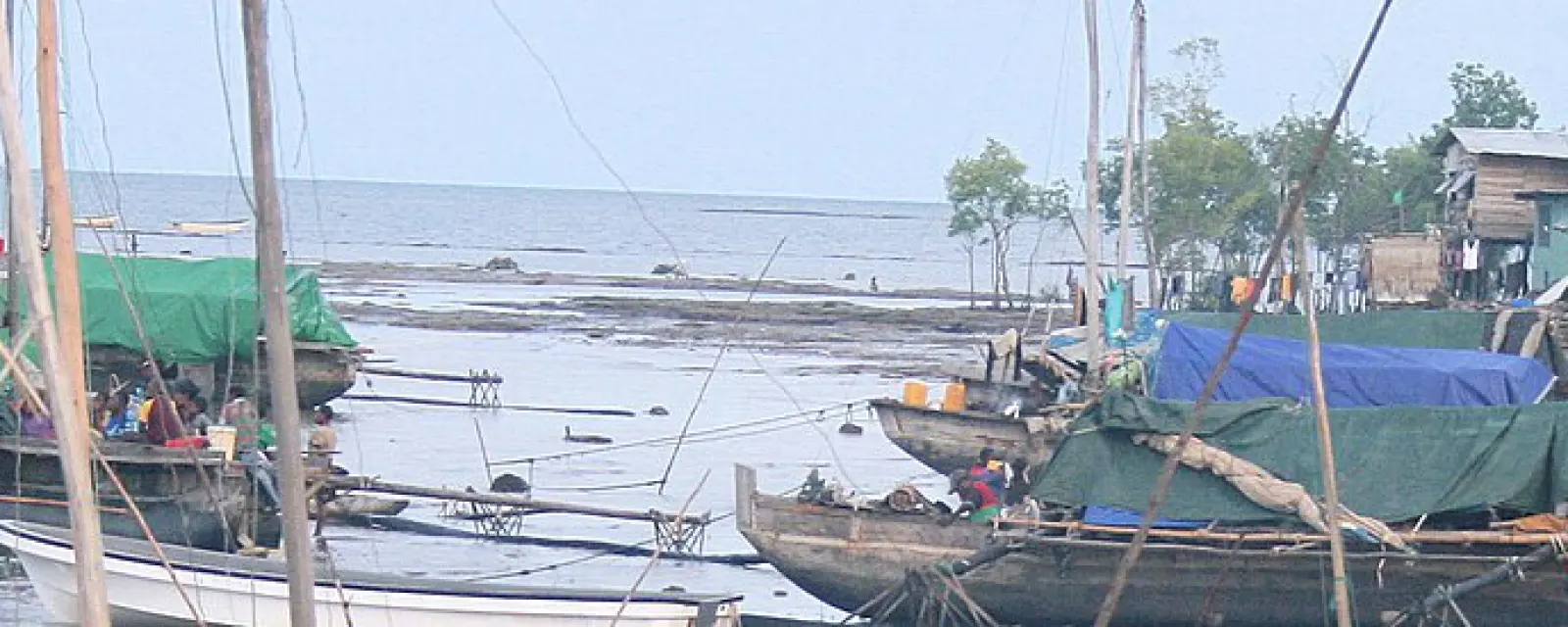
Overview
Papua New Guinea — PNG — holds a rank-55 passport reaching 73 destinations without a prior visa. Its population is around 10.3 million, the capital is Port Moresby, and the currency is the kina (PGK).
PNG has no citizenship or residence programme by investment.
📌 PNG is by far the largest Pacific island state — its population is nearly ten times all the other Pacific countries in this library combined. But the three things making PNG worth reading have nothing to do with size:
🔴 One — PNG is the most linguistically diverse country on earth, with more than 800 living languages.
🔴 Two — around 97% of its land is customary land, the highest share in the world.
📌 Three — Bougainville is in a process that may produce an independent state. For a site about citizenship this is worth following: new countries are born very rarely, and each time it happens the world gains a passport.
🔴 800 languages — understood correctly
PNG has more than 800 languages in use — roughly one eighth of all living languages on earth, in a country holding under 0.15% of the world's population.
These are not dialects. They are more than 800 genuinely distinct languages, many pairs of which are further apart than Vietnamese is from English.
📌 The cause is terrain: highland valleys divided by mountains so completely that communities a few dozen kilometres apart may have developed independently for thousands of years. Several densely populated highland valleys were unknown to the outside world until the 1930s.
Three languages serve in practice: Tok Pisin (the most widespread lingua franca), English (administration, education, law) and Hiri Motu.
📌 The practical consequence for anyone working here: there is no "PNG market" as a single thing. There are hundreds of communities with distinct interests, leadership structures and land relationships. Any project touching land must engage the specific community, not a general concept.
🔴 97% customary land — the highest in the world
This library has recorded customary land shares across the Pacific: Samoa 81% · Solomon Islands 87% · Tonga entirely Crown-held · Palau, the Marshall Islands, Micronesia, Tuvalu and Kiribati all closed to foreigners.
PNG tops the table at roughly 97%.
Only about 3% is registered land, transferable or leasable through ordinary procedure. Foreigners cannot buy customary land, and in practice that is nearly the entire country.
🔴 The consequence goes beyond "you cannot buy": in PNG every major project — mining, gas, palm oil, timber — must negotiate with customary landowners, and identifying precisely who those owners are is a standing dispute. Many projects stall for years not for technical or financial reasons but because that step is unfinished.
📌 A mechanism for leasing customary land through the state — the "lease-leaseback" model — was abused at large scale during the 2000s and a national commission of inquiry found serious irregularities, leading to the revocation of many titles. Anyone offered a large land opportunity in PNG should examine its legal provenance closely.
📌 Bougainville — a country that may come into being
This is the part most worth following for anyone interested in citizenship, because new countries are born rarely. The twenty-first century has produced only a few — Timor-Leste in 2002, Montenegro in 2006, South Sudan in 2011.
The sequence, stated as facts:
- Bougainville is an island province of PNG, closer to Solomon Islands than to mainland PNG both geographically and ethnographically.
- The Panguna copper mine — among the largest open-pit copper mines in the world in its time — contributed a very large share of PNG's budget. Disputes over benefit sharing and environmental damage with customary landowners were the trigger.
- Civil war from 1988 to 1998 killed tens of thousands; the mine closed and has not reopened.
- The Bougainville Peace Agreement of 2001 created an autonomous region and committed to a referendum on independence.
- The 2019 referendum returned around 98% in favour of independence.
- 🔴 But a referendum result does NOT automatically create a state. Under the agreement, the result must be ratified by the PNG parliament, and the two sides are negotiating a pathway. This is a political process, and the timetable has moved repeatedly.
📌 The general lesson for readers of this site: a 98% vote is not yet a passport. The citizenship of a new state exists only when a recognised state issues it and other countries agree to stamp it. Anyone offered the "citizenship" of an unrecognised entity — anywhere in the world — has here the framework for assessing it.
Geography & climate
PNG occupies the eastern half of the island of New Guinea — the world's second-largest island — plus around 600 smaller islands. The western half belongs to Indonesia.
The terrain is extreme: a central range above 4,000 m, densely populated highland valleys, the densest tropical rainforest outside the Amazon and Congo, and vast coastal swamp.
📌 PNG sits on the Ring of Fire: major earthquakes, active volcanoes, tsunami. Volcanic eruption destroyed the town of Rabaul in 1994.
PNG's biodiversity is among the world's highest, with a very large share of endemic species — birds of paradise are the national emblem.
🔴 Malaria, tuberculosis — including drug-resistant strains — and other tropical diseases are a serious health burden. PNG also recorded a re-emergence of polio in 2018 after years without cases. Serious pre-travel medical advice is essential here, not a formality.
History
People have been present on New Guinea for around 50,000 years, and 📌 agriculture at the Kuk swamp in the highlands is identified as one of the world's earliest independent centres of plant domestication — a UNESCO site. This is not a periphery of human history; it is one of its cradles.
In the colonial period the north was German and the south British, then Australian. After the First World War Australia administered both. The Second World War was fought fiercely here — the Kokoda Track and the New Guinea campaign are major chapters of the Pacific war.
Independence came on 16 September 1975, peacefully, from Australia. PNG is a constitutional monarchy within the Commonwealth, sharing a head of state with the United Kingdom.
Economy
1. Resources — overwhelmingly dominant. Liquefied natural gas, gold, copper, oil, nickel. The PNG LNG project, operating since 2014, changed the scale of the national economy.
2. Agriculture. Coffee, cocoa, palm oil, coconut — and most of the population still lives by subsistence farming.
3. Forestry and fisheries.
🔴 A paradox that must be stated plainly: PNG is far richer in resources than any other Pacific country in this library, yet its human development indicators are among the region's lowest. Resource revenue has not converted into healthcare, education and infrastructure at a commensurate level.
📌 PNG legislated a sovereign wealth fund in 2015, principally to stabilise the budget against resource price swings. But actual capitalisation has been slow relative to the original design.
Placed in this library's sequence on national funds:
Kuwait 1953 · Kiribati 1956 · Tuvalu 1987 · Norway 1990 — four funds still alive. Nauru's fund dissipated · Venezuela largest reserves, worst outcome · Tonga sold passports then lost the money. PNG — a fund correctly designed on paper, but slowly funded. PNG adds a fourth mode of failure, distinct from the other three: not misspent, not lost, but never filled. A fund existing on paper without money in it protects nothing.
As always: tax obligations here do not replace those in your country of residence.
Culture & people
Beyond the languages discussed above, two things to know:
📌 The wantok system operates in PNG as strongly as in Solomon Islands — a network of obligation by language and lineage. In PNG, given the larger scale, its influence on politics and public administration is correspondingly greater.
📌 The "big man" system: traditional leadership across much of PNG is not inherited but earned through organising capacity and the distribution of wealth. It is a heavily studied anthropological model, and it differs fundamentally from the hereditary title systems of Polynesia — Samoa's matai or Tonga's nobility, described in earlier articles.
One Pacific region, two opposing principles of authority: Polynesia inherits, Melanesia earns.
The Vietnamese community in PNG is very small, associated mainly with resource and construction projects.
Immigration routes
No investment programme.
Categories existing in law include employer-sponsored work permits — most commonly for specialists in resource projects, construction, healthcare and education — alongside residence through marriage and business categories with sectors reserved to citizens.
This is the only Pacific country in this library with a genuine specialist labour market for foreigners, owing to the scale of its resource sector.
Citizenship
Chiefly by descent. Naturalisation for foreigners exists but requires long residence and case-by-case assessment.
🔴 PNG restricts dual citizenship. Whether PNG permits retention of a prior nationality depends on the case and on arrangements with the country concerned, and the rules have been amended over time. This must be checked at the time you file, not inferred from an article — for Vietnamese readers it is the decisive question, since the objective is usually to add a nationality rather than exchange one.
Everyday life
Living costs in Port Moresby are high — the city appears regularly in expatriate cost rankings, largely because of secured housing and imports.
🔴 Safety is a serious problem and must be stated plainly. Violent crime in Port Moresby and Lae is high; foreigners working here typically live in secured compounds and travel under company security procedures. This is PNG's single largest disadvantage and should not be softened. Gender-based violence is also a serious social problem documented by many international bodies.
Healthcare: limited; large companies typically maintain medical evacuation arrangements to Australia or Singapore. International insurance with evacuation cover is absolutely mandatory.
Education: international schools in Port Moresby serve the expatriate community; the public system is resource-constrained.
Connectivity: Jacksons International Airport in Port Moresby, with flights to Brisbane, Cairns, Sydney, Singapore, Manila and Hong Kong. 📌 The best air connections of any Pacific country in this library — but domestic travel is difficult, with many highland areas reachable only by light aircraft.
Internet: improved by submarine cable; outside urban areas it remains limited and expensive.
Who should consider Papua New Guinea
It may fit if:
- You are a specialist in resources, construction, healthcare, education or development assistance with a specific contract — PNG is the only Pacific country in this library with a real specialist labour market.
- You work in anthropology, linguistics or biodiversity conservation — nowhere on earth offers this density of subject matter.
Not a fit if:
- 🔴 You are offered "PNG citizenship by investment" or "Bougainville citizenship": no such programme exists, and Bougainville is not yet a state.
- You want to buy land: 97% is customary land, the highest share in the world.
- You need ordinary urban safety or specialist healthcare on the spot.
- You need to retain your existing nationality without first checking PNG's dual citizenship rules.
But the article is worth reading even if you never go to PNG, because the Bougainville process is a live demonstration of how new countries come into being — and the answer, as the 2019 referendum shows, is that a 98% vote is not yet a passport.