Overview
Tajikistan holds a rank-68 passport reaching 58 destinations without a prior visa. Its population is around 10.1 million, the capital is Dushanbe, and the currency is the somoni (TJS).
Tajikistan has no citizenship-by-investment programme.
This article closes this library's Central Asian bloc, and it carries two features no other country in the region has:
📌 One — Tajikistan is the only Persian-speaking country in Central Asia. The other four speak Turkic languages. This is not a linguistic footnote; it shapes identity, culture and foreign relations.
🔴 Two — Tajikistan holds a dual citizenship treaty with Russia, and it is the only such treaty still in force.
🔴 The 1995 treaty — and why it must be read alongside Turkmenistan
The Turkmenistan article in this library tells the 2003 story: Turkmenistan terminated the dual citizenship treaty it had signed with Russia in 1993, placing tens of thousands who lawfully held both in a position of having to choose one.
Tajikistan signed a treaty of the same kind with Russia in 1995. That treaty remains in force.
📌 Placing the two side by side is the lesson of this section:
| Turkmenistan | Tajikistan | |
|---|---|---|
| Treaty signed with Russia | 1993 | 1995 |
| Status | 🔴 Terminated in 2003 | ✅ Still in force |
| Those relying on it | Forced to choose one | Still hold both |
The same class of instrument, the same counterparty, the same decade — opposite outcomes. And the difference lies not in the text of the treaties but in one party's political decision at one moment.
🔴 This is why the question posed in the Turkmenistan article must be asked before, not after: does this treaty permit unilateral withdrawal, and if a party withdraws, how are existing holders treated? Tajik–Russian dual nationals today sit on the fortunate side of the very mechanism that upended many lives next door.
📌 But for Vietnamese readers this opens nothing
Stated directly to save time: that treaty applies only between Tajikistan and Russia. With every other country — Vietnam included — Tajikistan follows a single-nationality principle, and those naturalising must renounce their prior nationality.
The regional table is now complete, and it serves for the whole bloc:
| Country | Dual citizenship |
|---|---|
| Vietnam | ✅ Acquiring another nationality does not automatically end the original |
| Kyrgyzstan | ✅ Permitted |
| Kazakhstan | 🔴 Banned, with penalties for concealment |
| Uzbekistan | 🔴 Not permitted |
| Turkmenistan | 🔴 Not permitted; the treaty with Russia was terminated in 2003 |
| Tajikistan | 🔴 Not permitted, except with Russia under the 1995 treaty |
📌 The table demonstrates the point made in the Kyrgyzstan article: five countries in one region, sharing a history and an inherited legal framework, differ on a rule that can decide a family's entire plan. It cannot be inferred from one to another.
📌 The Persian-speaking country in Central Asia
Tajik is a variety of Persian, written in Cyrillic. Tajik speakers and speakers of Persian in Iran or Dari in Afghanistan understand one another substantially.
This produces a distinct position:
- Culturally, Tajikistan presents itself as the heir to the Persian legacy in Central Asia. The state grounds national identity in the ninth- and tenth-century Samanid dynasty — Ismoil Somoni names the national currency, and his statue stands at the centre of Dushanbe.
- 📌 Rudaki, regarded as the founder of classical Persian poetry, was born in what is now Tajikistan. Ibn Sina (Avicenna) belonged to the same cultural sphere — the Uzbekistan article names him from the Bukhara side. This heritage is cut by two modern borders, and both countries claim it.
- In foreign relations, Tajikistan holds close cultural ties to Iran and Afghanistan, and shares the longest border with Afghanistan of any Central Asian state — around 1,300 km. This security factor dominates much of its policy.
Geography — the roof of the world
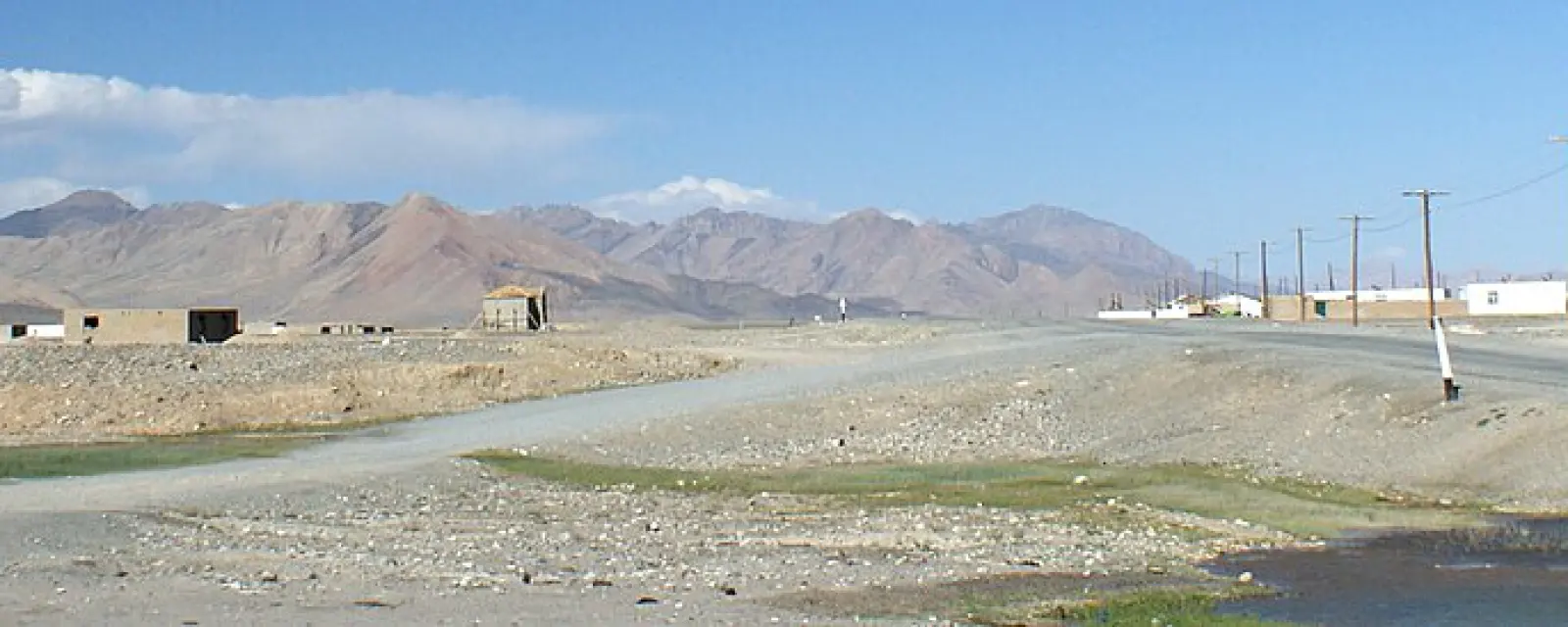
Roughly 93% of Tajikistan is mountain, making it Central Asia's highest country. The Pamir region to the east is called "the Roof of the World", with peaks above 7,000 m and broad plateaux above 4,000 m.
📌 The Pamir Highway crossing this region is among the highest roads on earth and a renowned overland destination — though a separate permit is required to enter the autonomous region of Gorno-Badakhshan (GBAO).
📌 GBAO matters for a further reason: it is home to the Pamiri Ismaili community, a branch of Shia Islam with distinct culture and organisation. The Aga Khan Development Network is the largest presence in infrastructure, education and health there — 📌 a rare example of a transnational non-state organisation assuming near-state functions across a territory. 🔴 GBAO has also seen tension and central government security operations in recent years.
Water is Tajikistan's greatest strategic asset, as in Kyrgyzstan: it is upstream of the whole Amu Darya basin. 📌 The Nurek dam was once the tallest in the world, and the Rogun dam under construction would, if completed to design, become the tallest in the world. The project has run for decades and was a major source of tension with downstream Uzbekistan — relations improved substantially after 2016.
🔴 Natural hazards: major earthquakes, landslides, flash floods and avalanches. Mountain terrain isolates many areas in winter.
History
This land belonged to the Persian cultural world from early antiquity and formed part of the Silk Road.
Russia conquered the region in the nineteenth century. Under Soviet rule, the Central Asian republican boundaries were drawn in the 1920s in a way that left Samarkand and Bukhara — two classical Persian-speaking cities — on the Uzbek side, while Tajikistan received largely mountain territory. 📌 This is the origin of a cultural dispute that persists, and a textbook case of something true worldwide: modern borders are usually drawn afterwards, and communities come first.
Independence came in 1991.
🔴 Civil war 1992–1997 — and a peace settlement worth studying
Tajikistan is the only Central Asian country to have experienced full civil war after the Soviet collapse. Fighting broke out almost immediately after independence between forces aligned with the government and an opposition coalition, along lines corresponding largely to region and clan rather than ideology.
The figures, stated as facts: tens of thousands killed, more than a million displaced, and economic infrastructure destroyed across the country. This is the direct reason Tajikistan remains the poorest post-Soviet state.
📌 The 1997 peace agreement contained a notable feature of institutional design: it allocated the opposition a share of positions in the state apparatus. It is among the few power-sharing settlements in the post-Soviet space genuinely to have ended a civil war.
🔴 For completeness: that power-sharing mechanism was progressively dismantled, and by the mid-2010s the principal opposition party was banned. International organisations classify Tajikistan as having very limited political and civil society space.
🔴 Border tension with Kyrgyzstan produced serious fighting in recent years around undelimited areas — the Kyrgyzstan article tells it from the other side. The two states have negotiated demarcation with substantial progress.
📌 A rare detail worth recording: in 2011, Tajikistan transferred around 1,000 km² of Pamir territory to China under a border settlement closing a dispute dating to the Qing era. Territorial cession by agreement in the twenty-first century is very rare — and for a site about citizenship it is worth knowing, because every time a border moves, people change country without going anywhere.
Economy
1. Remittances — this figure must come first. 🔴 Tajikistan has for many years ranked at or near the top of the world for remittances as a share of GDP, at times exceeding a third of the economy. Most Tajik labour migrants work in Russia.
📌 This is the highest dependence in the entire Central Asian bloc, above Kyrgyzstan and Uzbekistan as recorded elsewhere in this library. The consequence: the Tajik economy is tied directly to Russian economic conditions, the rouble and Russian migration policy — with no revenue source large enough to compensate if that flow is interrupted. It is the most serious concentrated risk this article must state.
📌 A notable connection: precisely because the labour community in Russia is so large, the dual citizenship treaty with Russia carries very real practical weight for ordinary people — it is not an abstract diplomatic matter.
2. Aluminium. The national aluminium smelter is the largest industrial facility in the country, powered by hydroelectricity.
3. Hydropower. Very large potential; the Rogun project is the state's single largest public-finance wager.
4. Agriculture. Cotton, dried fruit, grain.
🔴 Disadvantages, stated plainly: this is the poorest country in the bloc; public debt connected to the hydropower project has drawn warnings from international financial institutions; and the independent private sector remains small.
As always: tax obligations here do not replace those in your country of residence.
Culture & people
Tajik is the state language; Russian remains in use in business and as an inter-ethnic language. English is limited outside Dushanbe.
Navruz — the Persian new year — is the largest annual festival, shared across the Persian-speaking world and most of Central Asia.
🔴 Stated at the level of facts: the Tajik state applies numerous rules on dress and religious practice — including restrictions on certain garments regarded as foreign, regulation of religious activity, and limits on participation in some religious observance below a specified age. Foreigners intending to live here should know this in advance.
There is essentially no Vietnamese community in Tajikistan.
Immigration routes
No investment programme exchanging for citizenship, and no investor residence category in the ordinary sense.
Categories existing in law include employer-sponsored work permits, residence through marriage, and business categories assessed case by case. Practical opportunity for foreigners is very limited, concentrated in infrastructure and hydropower projects, development assistance and international organisations.
Citizenship
By descent. Naturalisation requires long residence, the Tajik language, and renunciation of the prior nationality — except for Russian citizens under the 1995 treaty.
🔴 If anyone offers you "Tajik citizenship by investment", stop. No such programme exists.
Everyday life
Living costs are low, among the lowest in the region.
Healthcare: limited; complex cases typically go to Türkiye, Iran, India or Kazakhstan. International insurance with medical evacuation cover is mandatory.
Education: a public system on the national curriculum; international options are very few, mainly in Dushanbe. The Aga Khan network operates several well-regarded institutions in the mountain regions.
Connectivity: Dushanbe airport connects to Istanbul, Dubai, Moscow, Almaty and Urumqi among regional points. 🔴 Domestic travel is very difficult given the terrain — many mountain routes close in winter, and reaching the Pamirs is measured in days.
Internet: limited and expensive relative to regional norms; access restrictions have occurred.
Safety: street crime is low in Dushanbe. 🔴 The Afghan border area and parts of GBAO carry travel advisories from many countries.
Who should consider Tajikistan
It may fit if:
- You work in hydropower, infrastructure, development assistance or international organisations with a specific project.
- You are interested in Persian-language culture or Pamir research.
Not a fit if:
- 🔴 You want an additional nationality while retaining your existing one: the dual citizenship treaty applies only to Russia, and with every other country Tajikistan follows a single-nationality principle.
- You are offered "Tajik citizenship by investment": no such programme exists.
- You need specialist healthcare on the spot, reliable internet, or year-round domestic travel.
The point to carry away, even for readers who will never visit Central Asia: Tajikistan and Turkmenistan signed the same class of dual citizenship treaty with the same country two years apart. One survives, one did not — and the people relying on them had no part in that decision. When someone tells you "there is a treaty, so you are safe", this is the example with which to ask again.