Overview
Azerbaijan holds a rank-54 passport reaching 74 destinations without a prior visa. Its population is around 10.2 million, the capital is Baku, and the currency is the manat (AZN).
Azerbaijan has no citizenship-by-investment programme, and does not permit dual citizenship.
Three parts of this article repay reading: nationality law compared directly with Armenia, where the world oil industry actually began, and a national oil fund among the better-regarded ones.
🔴 Two neighbours, opposite laws
The Armenia article immediately preceding this one describes a country that opens citizenship by descent and has accepted dual nationality since 2007, because its diaspora outnumbers its home population.
Azerbaijan sits next door and goes the other way:
| Armenia | Azerbaijan | |
|---|---|---|
| Dual citizenship | ✅ Permitted since 2007 | 🔴 Not permitted |
| Acquiring another nationality | Armenian nationality retained | 🔴 A ground for losing Azerbaijani nationality |
| Declaring foreign nationality | — | 🔴 Mandatory, with penalties for failure |
| Descent route | ✅ Yes, no residence requirement | No equivalent route |
📌 This is the closest comparison in the entire library: two countries in one region, both formerly Soviet, both independent in 1991, both mid-sized economies — with directly opposite nationality rules.
Why opposite? Because the two countries' real populations have different shapes:
- Armenia has a diaspora dispersed worldwide and larger than its home population, so the law is written to bring them back.
- Azerbaijan has no diaspora of that kind. The largest Azerbaijani community outside Azerbaijan lies in neighbouring Iran — 📌 and by most estimates outnumbers Azerbaijan's own population. But that is a co-ethnic community across an adjacent border, not an emigrant diaspora. Opening citizenship by descent in those circumstances is a wholly different matter politically and diplomatically.
📌 The transferable lesson: when reading a country's nationality law, ask where that nation's co-ethnic community is located. If it is distant and dispersed, the law tends to open. If it is immediately across a shared border, the law tends to close. The geography of a people shapes nationality law more than ideology does.
🔴 The consequence for Vietnamese readers: Azerbaijan excludes itself if the objective is to add a nationality. Naturalising here means dealing with your Vietnamese nationality, and concealing a foreign nationality carries penalties — the same enforcement pattern as Kazakhstan.
📌 Baku — where the world oil industry began
This is economic history many people do not know, and it is worth knowing.
Oil on the Absheron peninsula around Baku was extracted by hand for centuries. But the turning point came in the mid-nineteenth century:
- 📌 The world's first mechanically drilled oil well is recorded in the Baku region in 1846 — more than a decade before the Drake well in Pennsylvania (1859).
- By the late nineteenth century Baku was the largest industrial oil field in the world. 📌 Around 1900 the region supplied approximately half of all the world's oil.
- The Nobel brothers and the Rothschilds both invested heavily here. The fortune Ludvig and Robert Nobel built in Baku contributed to the estate Alfred Nobel left to establish the Nobel Prize.
- Baku's oil was a crucial strategic objective in the Second World War, and the German drive into the Caucasus aimed directly at controlling it.
📌 Why this belongs on a citizenship site: because it explains the shape of Azerbaijan today. A country that has been an oil centre continuously for 150 years has urban infrastructure, a technical class and international relationships quite unlike a country that has just discovered resources. Baku is an industrial city with depth, not a capital built recently out of oil money.
✅ SOFAZ — the oil fund, and its place in this library's sequence
The State Oil Fund of Azerbaijan (SOFAZ) was established in 1999, receiving petroleum revenue separated from the recurrent budget.
📌 One detail deserves recording: Azerbaijan was among the first countries to reach compliance with the Extractive Industries Transparency Initiative (EITI) — an international mechanism requiring publication of financial flows between extractive companies and the state. This is a genuine mark in favour on resource revenue transparency. 🔴 For completeness: Azerbaijan's EITI status was subsequently suspended and the country withdrew from the mechanism, in a dispute over requirements concerning civil society operating space. Both halves are facts, and omitting either makes the account wrong.
Placed in this library's sequence of national funds:
Kuwait 1953 · Kiribati 1956 · Tuvalu 1987 · Norway 1990 · Azerbaijan 1999 · Kazakhstan 2000 — funds still operating. Nauru dissipated · Venezuela largest reserves, worst outcome · Tonga sold passports then lost the money · PNG correctly designed but never filled · Turkmenistan reserves without a route to market.
📌 Azerbaijan and Kazakhstan established funds a year apart, and they are the two largest oil funds in the post-Soviet space. Both have drawn down to support budgets during low oil price periods, and in both countries the extent is contested — the same issue as Kiribati's RERF. 📌 No fund is immune to budget pressure; the difference lies in how far the drawdowns are recorded and debated in public.
Geography — and a detached territory
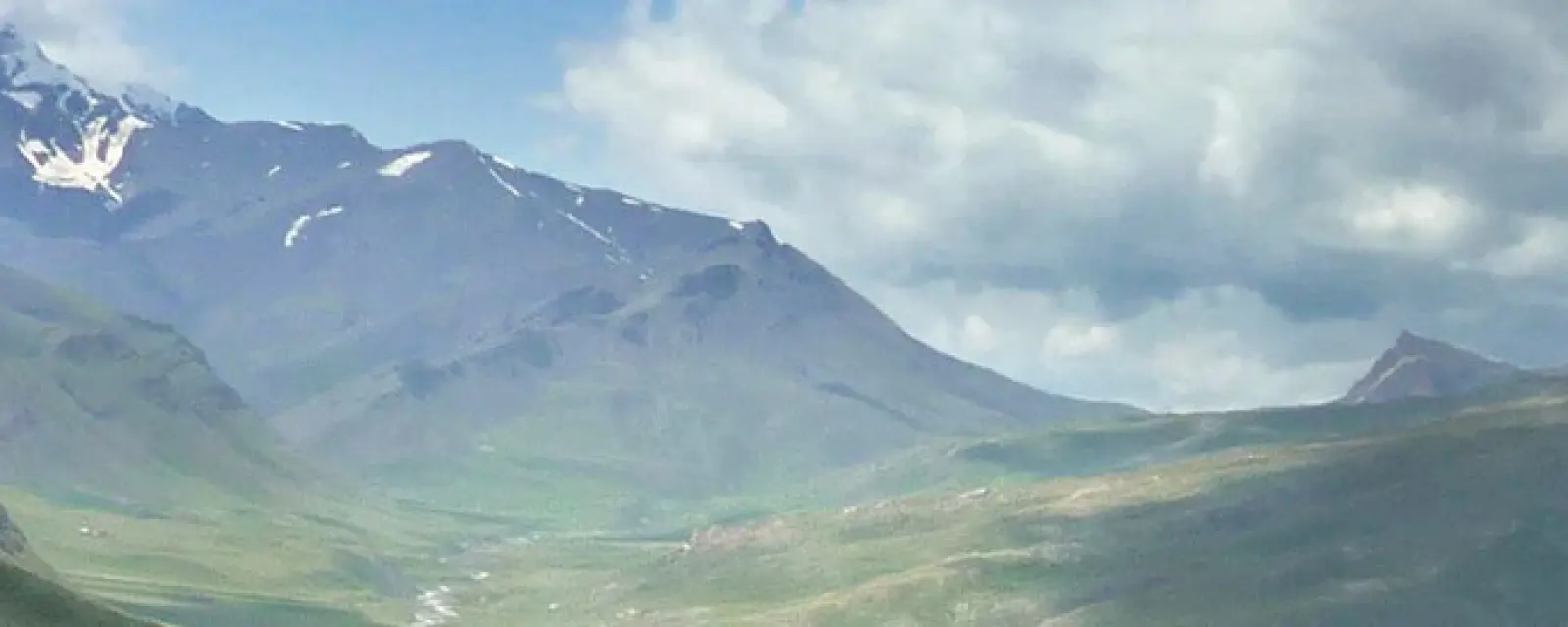
Azerbaijan lies in the South Caucasus, on the Caspian Sea to the east. Its terrain is unusually varied for its size: the Greater Caucasus in the north, an arid central plain, Caspian lowlands below sea level, and the humid subtropical Talysh region in the south.
📌 The Caspian is the world's largest inland body of water, and its legal status is an international law story worth knowing: is it a "sea" or a "lake"? The answer determines how seabed resources are divided and how navigation rights work. The five states concerned negotiated for more than two decades, and the 2018 Convention on the Legal Status of the Caspian Sea produced a bespoke regime, neither fully the law of the sea nor fully a lake regime. 📌 A clear illustration of something this library meets repeatedly: international law does not always have a box ready for reality — sometimes a new box must be built.
🔴 Nakhchivan is a detached territory of Azerbaijan, not contiguous with the rest of the country but separated by Armenian territory, and bordering Iran and Türkiye. It is one of the few remaining exclaves in the world, and connecting it to the mainland is among the central questions of regional politics.
📌 The name "Land of Fire" has a genuine physical origin: natural gas seeps to the surface and burns spontaneously in several places — Yanar Dag is a permanently burning hillside. The Ateshgah fire temple near Baku connects to Zoroastrian tradition and to pilgrim communities from India. The flame motif on Baku's Flame Towers is a modern reference to the same thing.
History — stated at the level of facts
This land belonged to the ancient Persian world, later coming under Arab, Turkic and Persian influence in turn. 📌 Treaties between the Russian and Persian empires in the early nineteenth century divided the Azerbaijani-inhabited region in two: the north to Russia, the south remaining in Iran. This is the origin of there being more Azerbaijanis in Iran today than in Azerbaijan itself — and of everything set out in the nationality section above.
📌 The Azerbaijan Democratic Republic (1918–1920) was the first secular republic in the Muslim world, and granted women the vote from its founding — earlier than many European states. It survived less than two years before incorporation into the Soviet Union. This is historical detail little known outside the region.
Independence came in 1991.
🔴 Nagorno-Karabakh — stated at the level of facts
This site records events with dates rather than delivering judgment, and records the same set of facts in both articles. The Armenia article presents it from the other side.
- The Nagorno-Karabakh region lies within the internationally recognised borders of Azerbaijan and had a majority Armenian population through much of the twentieth century.
- The 1988–1994 war ended with Armenian forces controlling the region and adjacent districts. Hundreds of thousands on both sides were displaced — including a very large number of Azerbaijanis who remained internally displaced for nearly three decades.
- The 2020 war ended in a ceasefire under which Azerbaijan regained control of most adjacent districts.
- In September 2023 Azerbaijan assumed control of the entire region; almost the whole Armenian population there left for Armenia within weeks.
📌 For this site's subject, the point to record is: both sides have large communities displaced by the same conflict, in different phases. The questions the citizenship field must answer — what status the displaced hold, how property left behind is treated, under what mechanism return occurs — arise for both.
🔴 On domestic institutions, international organisations document significant restrictions on press freedom, assembly and civil society activity in Azerbaijan. Stated as fact, because it bears on a foreigner's calculations here.
Economy
1. Oil and gas — overwhelmingly dominant in exports. The offshore Azeri–Chirag–Gunashli oil field and the Shah Deniz gas field are the two pillars.
📌 The contrast with Turkmenistan is striking: both lack access to open sea, but Azerbaijan built pipelines in several directions — including routes through Georgia and Türkiye to the Mediterranean, and the Southern Gas Corridor carrying gas to Europe. The result is that Azerbaijan has multiple customers and retains bargaining power, while Turkmenistan depends on essentially one.
The same "no route to the sea" problem, two different outcomes — and the difference lies in how many directions out were built. This is an important addition to the resource paradox this library tracks.
2. Agriculture. Fruit and vegetables, tea, hazelnuts, wine, silk.
3. Transit transport. Baku sits on the Eurasian corridor, and the port of Alat has received major investment for that role.
🔴 Disadvantages: heavy exposure to oil and gas prices; diversification modest relative to the scale of revenue; and international bodies document issues of transparency and concentration of wealth.
As always: tax obligations here do not replace those in your country of residence.
Culture & people
Azerbaijani is the state language, a Turkic language very close to Turkish — speakers of the two understand each other to a high degree. The script has moved to Latin. Russian remains widely used in Baku.
Relations with Türkiye are close, often described by the formula "one nation, two states".
Society is secular in practice, though the majority population is Muslim, chiefly Shia. Baku has a distinctly international urban life and hosts global events including Formula 1.
Mugham music is UNESCO intangible heritage, as are Azerbaijani carpets.
The Vietnamese community in Azerbaijan is very small.
Immigration routes
No investment programme exchanging for citizenship.
Categories existing in law include employer-sponsored work permits, residence through marriage, residence tied to business investment at prescribed thresholds, and specialist categories. 📌 Entry procedures for visitors have been substantially simplified through an e-visa system.
Citizenship
Chiefly by descent. Naturalisation requires long residence, the Azerbaijani language, and renunciation of the prior nationality.
🔴 Azerbaijani citizens acquiring another nationality must declare it, and failure to declare carries penalties. This is important to remember if you or family members have a connection to this country.
🔴 If anyone offers you "Azerbaijani citizenship by investment", stop. No such programme exists. Residence tied to investment does, and the two must be called by their correct names — the same error warned against in the Kazakhstan and Armenia articles.
Everyday life
Living costs are low relative to Europe; Baku is considerably more expensive than the rest of the country.
Healthcare: a basic public system; private hospitals in Baku serve foreigners. Complex cases typically go to Türkiye, Israel or Europe. International insurance is necessary.
Education: a broad public system; international schools in Baku and several foreign-affiliated universities.
Connectivity: Heydar Aliyev Airport in Baku connects to Istanbul, Dubai, Doha, Moscow, Frankfurt, London and Beijing among others — the best connections of the three South Caucasus countries. 🔴 But the land border with Armenia does not operate.
Internet: good urban infrastructure. 🔴 Access restrictions to certain platforms have occurred.
Safety: street crime is low; Baku is regarded as one of the region's safer capitals. 🔴 Travel advisories should be checked before approaching border areas.
Who should consider Azerbaijan
It may fit if:
- You work in oil and gas, energy infrastructure, Eurasian logistics or construction with a specific role.
- You need a South Caucasus base with the region's best air connections.
Not a fit if:
- 🔴 You want an additional nationality while retaining Vietnamese nationality: Azerbaijan does not permit dual citizenship and penalises non-declaration.
- You are offered "Azerbaijani citizenship by investment": no such programme exists.
- You need an open media environment or specialist healthcare on the spot.
The point to carry away: placing Azerbaijan beside Armenia reveals what reading either alone does not — a country's nationality law reflects where its co-ethnic community happens to be. Distant and dispersed, and the law opens; immediately across a shared border, and it closes. Two neighbours, one history, the same year of independence — with opposite rules, for reasons found on the map rather than in principle.