Overview
Turkmenistan holds a rank-76 passport reaching 50 destinations without a prior visa. Its population is around 6.4 million, the capital is Ashgabat, and the currency is the manat (TMT).
Turkmenistan has no citizenship-by-investment programme, does not permit dual citizenship, and is among the hardest countries in the world to enter.
This article is not written to present an opportunity — there is none here for this site's readers. It is written because Turkmenistan contains the most concrete lesson in this library on a treaty-granted right being withdrawn, and because it is the final piece needed to understand the Central Asian bloc.
🔴 2003 — a dual citizenship treaty cancelled, and people made to choose
After the Soviet collapse, Russia signed a dual citizenship treaty with Turkmenistan in 1993. It was one of very few such treaties Russia ever concluded. Under it, tens of thousands — mainly ethnic Russians living in Turkmenistan — lawfully held both nationalities.
In 2003, Turkmenistan terminated that treaty.
The consequences, stated as facts:
- Those holding both were placed in a position of having to choose one.
- 🔴 The choice was not procedural. Retaining Russian nationality meant becoming a foreigner in the place where one lived, with consequences for property rights, public sector employment and access to public services.
- Conversely, giving up Russian nationality meant losing the option to leave in a country tightening departure.
- The legal position of this group remained contested for years afterwards and featured in relations between the two states.
📌 Why this matters to Vietnamese readers, though it happened far away two decades ago:
This library has recorded the same principle three times, in three forms:
Micronesia — COFA welfare entitlements in the US cut by statute in 1996, partially restored only in 2020–2023. Samoa — New Zealand removed the citizenship status of those born 1924–1949 by statute in 1982, immediately after a court confirmed they held it. Tonga — the status of those who had bought documents was reworked by later legislation. Turkmenistan 2003 — 🔴 a bilateral treaty on nationality itself terminated by one party.
Turkmenistan is the gravest of the four, because what was withdrawn was the nationality itself, not an entitlement attached to it.
📌 Reduced to a rule usable anywhere: when you are told "these two countries have a treaty, so you may hold both nationalities", ask one further question — does that treaty permit unilateral withdrawal, and if a party withdraws, how are existing holders treated? This is a variant of the fourth question set out in the Tonga article, and Turkmenistan is why that question exists.
Turkmenistan's current constitution does not recognise dual citizenship.
🔴 The right to leave — the other side of the same problem
The Uzbekistan article in this library covers exit visas — the requirement that citizens obtain permission to leave their own country — and Uzbekistan's abolition of it on 1 January 2019.
Turkmenistan is the other side of that story. International human rights organisations consistently document restrictions on Turkmen citizens leaving the country, imposed not through a published permit but through unpublished restriction lists applied to certain categories.
📌 This is why the Uzbekistan article insists that passport rankings measure only half the problem. On paper the Turkmen passport reaches 50 destinations. That figure means something only to those actually permitted across the border, and that is an entirely separate question no ranking answers.
🔴 Among the hardest countries in the world to enter
For foreigners, Turkmenistan sits with the handful of most closed states on earth in terms of accessibility:
- Ordinary tourist visas require a letter of invitation approved in advance by the authorities, and in practice most visitors must travel through a licensed agency with a guide for essentially the entire itinerary.
- A very short transit visa exists, typically a few days, on a fixed route.
- Refusal rates are high and no obligation to give reasons applies.
📌 For this site's purposes, the conclusion is direct: Turkmenistan is not a destination for settlement, investment or residence, beyond the small number of specialists on state-managed gas and infrastructure projects.
Geography & climate
Around 80% of Turkmenistan is the Karakum desert — one of Asia's largest. Population concentrates in the oasis belt along the southern mountains and along the Karakum Canal, a vast Soviet irrigation work drawing water from the Amu Darya.
🔴 The Karakum Canal is among the direct causes of the Aral Sea disaster. The Kazakhstan and Uzbekistan articles describe the downstream end; this is the upstream end: water withdrawn before it could reach the lake, through an open desert canal with very heavy losses to evaporation and seepage.
The climate is harsh continental desert: summers above 45°C are routine, winters can fall below freezing.
📌 The Darvaza gas crater — the "Door to Hell" — has burned continuously for decades in the desert, originating in a drilling incident. The authorities have repeatedly announced plans to extinguish it on environmental and resource grounds.
History
This land lay on the Silk Road, with Merv once among the largest cities in the world before its destruction by Mongol armies in the thirteenth century — now a UNESCO site.
Turkmens are traditionally nomadic and tribally organised — and that tribal structure retains social meaning today, reflected in the traditional carpet motifs on the national flag.
Russia conquered the region in the late nineteenth century; it later became the Turkmen Soviet Socialist Republic. Independence came in 1991.
📌 Permanent neutrality. In 1995 the UN General Assembly adopted a resolution recognising Turkmenistan's status of permanent neutrality — a very rare status, and Turkmenistan is the only country holding it in this form. In practice it accompanies a policy of limited participation in regional alliances, including economic mechanisms every other Central Asian state has joined.
🔴 Institutionally, international organisations rank Turkmenistan among the most closed countries in the world for press freedom, access to information and civil society space. Stated as fact, because it bears directly on every calculation a foreigner might make here.
Economy
1. Gas — almost everything. Turkmenistan holds among the world's largest natural gas reserves, with Galkynysh among the largest fields on the planet.
🔴 But large reserves do not mean large income, and this is the crux: Turkmenistan is landlocked, so its gas can reach the world only by pipeline. Pipelines must cross other countries, and each route is a long-term political relationship. The result is that the overwhelming share of gas exports flows in one direction — to China — producing dependence on a single customer.
📌 This is the third variant of the resource paradox this library has recorded:
Nauru · Venezuela — resources present, spent or misgoverned. Papua New Guinea — resources present, fund correctly designed but never filled. Turkmenistan — 🔴 resources present, but no route to market, and therefore no bargaining power on price. Three distinct failure modes, one conclusion: reserves underground are not wealth until they can be sold, at a price you partly determine.
2. Cotton. The second crop, and another source of water pressure.
3. Beyond those two, very little. The private sector is small, and 🔴 currency controls are severe — there have been long periods with a large gap between official and effective exchange rates, alongside strict limits on transferring funds abroad. For a business, this is repatriation risk, and it outweighs any incentive on paper.
As always: tax obligations here do not replace those in your country of residence.
Culture & people
Turkmen is the state language. Russian was once common in cities but its role has declined markedly compared with Kazakhstan or Kyrgyzstan. English is limited outside those working on international projects.
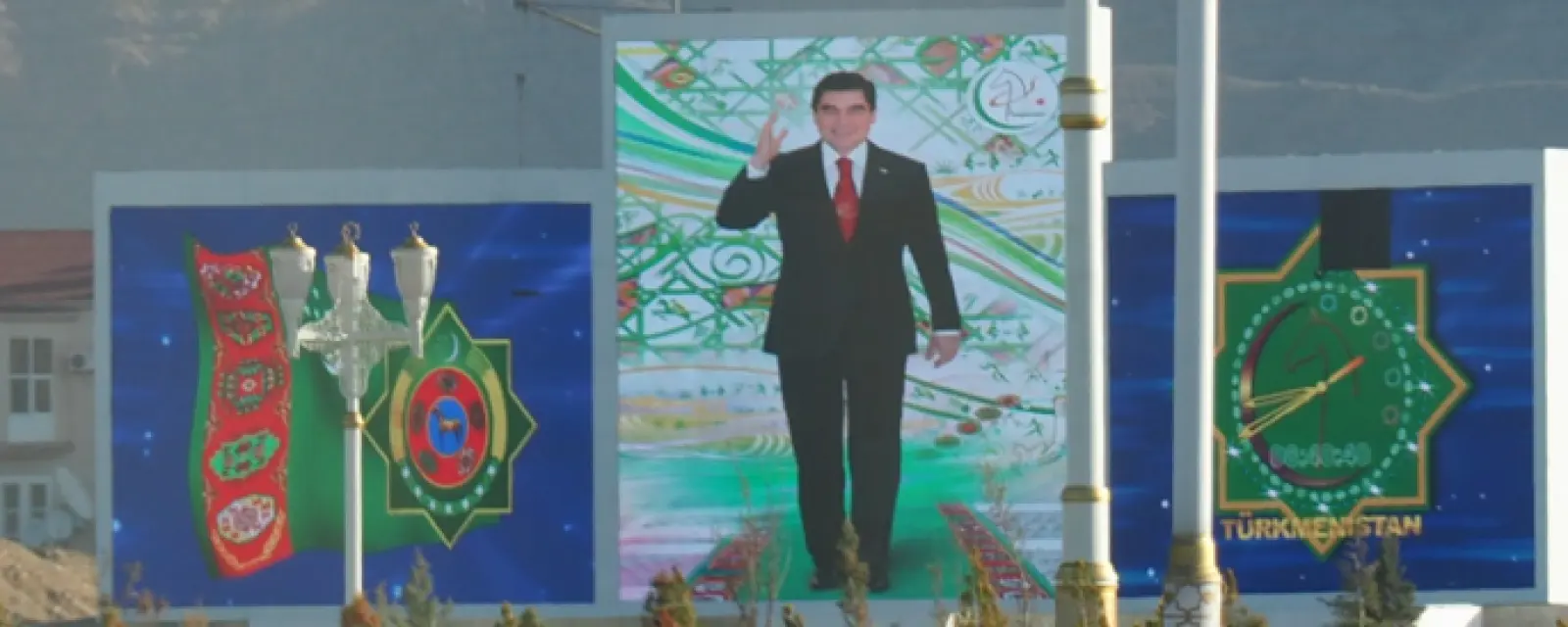
Turkmen carpets are a national emblem — the five principal tribal motifs appear on the national flag, one of the few flags anywhere carrying such intricate ornament. The Akhal-Teke horse, an ancient breed known for its metallic sheen, is also a national symbol.
📌 Ashgabat was rebuilt almost entirely after the 1948 earthquake levelled the city, and from the 1990s was constructed in a uniform white marble style. 🔴 The city applies strict urban rules — on vehicle colours, on photography in many areas — which foreigners need to know in advance.
There is essentially no Vietnamese community in Turkmenistan.
Immigration routes
No investment programme. No investor residence category in the ordinary sense.
The only practical route for foreigners is a work permit tied to a specific project, chiefly in gas, infrastructure construction and certain state-managed projects.
Citizenship
By descent. Naturalisation for foreigners is very restricted, requiring long residence, the Turkmen language, and renunciation of the prior nationality — the constitution does not recognise dual citizenship.
🔴 If anyone offers you "Turkmen citizenship" in any form, stop immediately. No such programme exists, and any pitch built on the country's gas reserves or neutrality status is invented.
Everyday life
This section is for the few who actually arrive here on a work contract.
Living costs: hard to state numerically given the exchange rate situation; imported goods are expensive and have at times been scarce.
Healthcare: limited; international companies typically maintain medical evacuation arrangements. International insurance with evacuation cover is absolutely mandatory.
Education: a public system on the national curriculum; international options are very few.
Connectivity: Ashgabat airport has limited connections, chiefly to Istanbul, Dubai, Moscow and Almaty plus a few regional points, on few and variable services.
🔴 Internet: limited infrastructure, low speeds, and many international platforms inaccessible. This warrants very serious consideration for anyone whose work depends on connectivity — markedly worse than anywhere else in the Central Asian bloc.
Safety: street crime is low.
Who should consider Turkmenistan
It may fit if:
- You are a specialist with a specific contract in gas or infrastructure — in practice almost the only reason foreigners work here.
Not a fit if:
- 🔴 You are seeking citizenship, investor residence or independent business opportunity: none exists.
- 🔴 You need to move capital or profit out of the country: currency control is the largest risk here.
- You need reliable internet, an open information space, or specialist healthcare on the spot.
But the opening section deserves reading even if Turkmenistan never crosses your mind. In 2003, tens of thousands of people lawfully holding two nationalities under a treaty between two states were placed in a position of having to choose one — because one party withdrew from that treaty. None of them had done anything wrong. This is why the question "if this programme or treaty ends, how are existing participants treated" must be asked before, not after.