Overview
Nauru holds a rank-53 passport with 76 destinations reachable without a prior visa. It is the world's third-smallest independent state by area — about 21 km² — with roughly 12,000 people.
Nauru has launched a citizenship-by-investment programme, named around the goal of raising climate adaptation funding. The stated purpose is legitimate and easy to understand: this is a low-lying coral island, and sea-level rise is an existential threat rather than a distant scenario.
But we must say this plainly, and before anything else:
🔴 The United Kingdom has revoked visa-free access for Nauruan citizens, on grounds relating to confidence in the programme's vetting. This is the worst signal an investment passport can carry, because it strikes at the only thing that gives such a passport value.
QuocTich.com does not market this programme, and we advise against buying it. This article exists to explain why, not to present a product.
Why one revocation matters so much
The value of an investment passport lies almost entirely in how many countries accept it without a prior visa. And those visa-free decisions rest on exactly one thing: confidence that the issuing country checks who it issues to.
When a country such as the United Kingdom withdraws visa-free access over vetting concerns, the consequences typically run like this:
- Other countries review. A major state's decision tends to trigger reassessment elsewhere, particularly among countries that share information.
- Travel value can keep falling after you have paid. An investment passport is an asset whose worth is decided by third parties, not by its holder.
- There is no refund mechanism when that happens. You bought a citizenship, not a guaranteed level of mobility.
None of this is a judgement about Nauru as a nation or about Nauruans. It is a judgement about the risk of a specific product at a specific moment.
The general principle, useful for any new programme: a newly launched citizenship programme has no track record to assess. What can be assessed is how other countries respond to it. When the first response is revocation, that is data, not rumour.
Geography & climate
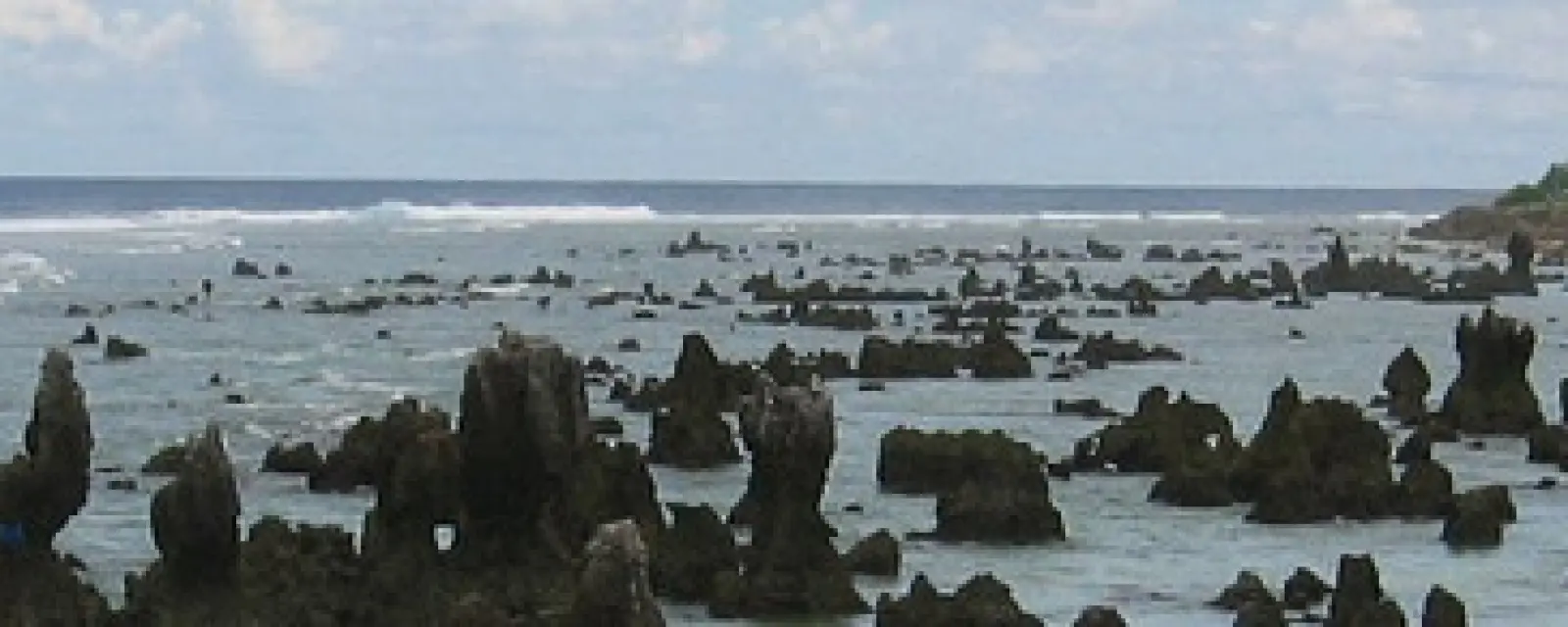
Nauru is a single coral island in Micronesia, in the south-western Pacific, roughly 40 km south of the equator. Its nearest neighbour is Banaba Island in Kiribati, some 300 km away.
The island is oval, with a narrow coastal belt holding the entire population and all infrastructure, while the raised interior — known as Topside — is the area stripped by phosphate mining.
The climate is tropical, hot and humid year-round, strongly affected by El Niño cycles that bring prolonged drought. Fresh water is a standing problem: the island depends on rainfall and desalination.
Nauru has no official capital. Government offices are located in Yaren, which is what is usually recorded in place of a capital.
History — the Pacific's most instructive economic lesson
Nauru's story is worth reading even if citizenship does not interest you, because it is among the clearest illustrations of a single resource raising and then lowering an entire country.
The island was found to hold very high-grade phosphate, accumulated over millennia from seabird guano. Mining began early in the twentieth century under German administration, then British-Australian-New Zealand administration, and Japanese occupation during the Second World War.
Nauru became independent in 1968 and took over the mining. Through the 1970s and 1980s it recorded among the highest incomes per head in the world.
Then two things happened at once: the phosphate ran down, and the sovereign fund established from those revenues was poorly managed and dissipated. Nauru went from exceptional wealth to financial crisis within roughly a generation.
The physical legacy is heavier still: around 80% of the island was mined to the point of being uninhabitable and uncultivable — a jagged limestone landscape where forest once stood. That is why the population is confined to the narrow coastal belt.
Set against Norway elsewhere in this series, the lesson is stark: two countries with major resource endowments, differing in how the revenue was handled.
Economy and present realities
After phosphate, Nauru's economy rests on a few narrow sources: fishing licence fees from selling access to its waters, development assistance principally from Australia, and for many years an Australian offshore asylum processing centre on the island — a meaningful revenue source but one subject to sustained international controversy and to shifts in Australian policy.
The citizenship programme emerged in that context: a very small country with narrow revenues, facing climate adaptation costs far beyond its budget.
Understanding this helps assess the situation fairly: the motive for launching the programme is real and urgent, but an urgent motive does not by itself create vetting capacity — and vetting capacity is precisely what determines how far that passport will travel later.
On everyday life, to avoid misunderstanding: almost nobody buys this kind of citizenship intending to move there. The island has neither abundant fresh water, nor specialist healthcare, nor international schooling. Air links are limited, mainly regional. This is a passport for travel, and its value therefore depends entirely on whether other countries accept it — which is what is now in question.
Who should consider Nauru
This section usually lists two groups. Here the answer is shorter:
We do not see a group for whom this programme makes sense at present.
If your objective is a second passport for mobility, there are Caribbean programmes that have operated for decades, have a vetting history to assess, and have not had visa-free access withdrawn by a major country. See the programme comparison page.
If your objective is residence and a place to live, Nauru does not offer that.
If what attracts you is a lower price than other programmes, that is precisely the reason to stop: in this product category, a low price usually reflects the risk the market is already pricing in.
How to assess any new programme
These four questions apply to any programme, not just this one:
- Has any major country withdrawn visa-free access? This is the strongest indicator, and it is public.
- How long has the programme operated? Less than one political cycle means there is nothing yet to assess.
- Who conducts the vetting, and is it independently reviewed?
- If travel value falls after purchase, what do you lose? If the answer is "the entire sum, with no recourse", that is a level of risk to face squarely before signing.
We believe stating this is more useful to you than presenting a product that would be easier to sell.