Quick summary: Most Vietnamese passport holders with Grenada citizenship have never spent more than a week there, and that's not wrong: as of 09/2026, Grenada has not imposed a residency requirement for those who obtained citizenship through investment, although five Caribbean nations have agreed to introduce this obligation. But for those planning to actually live there, Grenada is a small, relatively safe island where English is spoken and life moves very slowly; the real challenges are not weather or security, but expensive imports, limited specialized healthcare, and the feeling that "everyone on the island knows your face."
When clients ask us "what is it like to live in Grenada," the honest answer usually surprises them in two opposite ways.
The first way: it's easier than they think. It's not a desolate island or a place of deprivation. There are supermarkets, reliable internet, a large international university with thousands of students, and beaches that rank among the Caribbean's finest.
The second way: it operates at a very different pace—much more different than they imagine. People accustomed to getting things done in a single day in places like Ho Chi Minh City or Hanoi, where any task can be completed if you know the right person to call, often spend months learning that "tomorrow" here might mean next week.
This article is for those considering living part-time in Grenada, or simply wanting to know what the territory on your passport actually looks like.
How small is Grenada, and where is it located?
Grenada is an island nation at the southern end of the Windward Islands chain, north of Trinidad and Tobago, consisting of the main island of Grenada plus two smaller islands, Carriacou and Petite Martinique. Total area is approximately 345 km²; population is around 120,000—significantly smaller than many urban districts.
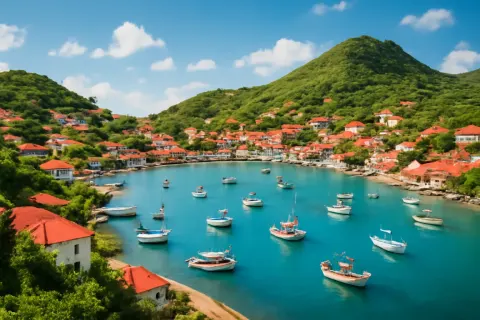
The capital, St. George's, curves around a horseshoe-shaped bay, with red-roofed houses climbing the hillsides. Expatriates and tourists concentrate on the southwestern tip: Grand Anse, Morne Rouge, Lance aux Épines, and True Blue. The drive from Maurice Bishop International Airport to Grand Anse takes only 15 minutes or so.
The island is famous for nutmeg production, earning it the nickname "the spice island." English is the official language; locals speak English Creole, which sounds difficult at first but becomes familiar quickly. The currency is the East Caribbean Dollar (XCD), pegged to the U.S. Dollar at 2.70 XCD = 1 USD; U.S. dollars are accepted in many places.
For more on history, geography, and administration, see the Grenada wiki page.
What does a typical day in Grenada look like?
People wake early as the sun rises fast and heat builds quickly. Many expatriates exercise or swim at Grand Anse Beach before 8 a.m., when it's still quiet.
The central market in St. George's is busiest Saturday mornings: vegetables, tropical fruits, fresh fish, spices. Local produce is reasonably priced. Imported goods in supermarkets—milk, cheese, beef, canned items, wine—cost considerably more than in Vietnam, since almost everything arrives by ship.
Afternoons are intensely hot; many shops and offices run on their own schedules. Most places close on Sundays. Friday evenings mean "lime"—a Caribbean term for gathering to eat, drink, and socialize without agenda. If you want to meet locals, that's the most natural entry point.
Getting around is by private car or minibus (small buses run by private operators, painted in bright colors, playing loud music, stopping anywhere). Taxis don't use meters; ask the price before boarding. Driving is on the left, roads are narrow and winding; newcomers usually need a few weeks before they feel confident driving.
Cost of living: expensive in unexpected places, cheap in others
We won't give fixed numbers because prices fluctuate and depend on lifestyle. But the cost structure is fairly consistent:
| Category | Relative to Hanoi/Ho Chi Minh City | Notes |
|---|---|---|
| Local vegetables, fruits, fish | Similar or slightly higher | Cheaper at markets than supermarkets |
| Imported goods (milk, beef, wine, Asian products) | Significantly higher | Vietnamese dried goods almost never available |
| Electricity | High | Powered mainly by diesel; air conditioning is the largest bill item |
| Rental housing in expatriate areas | High | Properties near beaches in Grand Anse and Lance aux Épines follow international pricing |
| Vehicles | High | Import taxes on vehicles are substantial; used cars hold value |
| Internet, phone service | Higher than Vietnam | Quality is adequate for remote work in the western areas |
The biggest surprise for many: eating out is not cheap. A meal at a tourist-oriented restaurant costs roughly what you'd pay in the U.S. Local eateries serving dishes like stewed chicken or "oil down" (a national dish made from breadfruit, salted meat, and coconut broth) are far more affordable.
Security, natural hazards, healthcare: legitimate concerns
Security: Grenada is considered relatively peaceful compared to the wider Caribbean. Petty theft and home break-ins while residents are away do occur; expatriates typically live in gated communities or install security bars. Nothing unusual beyond standard precautions anywhere: lock doors, don't leave valuables in vehicles.
Hurricanes: Atlantic hurricane season runs from June through November. Grenada's position far south historically meant less direct impact, but Hurricane Ivan in 2004 and Hurricane Beryl in July 2024 have shown this is no longer reliable. Beryl caused severe damage to Carriacou and Petite Martinique. If buying or renting a house, ask about roof reinforcement, backup generators, and water storage tanks.
Dry season: Roughly January through May; some areas may experience rotating water shutoffs. A home with a storage tank is a significant advantage.
Mosquitoes and dengue fever: Similar to Vietnam—nothing new for Vietnamese residents but don't be complacent.
Sargassum seaweed: Seasonally drifts ashore on the east coast; smells when decomposing. The west and southwest coasts are less affected.
Healthcare: the real weakness of a small island
Grenada has a main public hospital in St. George's and several private clinics. Routine consultations, minor injuries, and common ailments can be treated here.
But specialized care, complex surgery, oncology, cardiology interventions are limited. Serious cases are usually transferred to Trinidad, Barbados, or the U.S. For older people or those with chronic conditions, this is a decisive factor: anyone planning to live long-term in Grenada should have international health insurance with medical evacuation coverage (medical evacuation by air). We don't advise on specific insurers, but this is the first question to ask an agent.
For more on navigating first-time medical visits abroad, see seeing a doctor for the first time in a foreign country.
Unexpected realities few people mention
Everyone on the island knows your face. After a few months, the produce vendor at the market, the bank teller, the traffic officer—they all know who you are. For those used to anonymity in big cities, this is both warm and stifling.
Banking is harder than expected. Having a Grenada passport doesn't mean opening a bank account there is easy. Local banks follow strict compliance procedures for citizenship-by-investment applicants, often requiring in-person visits, proof of address, and source-of-funds documentation. Many people need to try several banks.
Asian goods are scarce. Fish sauce, pho noodles, fragrant rice, Asian herbs are nearly impossible to find. Long-term Vietnamese residents often grow herbs themselves and ask family to bring dried goods.
The Vietnamese community is very small. There is no Vietnamese neighborhood, no Vietnamese temple. If you need a diaspora community to live comfortably, Grenada is not the place.
A large medical university changes the whole market. St. George's University in True Blue has thousands of students, mostly from North America. Student and faculty housing demand drives rental prices in the southwest up and creates U.S.-style services around campus.
Getting anywhere requires flying. From Grenada, travel anywhere involves at least Miami, New York, London, or a connecting hub. Vietnamese citizens still holding Vietnamese passports need U.S. visas when transiting through the U.S.; those transiting through the U.K. must check current regulations. With a Grenada passport, travel through the U.K. and Schengen area is significantly easier—see the specific list at Grenada visa-free destinations.
The real disadvantages of actually living in Grenada
To be balanced, here are reasons Vietnamese residents have left the island after one or two years:
- The slow pace conflicts with managing large businesses. Paperwork, repairs, deliveries all take longer. Anyone who needs speed will find themselves constantly frustrated.
- Specialized healthcare requires leaving the island. For families with elderly members, this risk is real.
- International school options are limited. There are private schools, but nothing like the variety found in Dubai, Kuala Lumpur, or major European capitals.
- Cultural isolation. No Vietnamese community, Vietnamese meals must be homemade, no Lunar New Year atmosphere.
- Costs are higher than "tropical island" expectations. Electricity, imports, vehicles, flights are all expensive.
Conversely, those who stay long-term tend to be: retirees or remote workers, ocean lovers, those comfortable without urban amenities, and who use Grenada as an extended stay destination for a few months per year rather than a permanent base.
Do I have to live in Grenada to keep the citizenship?
As of the time of writing (09/2026), Grenada has not issued regulations requiring citizenship-by-investment holders to maintain residency to keep citizenship. This is why most Vietnamese passport holders with Grenada citizenship only visit briefly.
But this is changing. Five Caribbean nations with citizenship-by-investment programs have agreed on a regional reform package introducing a minimum residency obligation—currently under discussion at 30 days within 5 years of obtaining citizenship—and Antigua has already submitted draft legislation. Those who obtain citizenship before regulations take effect are expected to be grandfathered in, but details are still being finalized. We track this closely in 5-year passports and 30-day residency requirements in the Caribbean.
Thirty days over five years is not "living there." But it means anyone submitting an application now should plan at least several visits to Grenada—and that's when the details in this article become practical.
For families using Grenada as a stepping stone to the U.S. via the E-2 visa, actually living in Grenada is not a requirement; what matters is the authenticity of the citizenship and the investment in the U.S. That pathway is analyzed step-by-step in the Grenada–U.S. E-2 pathway, step by step.
Checklist if you're planning to stay in Grenada for a few months
| Task | Why |
|---|---|
| Rent short-term for 1–2 months before committing long-term | Visit the southwest and east coasts in both dry and rainy seasons |
| Get international health insurance with air medical evacuation | Serious cases require transfer off-island |
| Bring Vietnamese dried goods and common medications with English-language prescriptions | Asian goods and some medications are hard to find |
| Prepare bank account opening documents: proof of address, source of funds, bank reference letter | Local banks conduct strict due diligence |
| Ask landlord about water storage, generator, roof reinforcement | Dry season and hurricane season concerns |
| Research flights back to Vietnam and transit visa requirements in advance | Long journey with at least two connection points |
Next steps
If you already have Grenada citizenship, the best way to know if living there suits you is to try it for a season—not read more articles. Pick January–March, when weather is most pleasant and outside hurricane season.
If you're still deciding, separate two questions: "do I need this passport" and "do I want to live here." Most families only need a "yes" to the first question. The investment cost calculator helps you find specific numbers for that question.