Overview
Grenada is a small island nation in the southern Caribbean, located approximately 160 km north of the Venezuelan coast. At just 344 km² and with a population around 112,000, it ranks among the smallest sovereign states in the Western Hemisphere.
Yet size does not reflect international standing. Grenada is a member of the United Nations, the Commonwealth, the Organisation of Eastern Caribbean States (OECS), and the Caribbean Community (CARICOM). The Grenadian passport opens doors across much of Europe, the United Kingdom, Russia, Singapore—and remarkably among Caribbean passports—mainland China.
For international relocation planning, Grenada holds a distinction no other Caribbean citizenship-by-investment country possesses: a Treaty E-2 agreement with the United States. This position has made Grenada central to advisory work at Viking Global Group for over a decade.
Geography & Climate
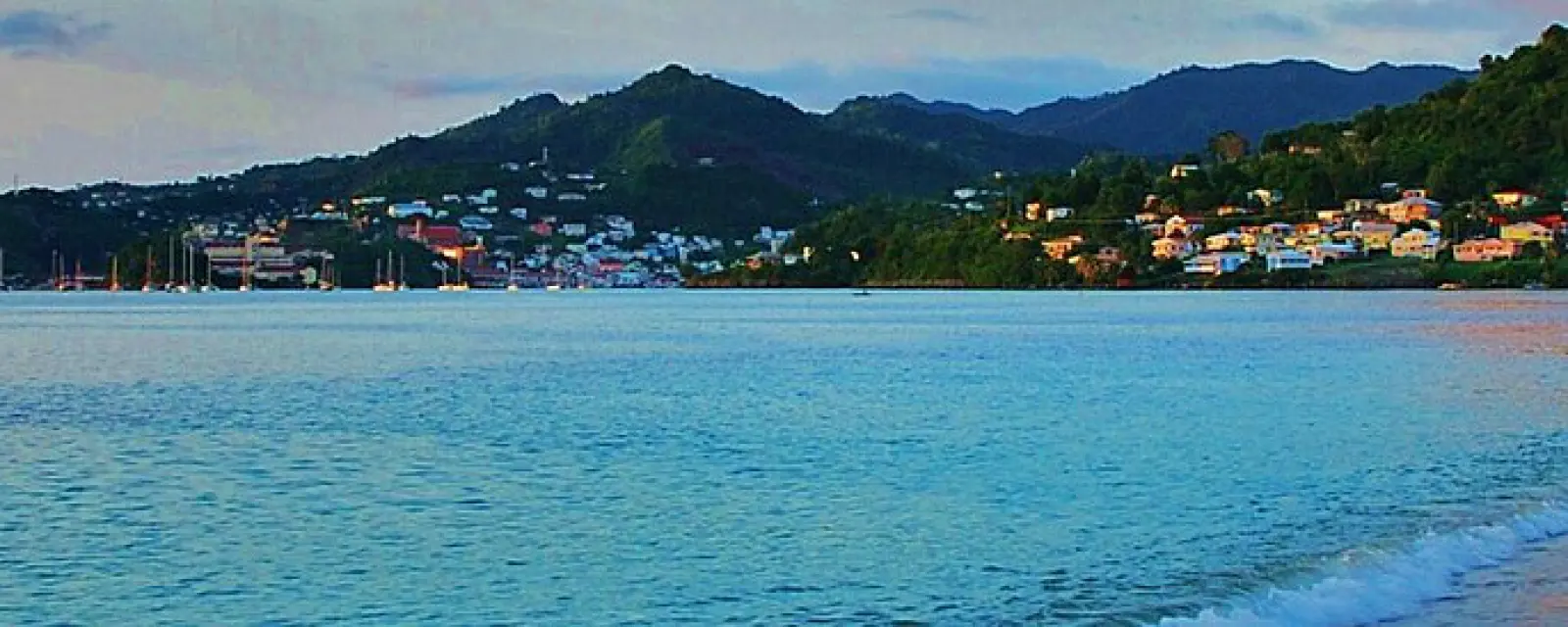
The nation of Grenada comprises the main island of Grenada plus two smaller islands, Carriacou and Petite Martinique. The main island's terrain is dominated by extinct volcanic peaks, creating steep verdant hills that run through the central spine, with the highest point—Mount St. Catherine—reaching 840 meters.
The climate is tropical maritime with steady trade winds; temperatures remain between 24–31°C year-round—stable and pleasant by tropical standards, thanks to consistent Atlantic breezes. The dry season runs January through May; the rainy season, June through December.
Hurricane risk warrants direct discussion: Grenada lies at the southern perimeter of the Atlantic hurricane belt, experiencing less exposure than islands to the north such as St. Kitts or Antigua, yet not immune. In 2004, Hurricane Ivan swept across the island, destroying approximately 90% of structures. This became a watershed moment for island building codes—construction standards applied after 2004 are substantially more rigorous. When evaluating property, establishing the construction date is highly relevant.
Grand Anse Beach, stretching nearly 3 km along the southwest coast, is the island's marquee attraction, appearing regularly on lists of the Caribbean's finest beaches.
Historical Development
Arawak and later Carib peoples were the first inhabitants. French colonizers occupied the island from the mid-17th century, naming the capital Ville de Saint-Georges—a name preserved today as St. George's. Britain gained control in 1763 under the Treaty of Paris, and Grenada remained a British colony until independence on February 7, 1974.
The post-independence period was turbulent. In 1979, the New Jewel Movement led by Maurice Bishop took power through a coup. By 1983, internal conflict resulted in Bishop's execution, followed by a U.S. military intervention in October of that year. Since 1984, Grenada has maintained a stable parliamentary democracy, holding regular elections and peaceful transfers of power.
Grenada operates as a constitutional monarchy within the Commonwealth—the British monarch serves as head of state, represented by a Governor-General, while executive authority rests with the Prime Minister.
Understanding this history has practical relevance: Grenada's legal framework inherits the English common law tradition, meaning contracts and property rights follow standards familiar to international investors.
Culture & People
English is the official language, used throughout government, education, business, and administration. Residents also speak Grenadian Creole in daily life. For international relocators, this represents a significant practical advantage over certain European destinations—no language barrier when processing paperwork, visiting healthcare providers, or enrolling children in school.
Grenadian society reflects African-Caribbean heritage blended with British and French colonial legacies. Catholicism and Anglicanism predominate. The pace of life is measured; community and family bonds carry weight—qualities with some cultural resonance for those from traditionally family-centered societies, though expressed differently.
The year's major festival is Spicemas in August, a two-week celebration featuring parades, soca, and calypso. Grenada is known as the Spice Isle—nutmeg appears on the national flag itself, an emblem few nations claim.
The Vietnamese community in Grenada is very small. Relocating requires psychological preparation for the absence of a large expatriate community from your home country, limited services in your native language, and restaurants or markets catering to your cultural background. This differs substantially from relocation to the U.S., Australia, or Canada.
Economy & Opportunity
Grenada's economy rests on three pillars: tourism, agriculture, and international education.
Tourism generates the largest share of foreign exchange, centered on yacht services, luxury hospitality, and diving. St. George's harbor accommodates cruise ships year-round.
Agriculture centers on nutmeg and mace—Grenada once ranked second globally in nutmeg exports after Indonesia, though production declined sharply following Hurricane Ivan and is recovering gradually. Grenadian cacao is considered high-quality and sought by artisanal chocolate makers internationally.
Education is less widely known but significant: St. George's University (SGU) is a respected medical school attracting thousands of international students, predominantly from the U.S. and Canada. SGU students create steady demand for rental housing, food services, and transportation—a foundation for real estate investment returns in areas like True Blue and Grand Anse.
The currency is the East Caribbean Dollar (XCD), pegged to the U.S. dollar at a fixed rate of 2.70 XCD = 1 USD for decades. This fixed exchange rate eliminates currency volatility—a meaningful advantage compared to emerging-market alternatives.
Grenada does not tax worldwide income for non-residents, does not impose inheritance tax, and does not tax capital gains for non-residents. Important caveat: this does not exempt you from tax obligations in your home country or your country of actual residence. Tax planning requires counsel knowledgeable in both jurisdictions; simplistic assumptions are risky.
Relocation Program
Grenada administers a Citizenship by Investment (CBI) program enshrined in law since 2013. Two primary pathways exist:
Contribution to the National Transformation Fund (NTF)—a non-refundable contribution to the government's development budget.
Real estate investment in government-approved projects, subject to holding periods before transfer rights are permitted.
Applications typically include spouse, children, parents, and siblings within applicable age and dependency criteria—Grenada ranks among the most inclusive in the Caribbean regarding dependent definitions.
On specific figures: minimum investment amounts, government fees, due diligence fees, and processing timelines change with regulatory updates. Notably, OECS nations coordinated baseline increases starting in 2024. Please consult the updated terms in the Program section of this site, or contact a specialist directly—publishing fixed figures in long-form content risks spreading outdated information, which is worse than offering none.
What Distinguishes Grenada: The E-2 Treaty with the United States
This is the advantage no other Caribbean CBI nation possesses.
The United States maintains a Treaty of Friendship, Commerce, and Navigation with Grenada, permitting Grenadian citizens to apply for the E-2 Treaty Investor visa. The E-2 allows you to invest a substantial amount of capital into a genuine business enterprise in the United States, relocate there to manage that business, and bring spouse and unmarried children under 21. Your spouse may obtain work authorization; children attend public school.
Critical distinction: E-2 is not a green card. It is a non-immigrant visa, renewable indefinitely provided the business remains active, but it does not automatically lead to permanent residency or U.S. citizenship. Children reaching age 21 no longer qualify as dependents on your E-2 petition and must obtain their own visa status.
The Grenada → E-2 pathway suits families wishing to send children to U.S. secondary and university education via public schools while operating a genuine business stateside. It does not suit those whose ultimate goal is a green card—those candidates should evaluate EB-5 or direct permanent residency pathways.
Additionally, processing timelines for Grenadian citizenship typically move faster than many European residency programs, and no residency requirement is imposed before or after citizenship is granted.
Practical Life Considerations
Cost of living in Grenada is substantially higher than Vietnam. The island is small; most consumer goods are imported, making packaged food, electronics, and vehicles considerably more expensive than in Ho Chi Minh City. Fresh seafood, tropical fruit, and local produce carry reasonable prices. Electricity is a significant expense—Caribbean utility rates rank among the world's highest due to petroleum import dependence, making continuous air-conditioning costs higher than many relocators anticipate.
Healthcare: Grenada operates a multi-specialty hospital in St. George's and several private clinics. Complex cases are typically referred to Trinidad, Barbados, or the United States. Long-term residents should secure international health insurance with regional coverage rather than relying solely on local systems.
Education: The public school system teaches in English using the Caribbean examination curriculum (CXC/CSEC). Several international private schools serve expatriate communities and SGU-related families. Students targeting British or North American universities typically pursue international curricula before applying abroad.
Transportation: Maurice Bishop International Airport provides direct service to the United States (New York, Miami, Atlanta), United Kingdom (London), Canada (Toronto), and neighboring islands. Direct flights from Vietnam do not exist—expect a minimum of two connections with total travel time of 24–30 hours. This warrants serious consideration if elderly parents remain in your home country and regular visits are necessary.
Internet and remote work: Fiber-optic infrastructure reaches major residential zones at speeds adequate for video conferencing and remote employment. The time difference from Vietnam is 11 hours—your Grenada working hours overlap with Vietnam's nighttime, requiring careful scheduling for continuing domestic business management.
Who Should Consider Grenada
Well-suited candidates typically fall into these categories:
- Planning to send children to the U.S. and seeking to use the E-2 pathway for the entire family
- Needing a second passport for frequent international travel, especially with regular mainland China requirements—very few Caribbean passports permit this
- Operating an international business requiring neutral citizenship for banking, contracts, and visa-free travel to multiple destinations
- Seeking a secondary option without requiring physical relocation—Grenada imposes no residency requirement
- Aiming to finalize citizenship within a relatively short timeframe rather than waiting years
May not be suitable if:
- Your ultimate goal is a U.S. green card or citizenship—E-2 does not lead there; consider EB-5 or family sponsorship instead
- You value proximity to a large expatriate community from your country of origin or readily available services in your native language
- Your family has significant health needs requiring specialized medical care immediately available
- You expect rapid real estate appreciation—the market is small, liquidity is limited, and resale timelines are extended; view CBI real estate as a citizenship vehicle rather than a profit-generating investment
- Your capital is constrained or borrowed—second citizenship should represent surplus wealth, not financial overextension for your family
This overview provides foundational reference material. Regulations, fees, and application requirements change periodically and vary by individual circumstance. Consult with a Viking Global Group specialist regarding your specific situation before making any decisions.