Quick Summary: Both Grenada routes produce the same passport with the same E-2 visa eligibility and the same per-person fees. They differ in one calculation: real estate requires approximately 320,000 USD (270,000 USD property plus 50,000 USD government contribution) versus 235,000 USD non-refundable for the NTF fund. Real estate is worthwhile only if you can resell for at least roughly one-third of the purchase price after the holding period—and potentially must be higher when accounting for the time value of money.
The most common question we receive about Grenada is not "should I do this," but "should I contribute to a fund or buy real estate." Most people asking are already leaning toward real estate for one very natural reason: a fund contribution is money gone, but property is still an asset.
That reasoning is half right. This article makes up the missing half with numbers, then lets you decide.
Where Both Routes Are Identical
Before comparing differences, let's confirm what is not different, since many sales pitches suggest otherwise:
- The passport is identical. There is no "second-tier citizenship" for fund contributors. Travel rights, the right to pass citizenship to your children, and E-2 visa eligibility are all the same.
- Per-person fees are identical. Due diligence fees, processing fees, interview fees, and add-on charges for a fifth family member, parents under 55, or siblings are the same across both routes. Full detail by line item is in our article The Real Cost of a Caribbean Family Application.
- Background and source-of-funds due diligence are identical. Buying real estate does not make your application easier to approve.
The only difference lies in the main investment and what comes with it.
Placing Both Routes Side by Side
Data from our Grenada fee schedule, updated 08/2026. Request the current schedule with a dated footer before signing.
| Criterion | NTF Fund Contribution | Approved Real Estate Purchase |
|---|---|---|
| Main investment amount | 235,000 USD, covering family of up to 4 | From 270,000 USD |
| Government contribution that accompanies it | None | 50,000 USD, covering family of up to 4 |
| Total cash required for investment portion | 235,000 USD | Approximately 320,000 USD |
| Can you get it back | No | Yes, after holding period; no price guarantee |
| Property holding period | Not applicable | Per program rules, typically 5 years |
| Payment in installments | 10% upfront, balance after approval | Similar; government contribution deferred to later installment |
| Ongoing duties after citizenship grant | None | Project progress, ownership documents, management fees, inheritance planning |
| Application complexity | Low | Additional: purchase contract, project documentation, escrow agreements |
Row three is the most important—and most often obscured. Marketing materials typically show "real estate from 270,000 USD" alongside "fund 235,000 USD," making the gap seem like only 35,000 USD. In reality, adding the mandatory government contribution, the difference in actual cash outlay is approximately 85,000 USD.
The Break-Even Calculation Most Advisors Don't Show You
With a fund contribution, your investment cost is 235,000 USD and that's the end of it. With real estate, you pay approximately 320,000 USD upfront and hope to recover part of it when you sell.
Real estate is worthwhile only when the proceeds from your resale exceed 85,000 USD — if you ignore the time value of money. But 320,000 USD sitting idle for five years is not free: that money could be earning returns elsewhere. The table below shows what you need to recover after five years, adjusted for what you could earn if you invested the money elsewhere instead:
| Opportunity cost per year | Required proceeds after 5 years to break even | Equivalent to % of 270,000 USD purchase price |
|---|---|---|
| 0% (not factored in) | 85,000 USD | Approximately 31% |
| 3% | Approximately 98,500 USD | Approximately 36% |
| 5% | Approximately 108,500 USD | Approximately 40% |
| 8% | Approximately 124,900 USD | Approximately 46% |
| 10% | Approximately 136,900 USD | Approximately 51% |
Read this table in reverse: the real question is not "will real estate hold its value," but "after five years, can I sell my stake for at least one-third to one-half of what I paid, after resale fees? And is this backed by a written commitment from a creditworthy party?"
If the answer is "yes, and I have a written buyback guarantee from a reliable source," the real estate route makes sense. If the answer is "probably," then you're paying an extra 85,000 USD for a possibility.
The table above doesn't include annual profit distributions that some hotel projects promise. Those could lower the break-even point, but they depend on actual operational performance, not a guaranteed rate. Don't include them in your calculation as certainties.
What You Actually Buy in a CBI Real Estate Project
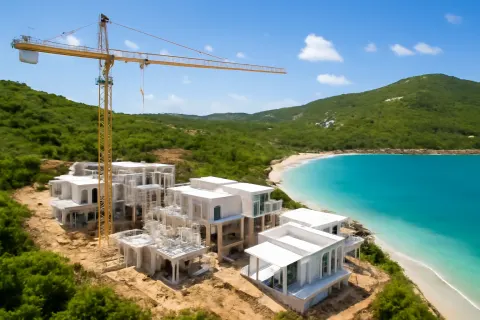
When people think "buy real estate," many imagine a standalone house with their name on the deed. In Grenada, most approved projects are hotels and resort developments, and what you typically purchase is a share or fractional ownership stake in the project, not an individual unit with a key in hand.
This creates three consequences:
- The pool of potential buyers is extremely narrow. Usually only future CBI applicants, since they need exactly this type of approved asset. A free market for small hotel shares barely exists.
- Resale price is determined by the project and CBI demand, not by local real estate values.
- Usage rights are limited. Many projects grant owners a few complimentary nights per year, not unlimited stay privileges.
We cover this structure in detail in our article Caribbean CBI Hotel Projects: What You Really Buy When You Buy Shares and Exiting a CBI Real Estate Investment After the Holding Period. One specific project example with two citizenship pathways is Grenada National Resort.
Risks to Know Before You Choose
NTF Fund Route:
- Money is non-refundable, even if you end up using the passport less than expected.
- You own no physical asset to pledge, bequeath, or sell.
- If your application is rejected after you've wired most funds (rare, since main funds transfer after approval), refund timing depends on government processing.
Real Estate Route:
- Project risk: construction delays, developer changes, poor operations. Caribbean has seen CBI projects sit unfinished for years.
- Liquidity risk: you can't sell when you need to, or you must accept a steep discount.
- Policy risk: Caribbean nations are tightening programs; if CBI demand falls, so does your buyer pool.
- Documentation risk: your ownership stake must be properly registered with clear inheritance instructions. Many families overlook this until it matters.
- Holding costs: annual management fees, property service charges, resale fees, and bank fees when repatriating proceeds.
- Currency risk: you invest in USD and hope to sell in USD, but your living expenses are in another currency. See currency risk in foreign investment.
We don't advise on real estate or tax. This analysis helps you ask the right questions; evaluating a specific project requires an independent lawyer and specialist.
Who Should Choose Each Route
NTF Fund is right for you if:
- Your goal is a passport, not an asset in another country.
- You want a fixed cost commitment with no ongoing monitoring for five years.
- You want to preserve the capital difference to invest elsewhere you understand better—for example, toward an E-2 plan later.
Real Estate is right for you if:
- There is a written buyback commitment or clear exit mechanism from a creditworthy party.
- You won't need this capital for at least five years.
- You genuinely like the idea of owning a resort stake and will actually use the complementary nights included.
- You understand and accept that resale price is not guaranteed.
- Someone in your family has time to track foreign ownership documents over several years.
One note for E-2 applicants: your Grenada investment does not count toward your E-2 investment in the United States. These are two separate budget items. Our article Grenada to E-2: Every Step Explained covers this in detail.
Questions to Ask Before Choosing the Real Estate Route
- [ ] Which project, approved by the government when, and how far along is construction?
- [ ] Am I buying shares, a fractional stake, or an individual unit? Where is ownership registered?
- [ ] Does the holding period start from purchase date or citizenship grant date?
- [ ] Who guarantees to buy my stake back, at what price, and what secures that promise? Do I have it in writing?
- [ ] What are the annual management fees, resale fees, and repatriation fees?
- [ ] If the project changes ownership or stops operating, what happens to my stake?
- [ ] How does my heir inherit this stake, and what process do they follow?
- [ ] If I change my mind and switch to the fund contribution mid-process, can I transfer, and what are the fees?
Next Steps
Run the break-even calculation above using the return rate you typically earn, then ask your advisor one single question: "Who will buy my stake after five years, at what price, and what document guarantees it?" To see total costs broken down by family structure for both routes, use our investment cost calculator; to learn more about the country you're about to adopt citizenship in, visit our Grenada page and Grenada wiki.