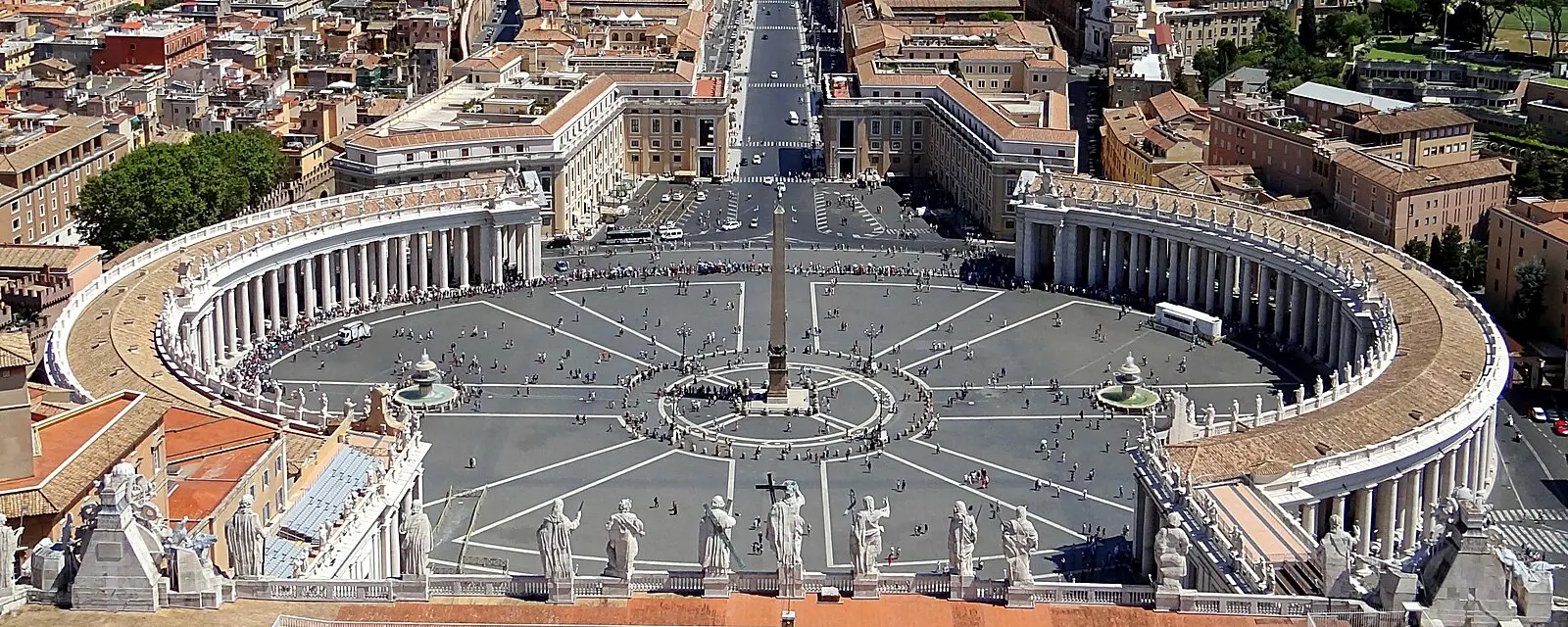
Overview
The Vatican holds a rank-21 passport reaching 135 destinations without a prior visa — the highest rank among all remaining countries in this library. Its population is around 800. Its area is about 0.44 km² — the smallest sovereign state in the world, by both area and population. The currency in circulation is the euro.
📌 But the rank-21 figure and the 135 destinations have almost no practical meaning for anyone reading this site, and the reason is in the next section — which is what makes the Vatican most worth reading.
🔴 Citizenship attaches to an OFFICE, not to a person
This is unique in the world, and it inverts nearly every assumption this site rests on.
In all 198 other countries in this library, nationality is established in one of three ways: birthplace, descent, or naturalisation after a period of residence. And once held, it stays with the person, absent a decision terminating it.
🔴 The Vatican operates on none of those three.
The mechanism, stated precisely:
- 📌 Vatican citizenship is granted to those holding an office or performing a function in service of the Holy See, and to certain resident family members under prescribed conditions.
- 🔴 When that office or function ends, Vatican citizenship ends with it.
- 📌 Holders retain their original nationality — Vatican citizenship is additional, not a replacement.
- ✅ And Vatican law contains a notable provision: it ensures nobody becomes stateless when their Vatican citizenship ends. The person reverts to their original nationality, and where none exists, arrangements with Italy apply.
📌 Why that last detail deserves a pause:
🔴 Throughout this library I have recorded twelve different mechanisms producing statelessness — Myanmar (a list), Syria (a census), Lebanon (political balance), Nepal (missing documents), Yemen (fragmented issuance), and more. In every one of those, statelessness happened because nobody had thought about it.
✅ The Vatican is the only country in this library with a clause written in advance to prevent it — because here, citizenship ending is routine and predictable, so the system had to account for it from the outset.
📌 The transferable lesson: when a system knows in advance that a right will end, it designs for the aftermath. When a system never contemplates a right ending, the consequences fall on people. That is the difference between the Vatican and those twelve cases — not a difference of morality, but of whether anyone thought about it.
🔴 Which means nobody can "apply for" Vatican citizenship
Stated directly to save time:
- 🔴 No naturalisation by residence. Living there for any length of time creates no entitlement.
- 🔴 No citizenship by birth — and in practice the Vatican has no maternity facility, so births there essentially do not occur.
- 🔴 No citizenship by descent in the ordinary sense — children hold it only while a parent holds office and resides there.
- 🔴 No investment programme, and there cannot be one. If anyone offers you "Vatican citizenship" in any form, it is absolutely fraudulent, without exception.
📌 Who makes up those 800 citizens? Chiefly Holy See officials, diplomatic personnel, members of the Swiss Guard, and certain employees and family members. A substantial share do not live in the Vatican but are serving on diplomatic assignment abroad.
📌 The Holy See and Vatican City State — two entities, not one
This is a point almost every popular article gets wrong, and it matters legally.
| Entity | What it is |
|---|---|
| The Holy See | 📌 A subject of international law — establishing diplomatic relations, concluding treaties, sending and receiving ambassadors. This is the entity with international legal personality. |
| Vatican City State | 📌 The territory — created in 1929 to guarantee the Holy See an independent territorial base. |
🔴 The diplomatic relations countries establish are with THE HOLY SEE, not with Vatican City State. The Holy See maintains diplomatic relations with most states in the world, and is a permanent observer at the United Nations rather than a member — a status very few entities hold.
📌 This affects passports: beyond ordinary passports for Vatican citizens, the Holy See issues diplomatic and service passports to those performing its functions. 🔴 Most travel documents bearing the Vatican name are in practice of this kind — meaning the "135 destinations" figure describes a passport whose holder is nearly always a diplomat on official duty.
🔴 The Vatican and the lesson of misleading numbers
This is the section I think most useful to readers who regularly compare rankings.
📌 One Vatican figure is repeated everywhere: "the country with the highest crime rate per capita in the world".
🔴 That figure is arithmetically correct and practically meaningless. Here is why:
- The numerator is recorded incidents — chiefly pickpocketing and petty theft in St Peter's Square and the museums, which receive millions of visitors annually.
- 🔴 The denominator is the resident population — around 800 people.
- Divide a figure generated by millions of visitors by a denominator of 800, and you get an enormous ratio.
📌 The Vatican is not dangerous. The division is in the wrong place.
🔴 Why this belongs on a site about nationality: because this whole site runs on ranking figures, and the Vatican is the cleanest example of a number that is entirely accurate and yet leads to an entirely wrong conclusion — when the denominator does not match the numerator.
📌 The North Korea article in this library describes another form of the same problem: a passport ranked 85th while ordinary citizens cannot obtain one, so the figure describes a capability nobody can access. The Vatican is the second form: the number is right but the comparison is wrong.
🔴 Applied to this field: when you read "programme X has a 98% approval rate", ask what the denominator is — 98% of applications submitted, or 98% of applications that passed preliminary screening? Those are very different numbers, and both can be called an "approval rate".
📌 The Swiss Guard — the world's most specific recruitment criteria
📌 The Pontifical Swiss Guard was established in 1506 and is among the oldest military units still in service anywhere in the world.
🔴 Its recruitment criteria are specific enough to record, because they are a rare example of one country's nationality being a mandatory condition for serving another:
- Must be a Swiss citizen.
- Must be male and Catholic.
- Must have completed basic training in the Swiss armed forces.
- Must meet age and minimum height requirements.
- Must be unmarried on joining — later marriage is governed by separate rules.
📌 During service they hold Vatican citizenship; on leaving, it ends and they revert to being simply Swiss citizens.
🔴 This is the clearest illustration of the principle opening this article: a person may hold the nationality of the world's smallest state for a few years and then not — and that is normal, anticipated, and causes no problem at all.
Geography & history
📌 The Vatican lies entirely within the city of Rome, making it one of three countries in the world completely surrounded by another — the other two being San Marino (also within Italy) and Lesotho (within South Africa).
🔴 The state was created by the Lateran Treaty of 1929 between the Holy See and Italy, ending a situation dating from 1870, when the Papal States — which had covered a large part of central Italy — were incorporated into a unified Italy.
📌 Which means: the Vatican is what remains of a state that was once vastly larger. This library has recorded many territorial losses — Bolivia losing its sea access, Tajikistan ceding territory in 2011. The Vatican is the most extreme: from an extensive territory to 0.44 km² — while retaining sovereign statehood.
📌 The whole of Vatican City State is a UNESCO World Heritage site — the only case where an entire country is a World Heritage site.
📌 It contains St Peter's Basilica, the Sistine Chapel with Michelangelo's ceiling, the Vatican Museums, and the Vatican Apostolic Archive — among the world's most important historical archives, with holdings spanning centuries.
Economy
🔴 The Vatican has no economy in the ordinary sense — no agriculture, no industry, no income tax.
Principal revenue:
- 📌 The Vatican Museums — among the most visited museums in the world.
- 📌 Vatican stamps and coins — with their own collector market, a genuine revenue source for a state of this size.
- Contributions from churches and faithful worldwide.
- Asset and property management.
📌 The Vatican uses the euro under a specific arrangement with the European Union, and may issue a limited quantity of euro coins with its own designs — in numbers so small that these coins go essentially straight into the collector market.
🔴 Financial transparency at Holy See institutions has been the subject of successive internal reforms and international attention over many years; the Vatican has participated in international anti-money-laundering evaluation mechanisms. This site states this at the level of facts.
Everyday life
📌 This section is brief, because almost nobody "lives in the Vatican" in the ordinary sense.
- 🔴 There is no hospital, no ordinary school, and no supermarket in the usual sense for a resident community — all such services are in Rome, a few hundred metres away.
- 📌 There is a shop, a pharmacy, a petrol station and a post office serving internal needs — the Vatican pharmacy is known for stocking some medicines not readily available elsewhere in the area.
- 📌 No airport; no port. There is a helipad and a short stretch of railway connecting to the Italian network — 📌 the shortest national railway in the world.
🔴 Entering the Vatican requires no separate visa — visitors walk in from Rome to the publicly open areas. But the administrative and residential areas are not open to the public, and access to them is controlled by Vatican security.
Who should read this article
Nobody reads this article looking for a second nationality — no route exists, as set out above.
It is written for three groups:
- 📌 Those wanting to see a nationality system built on an entirely different principle. This whole library assumes nationality is a durable attribute of a person. The Vatican shows it can be a temporary attribute of an office — and that such a system still functions, still issues passports, still conducts diplomacy.
- ✅ Those interested in preventing statelessness. The Vatican is the only country in this library with a standing provision ensuring nobody falls into statelessness when their citizenship ends — because it is the only place where such an ending is treated as normal and predictable.
- 🔴 Those who read many rankings. The Vatican's "highest crime rate in the world" figure is the cleanest example of a number arithmetically correct and semantically wrong — and that lesson applies directly to the figures the investment citizenship field itself uses.
The point to carry away: the Vatican inverts this entire site's founding assumption. Here, nationality is not something you HAVE — it is something you are HOLDING, while you occupy that position.
📌 And the striking part: precisely because this system knows in advance that citizenship will end, it wrote the protection for those it ends for. 🔴 Twelve other countries in this library wrote no such provision — not from malice, but because they never imagined nationality could be lost. And that is exactly where millions of people fall through.