Overview
North Korea — formally the Democratic People's Republic of Korea — is placed at rank 85 in passport comparison tables, corresponding to 40 destinations without a prior visa. Its population is around 26.1 million, the capital is Pyongyang, and the currency is the North Korean won (KPW).
North Korea has no citizenship-by-investment programme, and does not permit dual citizenship.
🔴 Most countries maintain advisories strictly restricting or against travel to North Korea, and some prohibit their citizens from going except in defined circumstances. Check what is in force.
📌 But this article is written for a reason unlike any other in this library: North Korea is where the passport ranking figure loses all meaning — and that teaches a great deal.
🔴 "40 destinations" — the most meaningless figure in this library
Throughout this library I have repeated one point: passport rankings measure THE BOOKLET, not THE HOLDER. Five articles have described five different mechanisms preventing citizens from leaving their own country:
Uzbekistan — exit visas, abolished 1 January 2019. Turkmenistan — unpublished restriction lists. Myanmar — restriction tied to conscription. Afghanistan — restriction by gender. Palestine — restriction through control of the exits.
🔴 North Korea is the end point of that sequence, and it differs in degree rather than merely in method: ordinary citizens are not issued passports.
Stated precisely:
- 📌 A passport here is not an ordinary civil document but something issued to those sent abroad — diplomats, approved official travellers, state-dispatched workers, athletes, performing troupes.
- 🔴 Leaving the country without permission is treated as a criminal matter.
- 🔴 Even travel between provinces requires a travel permit, under arrangements documented by many sources over many years.
📌 So the "40 destinations" figure describes a capability the overwhelming majority of 26 million people cannot access. It is not technically wrong — it simply does not describe what people assume it describes.
🔴 The lesson, applying to every figure on this entire site: an indicator means something only when its precondition holds. Passport rankings implicitly assume that anyone who wants a passport can get one. Across most of the world that assumption holds. Here it does not, and when the underlying assumption collapses, the number above it says nothing.
📌 This is why I wrote this article even though it serves no investment or migration purpose: so that readers of this site know the figures they are comparing rest on an assumption, and know what that assumption is.
🔴 Songbun — citizens graded by background
The Myanmar article in this library describes a country that grades citizens into three classes within the law itself, based on a list of recognised national groups. That is rare.
📌 North Korea operates a system of the same class but on a different criterion: political and family background. It is known as songbun.
As described by many research sources and by the accounts of people who have left, the system classifies people by their family's background across generations, into broad groups usually described as "core", "wavering" and "hostile", with numerous sub-categories.
🔴 Documented consequences: the classification affects where one may live, how far one may study, what work one may do, whether one may enter the military or state apparatus, and how food is allocated.
📌 The conceptually important point, connecting directly to the Myanmar article:
🔴 In most countries "citizen" is a condition you either hold or do not. Two countries in this library show a state can grade its citizens — Myanmar by ethnicity, North Korea by background — and once grading exists, a person's rights are determined not by WHETHER they hold nationality but by which grade they occupy.
📌 This is among the most instructive things this library has drawn out: "holding nationality" is a necessary condition, not a sufficient one.
✅ A very rare constitutional provision — and it sits in the south
This is the most notable legal detail in the article, and few outside the region know it:
📌 South Korea's constitution defines its territory as comprising the entire Korean peninsula. The legal consequence: South Korea regards people born in the northern half of the peninsula as South Korean nationals under its own constitution.
🔴 In practice this means North Koreans who reach South Korea can be recognised as South Korean citizens, through a verification and integration process set out in dedicated legislation, with initial resettlement support.
📌 Why this is a rare case worldwide: most countries treat people from another country as foreigners, requiring asylum or naturalisation. South Korea treats this not as naturalisation but as recognition of a status already existing under its constitution.
🔴 But for completeness, and this is the important part: the provision operates only once a person has reached South Korea. With no direct route across the demilitarised zone, the journey in practice usually runs through a third country, and 🔴 people in transit typically hold a very precarious legal position in the intermediate country — no documents, no residence status, and children born along the way risk being registered nowhere at all.
📌 This is the ninth piece in the sequence this library tracks on people unable to prove nationality — after Nepal, Bhutan, Myanmar, Bangladesh, Pakistan, Afghanistan, Lebanon and Palestine.
🔴 And it adds a new form: children unregistered because their parents cannot present themselves to any authority anywhere. No law strips those children of nationality; they simply do not exist in any registration system.
Geography & climate
North Korea occupies the northern half of the Korean peninsula, bordering China to the north across the Yalu and Tumen rivers, Russia along a very short northeastern stretch, and South Korea to the south across the demilitarised zone.
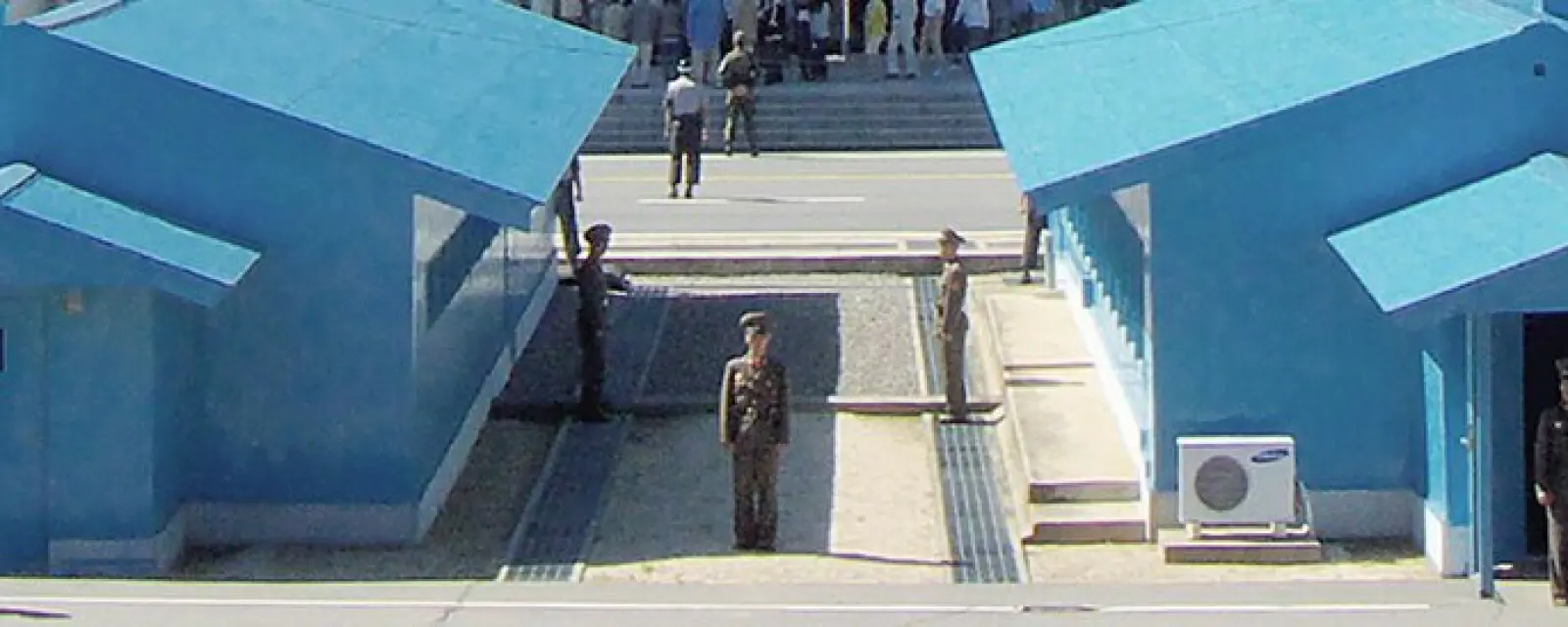
📌 The DMZ — around 4 km wide and 250 km long — is among the most heavily guarded borders in the world. 🔴 An unplanned consequence: with almost no human presence for seventy years, the strip has become one of East Asia's most significant unofficial nature reserves, home to many rare species.
The terrain is largely mountainous — around 80% — with narrow plains in the west. 📌 Mount Paektu on the Chinese border is the peninsula's highest mountain and holds particular symbolic standing in the culture of both Koreas.
The climate is continental: very cold, dry winters and hot, humid summers with concentrated rainfall.
🔴 Limited arable land combined with mountainous terrain makes food security a structural problem. UN agencies have documented food shortages in many periods, most severely the famine of the mid-1990s, where death toll estimates vary greatly between sources but are very large.
History — stated at the level of facts
The Korean peninsula has a unified state history spanning centuries, through the Goryeo and Joseon dynasties, with its own script, hangeul, created in the fifteenth century.
Modern markers:
- 1910–1945 — the peninsula under Japanese rule.
- 1945 — after Japan's surrender, the peninsula was divided into two occupation zones along the 38th parallel — the north under the Soviet Union, the south under the United States.
- 1948 — two separate states were established.
- 🔴 1950–1953 — the Korean War, with very heavy casualties on both sides and among the foreign forces involved. It ended in an armistice, not a peace treaty.
- 📌 Legally, the state of war has never formally ended — a little-known detail that explains a great deal about how both states organise government, military and travel rules to this day.
- Subsequent decades: 🔴 the nuclear and missile programmes led to numerous UN Security Council sanctions resolutions, and North Korea is among the most restricted economies in the world.
📌 This site states events with dates and delivers no political judgment.
Economy
🔴 Economic data on North Korea is very limited and not published to international standards, so every figure must be read with caution. This distinguishes the article from every other in this library, where at least there are figures to argue about.
What is known:
1. Minerals. 📌 North Korea is believed to hold significant reserves of coal, iron ore, magnesite, graphite and rare earths. 🔴 But as the Turkmenistan and Afghanistan articles state, reserves are not wealth until they can be sold — and here international sanctions and limited infrastructure are the barrier.
2. Agriculture. Chiefly for domestic consumption, with the constraints noted in the geography section.
3. Heavy industry and defence. A legacy of the earlier industrialisation model.
📌 4. Informal market activity. Many studies and accounts record the growth of spontaneous market systems, commonly called jangmadang, which emerged after the 1990s famine when the state distribution system could no longer meet needs. 🔴 This is economically notable: when a centralised distribution system fails to supply enough, spontaneous exchange appears regardless of the formal framework.
This site gives no investment advice, and here there is nothing to advise. 🔴 Any transaction touching North Korea must be checked carefully against the international sanctions framework in force — this is not a prudential suggestion but a serious legal matter for any business.
Culture & people
Korean is the sole language, written in hangeul. 📌 Both Koreas use the same language but substantial vocabulary differences have developed over seven decades of separation — the south borrowing extensively from English, the north pursuing native coinages. This is a living example of a language diverging when a community is divided.
📌 Several cultural elements shared across the peninsula remain present in both: kimchi and fermented dishes, hanbok (called joseon-ot in the north), taekwondo, and ssireum wrestling.
📌 Vietnam and North Korea have a long diplomatic history, and Vietnam is among the few countries maintaining relations with both Koreas. The Vietnamese community in North Korea is very small, mainly diplomatic staff.
Immigration routes
No investment programme, and no residence route for foreigners in the ordinary sense.
Foreigners here are chiefly diplomatic staff, international organisation personnel and a small number of approved group tourists, on accompanied itineraries.
🔴 Tourism to North Korea was suspended for an extended period and has reopened only partially to certain groups. This changes, and current information must be checked. Many countries advise their citizens not to travel.
Citizenship
By descent. Dual citizenship is not permitted. Naturalisation of foreigners is not, in practice, a meaningful concept here.
🔴 If anyone offers you "North Korean citizenship" or "a North Korean passport" in any form, it is fraud, and may additionally carry serious legal risk under international sanctions rules. There is no exception to this sentence.
Who should read this article
This article is not written for any investment, residence or citizenship purpose. There is nothing here for those purposes, and this site says so plainly.
It is written for two groups:
- 🔴 Those wanting to understand the limits of the very figures this site uses. The whole site is built on comparing passport strength. North Korea is the case that exposes the underlying assumption of every such comparison: that anyone who wants a passport can obtain one. When that assumption fails, the number above it means nothing.
- Those interested in the concept of graded citizenship. Together with Myanmar, this shows a person's rights can be determined not by whether they hold nationality but by which grade the state assigns them.
The point to carry away: throughout this library I have repeated that a stronger passport means more options. North Korea is where that sentence becomes meaningless — not because the passport is weak, but because most people are not in a position to ask the question at all.
📌 For readers comparing programme A with programme B, weighing tens of thousands of dollars and a few months of processing, this article is a reminder that simply being in a position to compare is itself a position most of the world does not occupy.