Overview
Mozambique holds a rank-70 passport reaching 58 destinations without a prior visa. Its population is around 34.6 million, the capital is Maputo, and the currency is the metical (MZN). The official language is Portuguese.
Mozambique has no citizenship-by-investment programme.
🔴 2016 — more than two billion dollars of debt nobody knew about
📌 The Zambia article records one form of sovereign risk: borrowing beyond capacity and then defaulting. ✅ Mozambique shows another, and I consider it more dangerous to outsiders.
The events, stated as facts:
- 📌 Between 2013 and 2014, three Mozambican state-controlled companies borrowed more than two billion US dollars from international banks, nominally for tuna fishing vessels, patrol boats and maritime security equipment.
- 🔴 These loans carried state guarantees — but were NOT put before parliament, did not appear in published public debt figures, and were absent from reporting to international financial institutions.
- 🔴 In 2016 the matter came to light. Mozambique's true public debt was substantially higher than published.
- 🔴 Immediate consequences: donors and international institutions suspended support; the metical depreciated sharply; Mozambique defaulted; and the economy entered a prolonged difficulty.
- 📌 The affair led to investigations and prosecutions in several countries, including outside Mozambique, and to international legal disputes lasting years.
🔴 Why this matters to anyone weighing a citizenship purchase
📌 In the Zambia article I wrote: when comparing options within a programme, ask whether what you paid depends on that state's financial health. ✅ Mozambique shows that question is not enough.
🔴 Because to assess a state's financial health, you must TRUST the figures that state publishes. 🔴 In Mozambique the published figure was short by more than two billion dollars — and nobody outside detected it for two years, including international financial institutions with full access.
📌 So the fuller question is:
✅ "Does this state have a mechanism requiring every debt to pass through parliament and be published — and has that mechanism been tested?"
📌 For the investment-citizenship countries this library covers — Grenada, Dominica, St Kitts, Vanuatu — that is an entirely reasonable question to ask, and far more worth asking than comparing prices. 🔴 Not because there is cause to suspect any particular country, but because small state size means a hidden debt need not be large to matter.
🔴 And one more point I think must be said: 📌 citizenship programme revenue accounts for a significant share of the budget in some countries. ✅ If that share is transparent — recorded in the budget, audited, published — that is a good signal about the state itself, not only about the programme. 🔴 If not, the structure is exactly Mozambique's: money entering somewhere the reporting cannot see.
📌 Gas — and what happens when the field lies in an unstable place
📌 Mozambique holds very large offshore natural gas reserves off Cabo Delgado province in the far north, among the largest discoveries in decades.
🔴 But since 2017 that very region has seen a prolonged armed conflict, causing casualties and displacing hundreds of thousands of people. 🔴 Major gas projects were suspended for years on security grounds, and forces from several regional countries were deployed in support.
📌 Some projects are operating and some are restarting, but 🔴 security conditions remain the determining factor for schedules.
🔴 The transferable lesson: 📌 resource reserves are a necessary condition, not a sufficient one. ✅ Guyana and Senegal brought hydrocarbons into production relatively smoothly; Mozambique holds comparable reserves but lost years because the field lies where the state has not established control. 📌 When someone says a country is "about to get rich from its resources", the next question is where on the map those resources sit.
Geography & economy
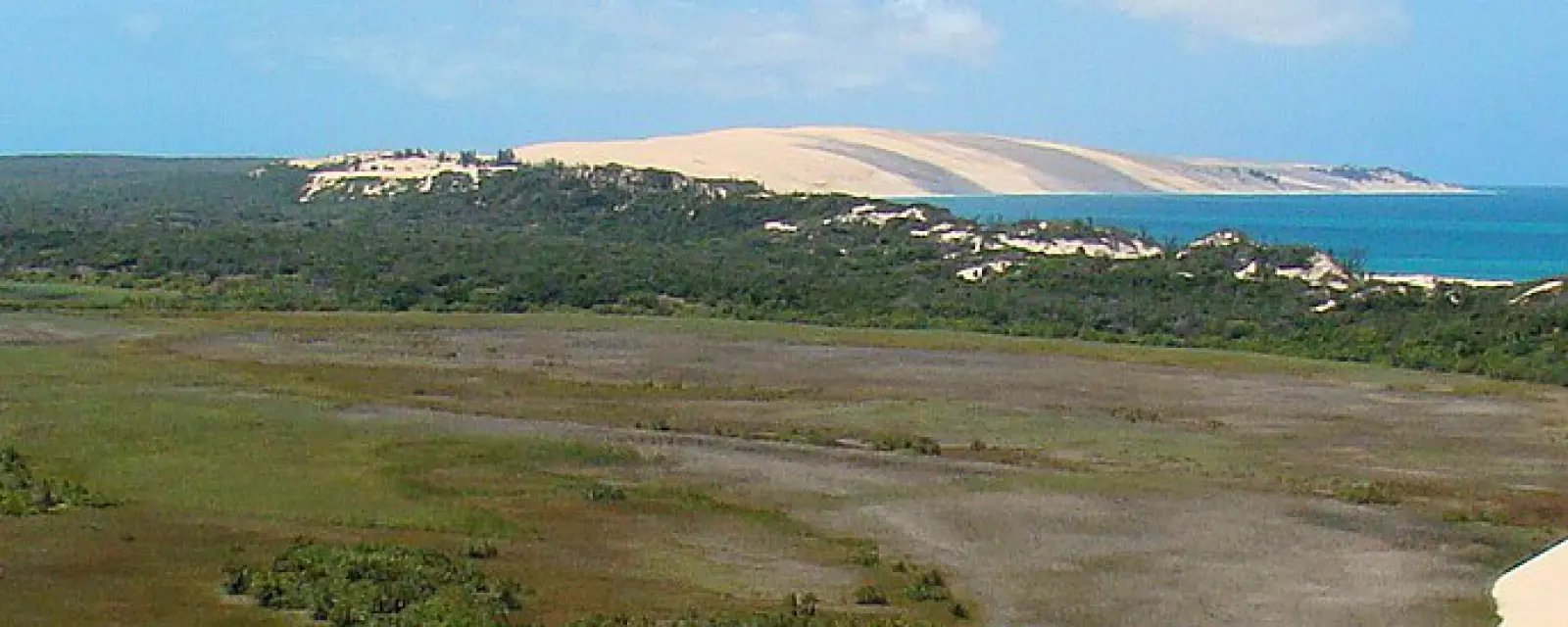
Mozambique has more than 2,500 kilometres of Indian Ocean coast — 📌 among Africa's longest — and borders Tanzania, Malawi, Zambia, Zimbabwe, Eswatini and South Africa.
📌 That position makes Mozambique the sea outlet for several landlocked countries in the region — 🔴 and the transport corridors through Beira, Nacala and Maputo ports are infrastructure of regional rather than merely national significance.
📌 Mozambique Island — the old Portuguese capital — is a UNESCO site. The Bazaruto and Quirimbas archipelagos are marine tourism destinations.
Economy: gas (rising), aluminium, coal, hydropower — 📌 the Cahora Bassa dam is among Africa's largest hydroelectric plants and exports power to South Africa — plus agriculture, fisheries and tourism.
🔴 Disadvantages: the lingering consequences of the hidden-debt affair; 🔴 the Cabo Delgado conflict; 🔴 very high tropical cyclone risk — Mozambique lies on the path of Indian Ocean storms and has taken several damaging strikes; infrastructure and electrification remain limited beyond main corridors.
As always: tax obligations here do not replace those in your country of residence.
Immigration routes & citizenship
Categories existing in law include quota-based work permits, residence tied to investment registered with the investment promotion authority, and residence through marriage.
📌 On dual citizenship: Mozambican rules distinguish between nationality of origin and nationality acquired later — 🔴 the same structure as Nigeria recorded earlier. 📌 Check the current statute for your own circumstances.
🔴 If anyone offers you "Mozambican citizenship by investment", stop. No such programme exists.
Who should consider Mozambique
It may fit if: you work in gas and oilfield services, ports and corridor logistics, hydropower, agriculture or marine tourism — 📌 and can work in Portuguese.
Not a fit if: 🔴 you are offered "Mozambican citizenship by investment"; you need low natural-disaster risk; or you need macroeconomic stability.
The point to carry away: ✅ Mozambique raises the Zambia question by one level.
📌 Zambia teaches: don't just compare prices, ask whether what you paid depends on that state's financial health. 🔴 Mozambique teaches: to answer that, you must trust the state's published figures — and those figures can be short by two billion dollars without anyone outside noticing for two years.
✅ So the most telling criterion in a small state is not the debt number, but the MECHANISM forcing every debt to appear in that number.