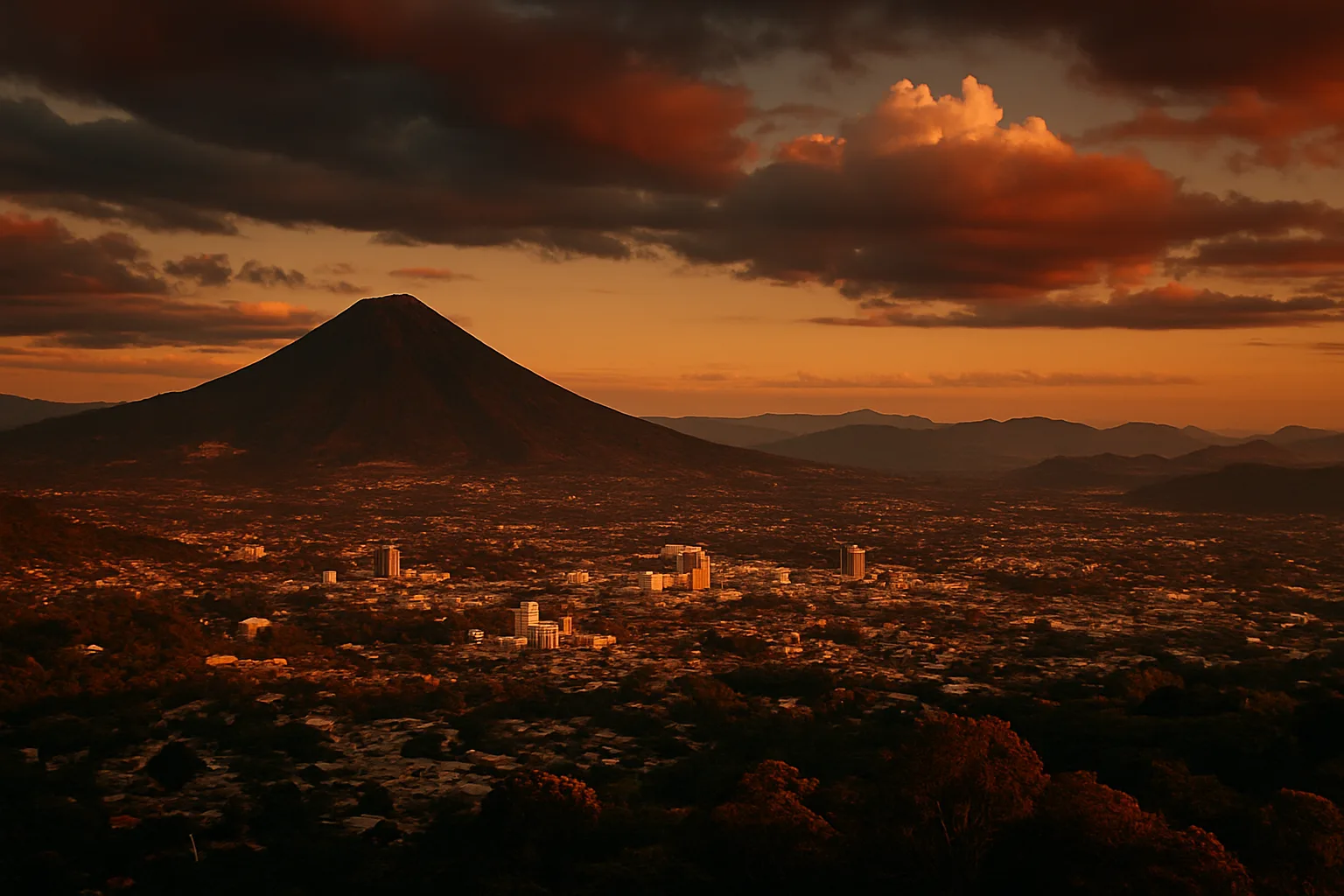
Overview
El Salvador sits on the Pacific coast and is Central America's smallest yet most densely populated nation, with approximately 6.3 million inhabitants. At just 21,041 km²—comparable to the US state of Maryland—it has one of the highest population densities in the Americas.
The capital, San Salvador, is the economic, political, and cultural hub, concentrating nearly half the national population in its expanded metropolitan area. The official language is Spanish, the primary currency is the US dollar (USD) since 2001, and as of September 2021, El Salvador became the first country globally to recognize Bitcoin as legal tender.
The El Salvador passport ranks #32 globally, offering visa-free access to 118 countries and territories, including the Schengen zone (Europe), the United Kingdom, Singapore, and many other key destinations. This is a significant advantage compared to passports from most developing nations.
Geography & Climate
El Salvador lies between Guatemala (northwest), Honduras (northeast), and the Pacific Ocean (south). The country has no Caribbean coastline, with over 300 km of Pacific shoreline instead.
The terrain is predominantly volcanic and volcanic highlands. A chain of volcanoes runs parallel to the coast, creating stunning landscapes but also posing risks of earthquakes and periodic eruptions. The highest peak is El Pital (2,730 m), while major cities typically sit at 600-900 m elevation, providing a cooler climate than coastal zones.
The climate is tropical with two distinct seasons: dry season (November-April) and rainy season (May-October). Average temperatures range 24-27°C year-round, roughly 3-5°C warmer than Vietnam. Highland areas can drop to 15-18°C at night, while coastal regions are hot and humid, occasionally reaching 35°C at midday.
The Pacific hurricane season (June-November) occasionally affects the country, though less frequently than the Caribbean region. Greater risks include flash flooding during the rainy season due to steep terrain and deforestation.
Historical Background
Before Spanish arrival, this territory was inhabited by the Maya and later the Pipil—a branch of the Nahua people who migrated south from Mexico. Cuscatan was a major civilizational center with pyramid architecture and advanced agricultural systems.
In 1524, conquistador Pedro de Alvarado defeated the indigenous confederations, bringing the region under Spanish colonial rule for nearly 300 years. El Salvador was part of the Captaincy General of Guatemala, primarily cultivating indigo (xiquilite) for textile dye exports.
After independence from Spain in 1821, El Salvador experienced decades of instability with multiple coups and internal wars. From the late 19th century onward, wealthy families monopolized coffee cultivation, creating deep wealth and power inequality.
The 1980-1992 period saw a devastating civil war between government forces and the leftist FMLN guerrillas, claiming over 75,000 lives and displacing millions to the United States. The 1992 Peace Accord ended the conflict, but social consequences persist to this day.
In the 21st century, El Salvador gained global attention through bold policies by President Nayib Bukele—the region's youngest leader upon taking office in 2019—notably his strict gang suppression campaign and Bitcoin adoption.
Culture & People
Salvadorans refer to themselves as "Salvadoreños" or "Guanacos" (an affectionate colloquialism). The population is predominantly Mestizo (Spanish-indigenous mixture, 86%), with significant European-descended populations (12%) and indigenous peoples (under 2%).
Culture is deeply influenced by Roman Catholicism blended with ancient Maya traditions. Religious festivals (fiestas patronales) occur throughout the year with processions, dancing, and traditional cuisine.
Iconic cuisine features pupusas—thick cornmeal patties filled with cheese, beans, or meat, cooked on a griddle, served with curtido (pickled cabbage slaw) and red salsa. Similar to Vietnam's bánh mì in cultural significance, pupusas are available from early morning to late evening at 0.50–1 USD each. Other staples include yuca frita (fried cassava), sopa de pata (beef foot soup), and tamales wrapped in banana leaves.
Soccer is a national passion. While the national team is not among Central America's strongest, matches draw massive fan engagement. Surfing is also prominent due to pristine Pacific beaches, attracting international athletes.
The Salvadoran diaspora is substantial, with approximately 2.5 million living abroad, particularly in the United States—nearly equal to the domestic population. They remit billions of dollars annually, a critical source of foreign exchange.
Economy & Opportunities
El Salvador's economy is valued at approximately 32 billion USD (2023), with per capita GDP around 5,000 USD. It is classified as a lower-middle-income country, slightly ahead of Vietnam in nominal per capita GDP, though living costs are also higher.
Primary economic sectors:
- Services (60% of GDP): finance, telecommunications, tourism, logistics
- Industry (25%): textiles, processed foods, chemicals, electronics assembly
- Agriculture (15%): coffee, sugar cane, corn, beans, shrimp farming
Since 2001, El Salvador uses the US dollar as official currency, eliminating exchange rate risk and uncontrolled inflation but surrendering monetary policy autonomy.
In 2021, the government passed legislation recognizing Bitcoin as legal tender, established a national digital wallet system (Chivo), and even mines Bitcoin using geothermal energy from volcanoes. This move captured global attention, particularly from technology and cryptocurrency communities, though it remains controversial regarding feasibility and financial risk.
Business opportunities concentrate on:
- Fintech and blockchain: open regulatory environment for Bitcoin and cryptocurrency
- Sustainable tourism: world-class Pacific surfing beaches, Maya archaeological sites, volcano tourism
- Organic agriculture: specialty coffee, cacao, tropical fruits
- BPO services: favorable time zone alignment with North America, competitive labor costs
Major challenges center on security. MS-13 and Barrio 18 gangs have operated for decades, creating high crime rates. However, since 2022, President Bukele's strict crackdown has substantially reduced street crime, making many areas considerably safer than five years ago.
Residency Programs
El Salvador currently offers a residency program targeting cryptocurrency investors, though this carries significantly higher policy risk. Our firm does not accept applications for this pathway.
Freedom Visa El Salvador
Program Type: Residency
This residency program targets cryptocurrency investors, reflecting El Salvador's vision as the first nation to adopt Bitcoin as legal tender.
Key Points Requiring Caution:
- Limited number of slots
- Extremely new and experimental
- Policy risk substantially higher than conventional residency programs
- Specific investment requirements and terms not fully publicly disclosed
Important Notice: WE DO NOT ACCEPT APPLICATIONS FOR THIS PROGRAM due to its experimental nature and unquantifiable policy risks.
For clients seeking stable, transparent residency programs with long-term track records, we recommend considering alternative nations such as Portugal, Greece, or Caribbean citizenship-by-investment programs with decades of proven operation.
If you have specific business interests or relocation goals in El Salvador, traditional residency pathways may be available, such as entrepreneur visas, employment visas, or pensioner visas (pensionado) for those over 50 with stable foreign-sourced retirement income—these fall outside our service offerings but can be pursued through local immigration attorneys.
Living Realities: Costs, Healthcare, Education, Transportation
Cost of Living
Compared to Vietnam, El Salvador's living costs are 30-50% higher depending on location. However, relative to North America or Europe, it remains substantially cheaper.
Monthly expenses for one person (USD):
| Category | Central San Salvador | Suburban/Coastal Areas |
|---|---|---|
| One-bedroom apartment rental | 400-700 | 250-400 |
| Utilities (electricity, water, internet) | 80-120 | 60-90 |
| Food (cooking at home + dining out) | 250-400 | 200-300 |
| Transportation (bus/Uber) | 80-150 | 50-100 |
| Entertainment, shopping | 150-300 | 100-200 |
| Total | 960-1,670 | 660-1,090 |
A family of three requires approximately 1,500-2,500 USD monthly for comfortable living in average areas. Foreigners typically spend more due to imported goods purchases and residence in safer neighborhoods.
Property prices vary significantly. Two-bedroom apartments in San Salvador cost 80,000-150,000 USD, while beachfront villas in resort areas like El Tunco or El Cuco range from 200,000-500,000 USD depending on location and amenities.
Healthcare
The public healthcare system is free but limited in quality, lacking modern equipment and consistent medication availability. Wait times are long, and public hospitals are typically overcrowded.
Private healthcare is substantially better, with international hospitals like Hospital de Diagnostic, Hospital de La Mujer, and clinics affiliated with American systems. Costs:
- Specialist consultation: 40-80 USD
- General blood work: 25-50 USD
- X-ray: 30-60 USD
- Hospital childbirth: 1,500-3,000 USD
- Minor surgery: 800-2,500 USD
International health insurance is advisable for long-term residents, costing 100-300 USD per person monthly depending on age and coverage scope.
Education
Public schools are free but low-quality, with teacher shortages and poor facilities. Most expatriate families choose private or international schools.
International schools in San Salvador teach American or IB curricula:
- American School of El Salvador: 600-1,200 USD/month
- International School of San Salvador: 550-1,100 USD/month
- Escuela Panamericana: 400-900 USD/month
Annual tuition ranges 6,000-14,000 USD, excluding enrollment fees, textbooks, and uniforms. Pricing is comparable to or slightly above international schools in major Asian cities.
Higher education includes some quality institutions like Universidad Centroamericana "José Simeón Cañas" (UCA) and Universidad Dr. José Matías Delgado, though affluent students often pursue degrees in the US, Mexico, or Costa Rica.
Transportation
Public transit consists primarily of refurbished American school buses (nicknamed "chicken buses")—aged vehicles repainted in vibrant colors. Fares are cheap (0.25-0.50 USD per ride) but buses are crowded, lack safety features, and are unsuitable for most foreigners.
Uber and Cabify operate effectively in San Salvador and major cities. Typical fares range 3-8 USD for in-city trips, substantially cheaper than traditional taxis.
Car rental is common, costing 30-60 USD daily depending on vehicle type. Driving requires caution due to chaotic traffic, poor rural roads, and robbery risks in sensitive areas after dark.
Your current driver's license accompanied by an International Driving Permit is initially acceptable; after 3-6 months, obtain a local Salvadoran license.
Domestic flights are underdeveloped due to the country's small size. Any destination within El Salvador is accessible by car within 1-3 hours.
International Connectivity: Monseñor Óscar Arnulfo Romero International Airport (SAL) is located 40 km from downtown San Salvador, with flights to the US (Los Angeles, Houston, Miami, New York), Mexico, Panama, and Guatemala. No direct flights operate from Vietnam—connections require transit through the US (requiring US visa) or Mexico.
Who Should Consider This Country
El Salvador suits those who:
Should Consider:
- Technology and crypto investors: Especially those in blockchain and fintech seeking to leverage the open regulatory environment for Bitcoin and access emerging technology communities.
- Entrepreneurs seeking emerging market opportunities: Those willing to accept higher risk for pioneering opportunities in a small but transforming market.
- Remote workers for North American companies: Central Time compatibility, reasonable living costs, USD currency—convenient for freelancers and remote employees.
- Ocean enthusiasts and nature lovers: The Pacific coast features world-class surfing (El Tunco, Punta Roca, Sunzal), volcanoes, cloud forests, and volcanic crater lakes.
- Latin American or Spanish speakers: Cultural integration, communication ease, and business networking advantages.
NOT Suitable If:
- You prioritize stability and low risk: Political conditions remain volatile, the experimental residency program lacks long-term track record.
- You have young children and prioritize security: While significantly improved, El Salvador has a historical gang presence—not the most reassuring choice for families.
- You are unfamiliar with or skeptical of cryptocurrency: Without understanding or belief in Bitcoin/crypto, you cannot leverage El Salvador's distinguishing features.
- You require world-class public healthcare and education: Public systems are underfunded; private alternatives are expensive—not comparable to developed nations.
- You need advanced medical care: Private healthcare handles routine treatment well but complex cases typically require referral to the US or Mexico.
- You seek a top-tier passport for global mobility: While the El Salvador passport offers respectable visa-free access, Caribbean or European citizenship programs are stronger if that is your primary objective.
Final Note: Information herein is for reference. El Salvador represents an emerging market in residency and investment programs, with many policies lacking long-term precedent. Before deciding, consult thoroughly with immigration specialists with deep local expertise tailored to your circumstances. Viking Global Group recommends clients carefully evaluate more established alternatives in our service portfolio.