Overview
Saint Lucia is an island nation in the eastern Caribbean, situated between Martinique and Saint Vincent. Area: 617 km²; population approximately 180,000.
This is the youngest citizenship by investment program among the five Caribbean nations — enacted in 2015, two years after Grenada and three decades after Saint Kitts.
As a later entrant, Saint Lucia designed a comparatively more flexible program: besides contributions and real estate, it offers a government bond structure — you purchase bonds, hold them for the required term, then receive full principal repayment. No other Caribbean nation offers a comparable bond mechanism.
Visually, Saint Lucia possesses something unmatched in the region: the twin Pitons peaks — a pair of volcanic spires rising sharply from the sea, a UNESCO World Heritage Site and the iconic symbol on the national flag.
A lesser-known but noteworthy detail: Saint Lucia has two Nobel Prize winners — poet Derek Walcott (Literature 1992) and economist Arthur Lewis (Economics 1979). Calculated per capita, this represents the highest Nobel density in the world.
Geography & Climate
A volcanic island with steep terrain and extensive forests. The highest point is Mount Gimie at 950 m, but more famous are Gros Piton (798 m) and Petit Piton (743 m) on the southwestern coast.
Near the base of the Pitons lies Sulphur Springs — an active volcanic crater accessible by vehicle, often called the world's only drive-in volcano. Hot springs and mineral mud here are major tourist attractions.
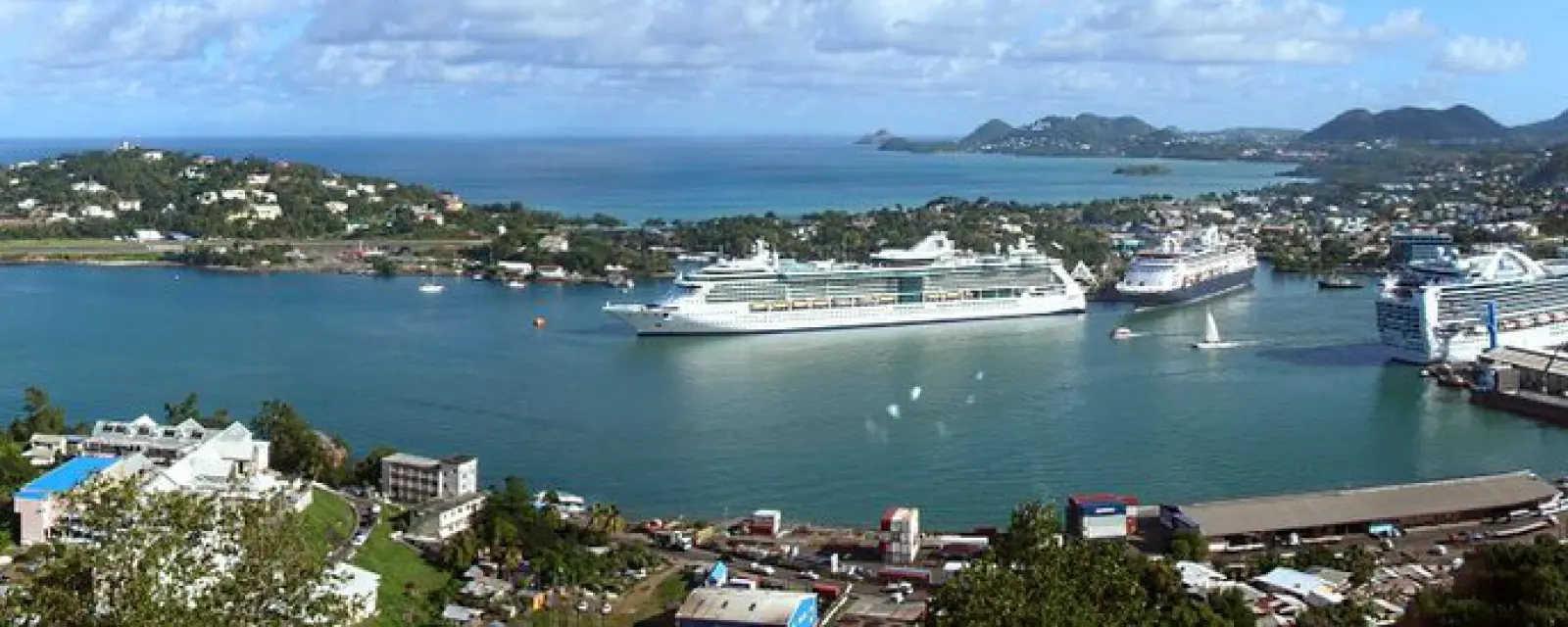
The capital Castries sits on the northern coast, with nearby Rodney Bay serving as the main hub for services, hotels, and yachting. The quieter, more scenic southern region around Soufrière offers a different character.
Tropical climate, 24–31°C year-round, with consistent trade winds. Dry season: December–April; rainy season: June–November.
Hurricane risk: Saint Lucia lies within the Caribbean hurricane belt in a central position, so risk is higher than Grenada but lower than northern islands such as Antigua or Saint Kitts. Hurricane season runs June–November. The steep topography also carries landslide hazards during heavy rainfall — when purchasing hillside property, you should carefully inquire about foundation quality and drainage systems.
Historical Background
Arawak peoples, followed by Kalinago, inhabited the island before European arrival.
Saint Lucia experienced one of the Caribbean's most turbulent colonial histories: Britain and France exchanged sovereignty fourteen times over two centuries. Consequently, the island is called the "Helen of the West Indies" — after Helen of Troy, fought over by rival powers.
Cultural consequences remain evident: most place names are French (Soufrière, Gros Islet, Vieux Fort), the population speaks French-based Creole in daily life, yet administration, law, and education follow the English system, as Britain secured final control in 1814.
Independence: February 22, 1979. A constitutional monarchy within the Commonwealth, with a legal system based on English common law.
The colonial economy centered on sugar, then bananas — once the dominant export. When the European Union abandoned preferential import terms for bananas from ACP countries in the 1990s–2000s, that sector collapsed, forcing Saint Lucia to pivot decisively toward tourism and services.
Culture & People
English is the official language, used throughout government, education, and business. The population also speaks Kwéyòl — French-based Creole — in everyday life.
Roman Catholicism predominates, reflecting the French colonial period. This differs from Saint Kitts or Antigua, which follow Anglicanism — another marker of the island's dual colonial heritage.
Major festivals include Carnival in July and the Saint Lucia Jazz Festival — a regionally prominent music event attracting international artists.
Society emphasizes family and community, with a slower pace of life. With 180,000 inhabitants, Saint Lucia is among the more populous Caribbean nations in the CBI group — larger than Grenada, Saint Kitts, Antigua, and Dominica.
There is virtually no Vietnamese community.
Economy & Opportunities
Tourism is the economic cornerstone, the principal source of foreign exchange. Saint Lucia positions itself in the luxury resort and honeymoon market — one of the Caribbean's premier honeymoon destinations, generating steady demand for hotels and rental villas.
Yachting: Rodney Bay Marina is a major port facility, and Saint Lucia is the finish line for the Atlantic Rally for Cruisers (ARC) — an event that brings hundreds of yachts from Europe each December.
Agriculture — bananas, cacao, mangoes, coconuts. Saint Lucia cacao is sourced by select international artisanal chocolate makers.
Financial services and citizenship by investment programs contribute meaningfully to government revenue.
Currency: East Caribbean Dollar (XCD), pegged at 2.70 XCD = 1 USD.
No worldwide income tax on non-residents, no inheritance tax, no capital gains tax. Reminder: this does not automatically exempt you from tax obligations in your home country.
Residency & Citizenship Program
The program has operated since 2015, administered by the Citizenship by Investment Unit (CIP). Four investment pathways:
Contribution to the National Economic Fund (NEF) — a non-refundable contribution to development revenue.
Real estate investment in government-approved projects, subject to holding period requirements.
Government bonds — Saint Lucia's distinctive option. You purchase interest-free bonds, hold them for the prescribed duration, then receive full principal repayment. In substance, your cost is foregone interest plus fees, rather than a permanent capital loss. Worth considering if you have available capital and wish to recover most of your investment within a few years.
Business investment in government-approved enterprises, typically with job creation conditions.
Applications include spouse, dependent children, parents, and siblings per statutory conditions. No residency requirement, no interview, no language test.
Saint Lucia passport access: visa-free or visa-on-arrival entry to most of Europe including the Schengen zone, the United Kingdom, Singapore, Hong Kong, and numerous countries in Asia, Africa, and Latin America.
Saint Lucia has no E-2 treaty with the United States and does not offer mainland China visa-free access like Grenada does.
On specific figures: contribution amounts, bond values, real estate thresholds, due diligence fees, and holding periods vary by regulation and change over time; OECS nations have coordinated minimum floor increases from 2024. Consult the fee schedule on this website or ask an advisor.
Practical Living
Cost of living is noticeably higher than Vietnam, comparable to Caribbean-wide levels. Imported goods are expensive; local produce and seafood are reasonably priced thanks to fertile land and a larger population than smaller islands. Electricity is costly due to dependence on imported fuel.
Healthcare: Owen King EU Hospital in Castries is the principal facility, opened in 2019 with EU funding — more modern than the typical small-island standard. Complex cases are often transferred to Martinique, Barbados, or the United States. International health insurance is mandatory for long-term residents.
Education: Public schools teach in English following the Caribbean CXC/CSEC curriculum. There is a branch of the University of the West Indies and several private schools.
Transportation: Hewanorra International Airport in the south accepts wide-body aircraft and offers direct flights to New York, Miami, Atlanta, Toronto, and London. George F. L. Charles Airport in Castries serves regional connections.
This is a strength compared to Dominica — Saint Lucia can receive large aircraft from North America and Europe.
No direct flights from Vietnam — you will connect through at least two stops, totaling 24–30 hours. Time difference: 11 hours ahead.
Who Should Consider Saint Lucia
A good fit if you:
- Want to recover most of your capital within a few years — the government bond option with principal repayment is exclusive to Saint Lucia
- Need a second passport for convenient travel to Europe and the UK, without relocation
- Wish to include multiple family members, including siblings
- Are interested in vacation rental real estate — Saint Lucia is a top Caribbean honeymoon destination with steady rental demand
- Need an island with large-aircraft airport capacity — far more convenient than Dominica
May not be the best fit if:
- Your goal is to establish and operate a business in the U.S. — no E-2 treaty; consider Grenada instead
- You need frequent mainland China access — only Grenada in this group has a visa-free arrangement
- You prioritize program longevity and track record — Saint Lucia launched in 2015, the youngest; for longer history, choose Saint Kitts or Dominica
- You are concerned about hurricane and landslide risk — steep terrain requires careful foundation and drainage review for hillside purchases
- You rely on a Vietnamese community or specialized local healthcare
This article provides foundational information for reference purposes. Investment requirements, fees, and application conditions change over time. Please consult with a Viking Global Group advisor before making a decision.