Overview
Saint Kitts and Nevis is a two-island nation in the eastern Caribbean, part of the Leeward Islands chain. With an area of 261 km² and a population of approximately 48,000, it is the smallest sovereign nation in the Western Hemisphere by both area and population.
What distinguishes this country globally is that it is the birthplace of citizenship by investment. Saint Kitts enacted the enabling legislation in 1984 — nearly three decades before Grenada and before any European program. Every CBI program in the world today is descended from this pioneering model.
Four decades of continuous operation brings something money cannot instantly buy: a track record verified through multiple administrations and several cycles of international regulatory tightening.
However, clarity is important: Saint Kitts and Nevis does not have an E-2 treaty with the United States. If your goal is to establish a pathway to operate a business in America, this is not the right choice — Grenada is.
Geography & Climate
The two islands are separated by approximately 3 km across The Narrows strait, connected by a ferry crossing of about 45 minutes.
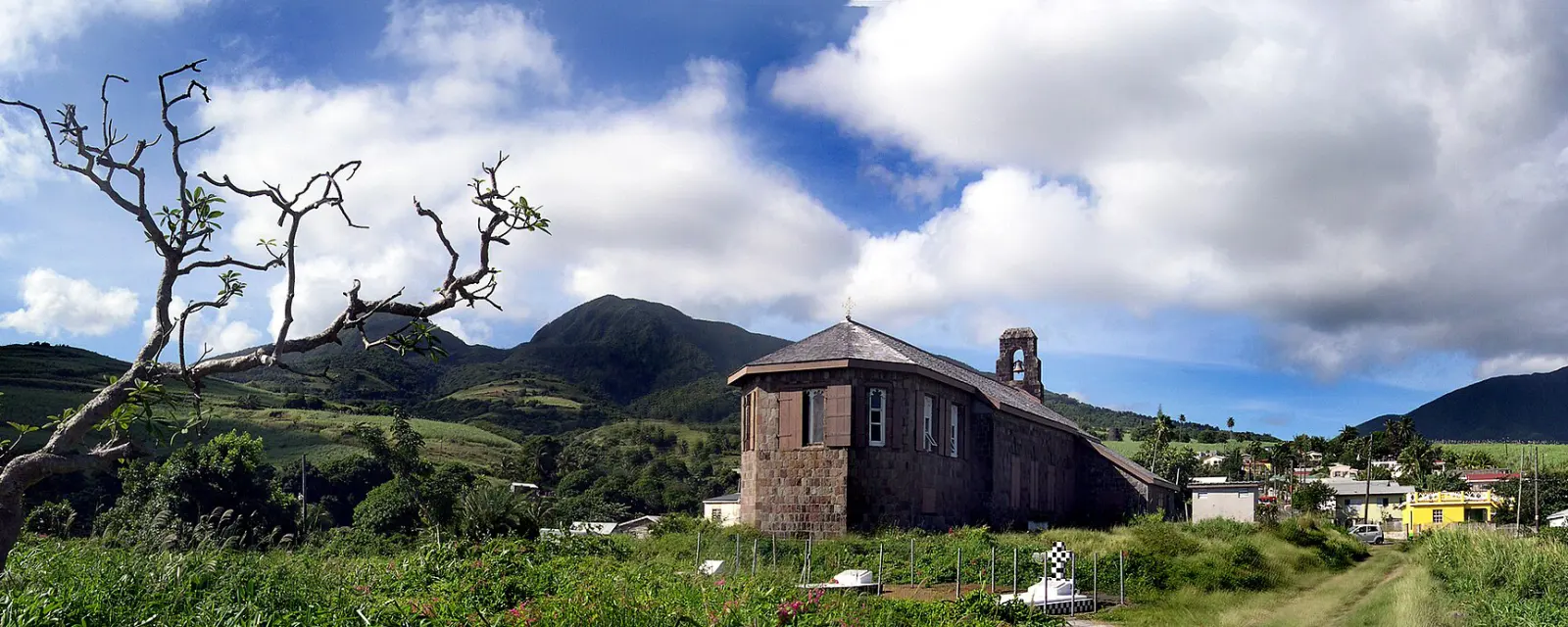
Saint Kitts is the larger island, roughly oval in shape, dominated by the extinct volcano Liamuiga at 1,156 m in the center. Basseterre is the capital and main port. The island has tropical rainforest on the volcanic slopes and extensive abandoned sugar cane fields.
Nevis is smaller, nearly circular, with Nevis Peak at its center, perpetually shrouded in cloud. It is noticeably quieter, less touristy, and home to numerous high-end retirement properties.
The tropical climate is stable year-round, ranging from 24–31°C, with consistent trade winds that prevent excessive humidity. The dry season runs December through April; the rainy season is May through November.
Hurricane risk must be stated clearly: Saint Kitts lies within the Caribbean hurricane belt in the northern zone, making it significantly more vulnerable than Grenada. Hurricane season spans June through November. When purchasing real estate, specifically ask about a property's hurricane-resistant construction standards and the damage history of the area.
Historical Background
The Kalinago people inhabited the islands before Columbus sighted them in 1493. Saint Kitts became England's first Caribbean colony in 1623, and France also established settlements—the two powers divided and fought over the island for more than a century.
Because of its role as a springboard for colonizing other islands, Saint Kitts earned the title "Mother Island of the West Indies". Brimstone Hill Fortress—an imposing military installation built on volcanic slopes and now a UNESCO World Heritage Site—witnessed repeated sieges between British and French forces.
The colonial economy was entirely dependent on sugar cane and enslaved labor. The sugar industry persisted until 2005, when it finally closed—the latest closure in the Caribbean. This represented a major economic shock, forcing the nation to pivot toward tourism, financial services, and citizenship by investment.
Independence from Britain came on September 19, 1983. The nation operates as a constitutional monarchy within the Commonwealth, with a legal system inherited from English common law.
A distinctive constitutional feature: Nevis has its own parliament and significant autonomy, including a constitutional right to secession. In practice, Nevis has developed a separate legal framework for corporate entities and asset protection trusts, earning high regard from international wealth managers.
Culture & Society
English is the official language and is used in all formal matters — there are no language barriers for Vietnamese citizens navigating documentation, medical care, or education.
Society reflects a blend of Afro-Caribbean heritage with British colonial influences. Anglicanism and various Protestant denominations dominate. The pace of life is measured; community bonds are tight — with 48,000 residents, nearly everyone knows one another.
Major festivals include Carnival at year-end in Saint Kitts and Culturama in August in Nevis. Cricket is the national sport.
Nevis has a notable historical connection: Alexander Hamilton — the architect of the U.S. financial system whose likeness appears on the $10 bill — was born in Charlestown, Nevis. His birthplace is now a museum.
The Vietnamese community here is virtually nonexistent. You should mentally prepare for the complete absence of Vietnamese-language services, Vietnamese markets, or compatriots for support.
Economy & Opportunities
Since the sugar industry closed in 2005, the economy rests on three pillars:
Tourism — primarily cruise ship calls at Basseterre and high-end resort stays. Nevis is positioned in the ultra-luxury, discreet segment, distinctly different from mass-market tourism.
Financial services — an underappreciated strength. Nevis has developed a legal framework for limited liability companies and asset protection trusts among the world's most stringent. International wealth managers regularly employ Nevis structures.
Citizenship by investment program — a direct and meaningful contributor to the national budget for four decades.
The currency is the East Caribbean Dollar (XCD), fixed at 2.70 XCD = 1 USD — no foreign exchange risk.
Tax environment: Saint Kitts and Nevis imposes no personal income tax, no inheritance tax, and no capital gains tax. However, understand clearly that this does not automatically exempt you from tax obligations in Vietnam or your actual country of residence. Tax planning requires an attorney versed in both jurisdictions—straightforward extrapolation is not safe.
Relocation Program
The program has operated since 1984 and undergone several reforms. Current primary mechanisms include:
Contribution to the national development fund — a non-refundable contribution; the fund's name and administration have changed multiple times through different eras (from the former Sugar Diversification Fund to the current sustainable development contribution framework).
Real estate investment in government-approved projects, subject to minimum holding periods.
Approved residential property investment — a supplementary avenue with separate conditions.
The application encompasses spouse, dependent children, parents, and grandparents under legal conditions. No residence requirement, no interviews, no language testing required.
Visa-free and visa-on-arrival access with Saint Kitts passport: the majority of Europe including the Schengen zone, United Kingdom, Russia, Singapore, Hong Kong, and numerous countries across Asia, Africa, and Latin America.
Reiterating a critical point: Saint Kitts has no E-2 treaty with the United States. Citizens of Saint Kitts still must apply for U.S. visas through standard channels. This is a fundamental difference from Grenada and the reason Viking Global Group typically directs clients with U.S. goals toward Grenada.
On specific figures: contribution amounts, minimum real estate values, due diligence fees, and processing timelines change with each regulatory revision. OECS nations aligned on raising minimum thresholds from 2024 onward. Please consult the program parameters on our updated program page or speak with a specialist — posting fixed numbers risks becoming dangerously outdated.
Practical Life
Cost of living is significantly higher than Vietnam. As a small island, nearly all consumer goods are imported; packaged food, electronics, and vehicles are notably expensive. Local seafood, tropical fruit, and fresh produce are reasonably priced. Electricity is particularly expensive — the Caribbean depends on imported petroleum, and continuous air conditioning use will exceed most expectations.
Healthcare: there is a general hospital in Basseterre and several private clinics. Complex cases are typically referred to Puerto Rico, Trinidad, or the United States. Anyone planning to relocate long-term should definitely purchase comprehensive international health insurance with regional coverage — do not rely solely on in-island systems.
Education: public schools teach in English following the Caribbean CXC/CSEC curriculum. A few private schools operate. Students aiming for university in the UK or U.S. typically complete an international curriculum and then apply abroad. The island hosts several international medical education facilities serving North American students.
Travel: Robert L. Bradshaw International Airport offers seasonal direct flights to Miami, New York, Charlotte, Toronto, and London. There are no direct flights from Vietnam — you will realistically need to connect through at least two hubs, with total travel time usually 24–30 hours.
The time difference from Vietnam is 11 hours — business hours in Saint Kitts fall in the middle of the night in Vietnam. Calculate carefully if you still manage domestic operations.
Who Should Consider Saint Kitts & Nevis
Well-suited if you:
- Value track record and operational stability — 40 years of continuous operation, the oldest program globally
- Need a second passport for convenient travel, particularly to Europe and the United Kingdom
- Are interested in asset protection structures — Nevis's legal framework for trusts and companies ranks among the world's most rigorous
- Wish to complete your application without relocating — no residence requirement
- Want to include multiple generations, including parents and grandparents
Not the right fit if:
- Your goal is to relocate to the United States to operate a business — no E-2 treaty; consider Grenada instead
- You need frequent access to China — Grenada has a visa-free agreement with China; Saint Kitts does not
- You require a Vietnamese-speaking community and Vietnamese-language services
- Family members have serious medical conditions requiring specialized in-country care
- You fear hurricane exposure — northern Caribbean location carries meaningfully higher risk than Grenada
- You expect real estate appreciation — thin market liquidity makes property better viewed as a citizenship vehicle than an investment asset
This article provides foundational reference information. Regulations, fees, and application requirements change periodically. Please consult with a Viking Global Group specialist regarding your specific circumstances before making a decision.