Overview
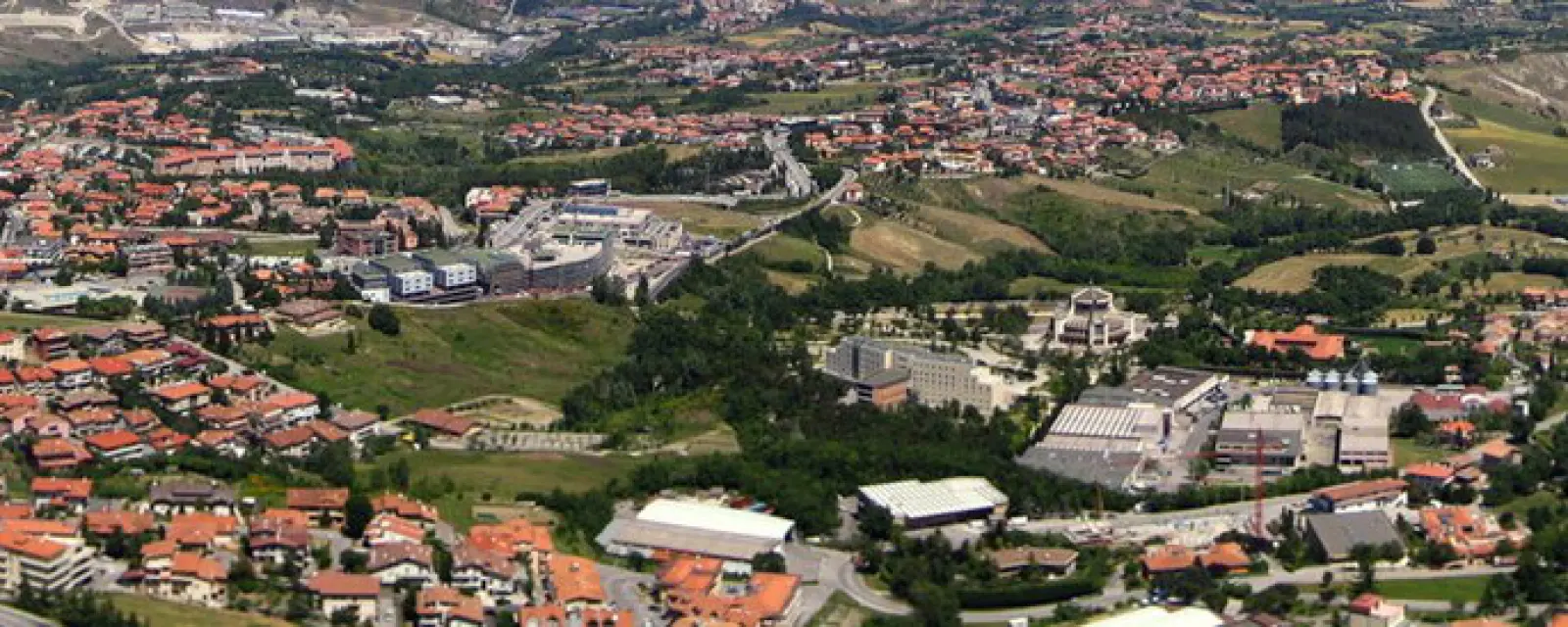
San Marino is a republic located entirely within Italian territory, near the Adriatic coast. It covers approximately 61 km² — comparable to about three-quarters of Malta — with around 34,000 residents.
It is the world's oldest surviving republic, traditionally founded in 301 AD.
Important clarifications
Like Andorra: San Marino is NOT part of the European Union.
This country uses the euro under a separate bilateral agreement, has an open border with Italy in practice, but is not an EU member state and is not legally part of the Schengen Area. Residency in San Marino does not grant residency or work rights in the European Union.
Because it is completely surrounded by Italy, travel in practice is unrestricted. However, "residency in Europe" and "residency in the European Union" are two different things, and this is where marketing materials often leave readers to draw incorrect conclusions.
Geography and climate
The terrain is hilly and mountainous, with Mount Titano at the center reaching approximately 750 meters, topped by three historic fortresses — the iconic symbol of the country and a UNESCO World Heritage site.
The Mediterranean climate is temperate: summers are warm at around 25–30°C, winters are cool at around 5–10°C, with snow on the mountain peaks. Considerably more pleasant than Andorra.
It is approximately 20 km from the Rimini coast and about two hours by car from Bologna airport.
History and culture
San Marino maintained its independence for millennia through its mountainous, hard-to-access location and steadfast neutrality policies. During World War II, the country remained neutral and sheltered a refugee population larger than its own citizenry.
The political system has distinctive features: the state is headed by two co-chiefs called Captains Regent, serving terms of only six months — an anti-concentration-of-power mechanism dating to medieval times and still maintained today.
The language is Italian. Culture, cuisine, and lifestyle are nearly identical to Italy's Emilia-Romagna region.
Economy and taxation
Corporate tax is low compared to Italy and most of Western Europe — this is the primary attraction. Personal income tax is progressive.
The economy relies on tourism, banking, small-scale manufacturing, and collectible postage stamps. With a domestic market of 34,000 people, virtually all business activity is oriented outward — primarily toward Italy.
San Marino has signed financial information-exchange agreements and is no longer a destination for anonymous wealth storage.
Residency programs
San Marino grants residency under economic or entrepreneurship categories, with requirements covering investment, housing, and proof of financial capacity.
Strengths: low corporate tax, excellent security, quality healthcare, tranquil living environment, proximity to Italian cities.
Disadvantages:
Not part of the EU. This is the most important point.
Extremely small scale. 61 km² and 34,000 residents. Real estate supply is severely limited, and everything depends on Italy — from goods to services.
Italian language required for practical living and work.
The path to citizenship is very long, requiring decades of residence under traditional rules. This is not a realistic objective.
We have not processed applications under this category. Conditions may change — verify with the relevant authorities.
Who should consider San Marino
Well-suited for those with a business oriented toward the Italian market who want to benefit from lower corporate taxation, and who are prepared to live in a very small, quiet location.
Well-suited for those who appreciate Italian culture, speak Italian, and prioritize security and quality of life over business scale and opportunities.
Not suitable for those seeking residency or work rights in the European Union.
Not suitable for those who need a market or business ecosystem. At 34,000 people, there simply isn't one.
Not suitable for those seeking a passport.
This information is for reference only and does not constitute legal or investment advice.