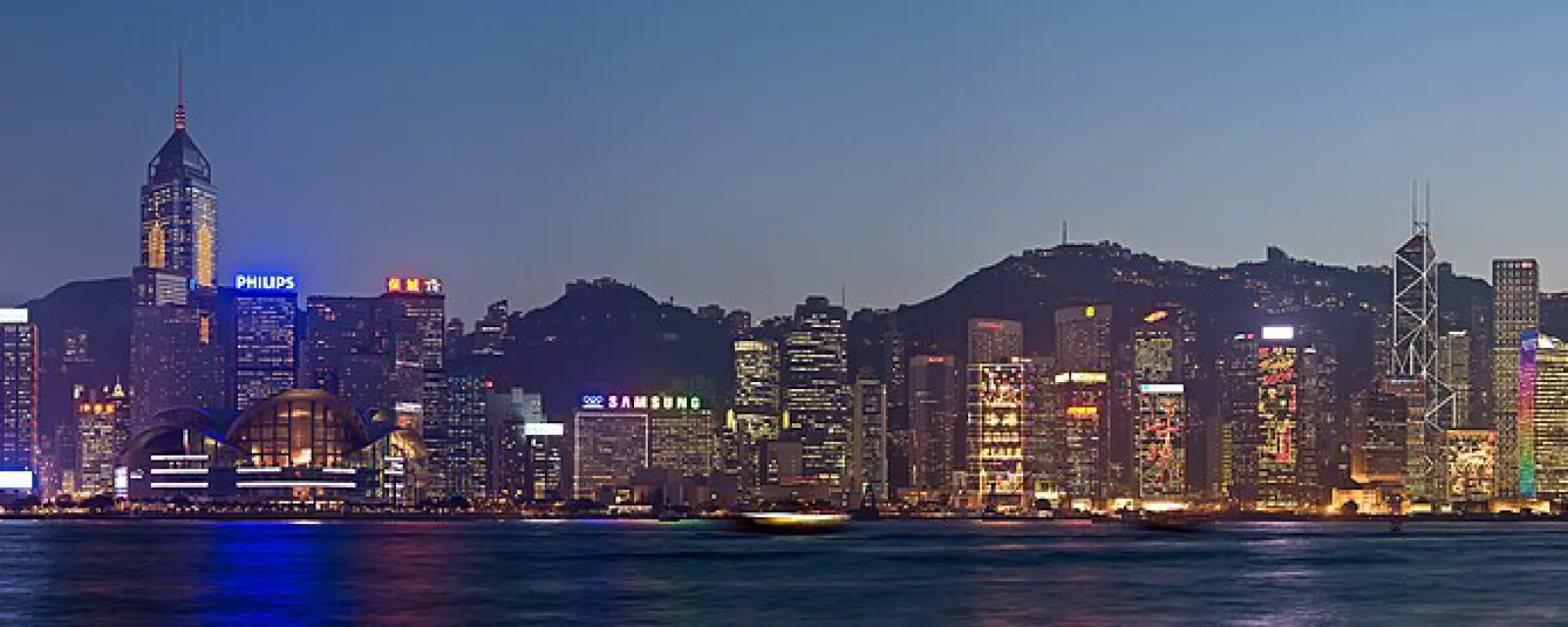
Overview
Hong Kong is a special administrative region of China, covering approximately 1,100 km² with over seven million residents. It is one of the three largest financial centers in Asia, alongside Singapore and Tokyo.
For international investors, Hong Kong offers three notable advantages: a flight of just over two hours from major regional hubs, English as the language of administration and business, and an investment-based residency program without language requirements or management experience — a feature few jurisdictions offer.
Geography and Climate
Hong Kong comprises the Kowloon Peninsula, Hong Kong Island, and over two hundred smaller islands. The terrain is predominantly hilly and mountainous, with only about one-quarter of the land area developed — a key reason for the exceptionally high population density and property prices, among the world's highest.
The climate is subtropical monsoon, similar to Southeast Asian lowlands but more humid. Summer, from May to September, is hot and humid with typhoon season. Winter, from December to February, is mild, ranging from 15 to 20 degrees Celsius. Most tropical and subtropical immigrants adapt to the climate with minimal adjustment period.
Historical Development
Hong Kong became a British colony following the First Opium War in 1842, and expanded through subsequent treaties. Over more than a century under British administration, it developed from a fishing village into a major entrepôt and financial center.
On July 1, 1997, Hong Kong was handed back to China under the "One Country, Two Systems" principle, with commitments to maintain a separate legal and economic system for fifty years.
From 2019 to 2020, Hong Kong experienced significant political and legal changes, resulting in substantial alterations to its legal framework and emigration of portions of the population. This is a factor investors should independently research and evaluate — we mention it because it affects long-term decisions, but we do not offer political opinions.
Culture and Society
Cantonese is the everyday language, but English is the official language and widely used in administration, courts, banking, and education. Mandarin Chinese is increasingly common.
This is a major advantage for international investors: basic living and working do not require learning Cantonese.
A Vietnamese community exists in Hong Kong, though smaller than in Taiwan or Japan. Asian cuisine is diverse and Vietnamese ingredients are readily available.
Economy and Opportunities
Hong Kong operates under an open economic model with low taxes and minimal state intervention. Several key features:
Low personal income tax, assessed on a progressive scale with lower marginal rates than most developed economies. No capital gains tax, no dividend tax, no inheritance tax.
Low corporate tax with a territorial tax principle — income sourced outside Hong Kong is generally not taxed.
No foreign exchange controls. Capital flows freely; the Hong Kong dollar is pegged to the US dollar.
Robust financial infrastructure. The Hong Kong Stock Exchange is one of Asia's largest, and the international banking system is comprehensive.
For Vietnamese businesses engaged in international commerce, Hong Kong is commonly used as an intermediary jurisdiction for its streamlined procedures and convenient banking system.
Residency Program
Hong Kong reopened the New Capital Investment Entrant Scheme in 2024 after a nine-year hiatus since 2015.
Asset requirement: Demonstrate net worth of at least HKD 30 million — approximately USD 3.85 million — maintained continuously for six months before application.
Investment requirement: Invest HKD 30 million, divided into two components. Approximately HKD 27 million into approved asset classes: listed Hong Kong equities, bonds, certificates of deposit, qualified investment funds, and real estate with limitations. Approximately HKD 3 million into an investment fund managed by Hong Kong Investment Corporation.
Key strengths of this program:
- No language requirements — unlike Japan, which requires JLPT N2 Chinese from October 16, 2025
- No management experience required
- No obligation to establish or operate a business — this is passive investment, unlike the US E-2 visa which mandates direct business operation
- Dependents include spouse and unmarried children under 18
Timeline: Initial visa valid for 36 months, renewable on a 3+3+2 year schedule. Permanent residency after seven years of continuous ordinary residence.
We have not processed applications under this pathway. This information is provided for reference and comparison. The investment amount and permitted asset portfolio may change at the discretion of the regulatory authority — verify current requirements with Hong Kong's Immigration Department before committing.
Daily Life
Housing costs are extremely high. This must be stated upfront. Hong Kong rental and purchase prices are among the world's highest, and residential unit sizes are substantially smaller than equivalent expenditures elsewhere. A family of four in Hong Kong typically occupies space that would be considered compact in Hanoi or Ho Chi Minh City.
Public transportation is excellent. The subway system is extensive, punctual, and most residents do not require a private vehicle. This represents significant savings compared to other cities of equivalent income levels.
Healthcare is tiered. The public system offers good quality and low costs for residents, though non-emergency specialist waiting times can be lengthy. The private system offers high quality at high cost. Most higher-income residents purchase private insurance.
Education. Public schools teach in Cantonese or English depending on the school, with highly competitive entrance to better institutions. International schools are numerous but tuition is among Asia's highest, with long waiting lists. Families with children should research schooling before deciding to relocate, not after.
Travel to Vietnam is convenient. Direct flights take just over two hours, multiple carriers operate the route, and fares are generally reasonable.
Who Should Consider Hong Kong
Well-suited for those with substantial assets, engaged in Asian-focused commerce or finance, seeking residency without language requirements and without mandatory business operation. Particularly suitable for those frequently traveling between Vietnam, mainland China, and other East Asian countries.
Well-suited for those seeking to structure assets through a financial system with no foreign exchange controls and no capital gains taxation.
Not suitable for those with limited capital — HKD 30 million exceeds the thresholds of most European programs.
Not suitable for those seeking a passport. Hong Kong issues residency, with permanent residency after seven years. The Hong Kong passport is that of a special administrative region, distinct from mainland passports, and is not a readily attainable objective.
Not suitable for families seeking spacious living. This is a non-negotiable tradeoff in Hong Kong.
Requires additional consideration of the legal and political developments from 2019 to 2020. Investors should independently research from multiple sources and evaluate according to their own risk tolerance.
Information in this article is for reference only and does not constitute legal advice or investment advice. Program conditions may change at the discretion of regulatory authorities. For decisions involving substantial assets, consult an independent attorney and financial advisor.