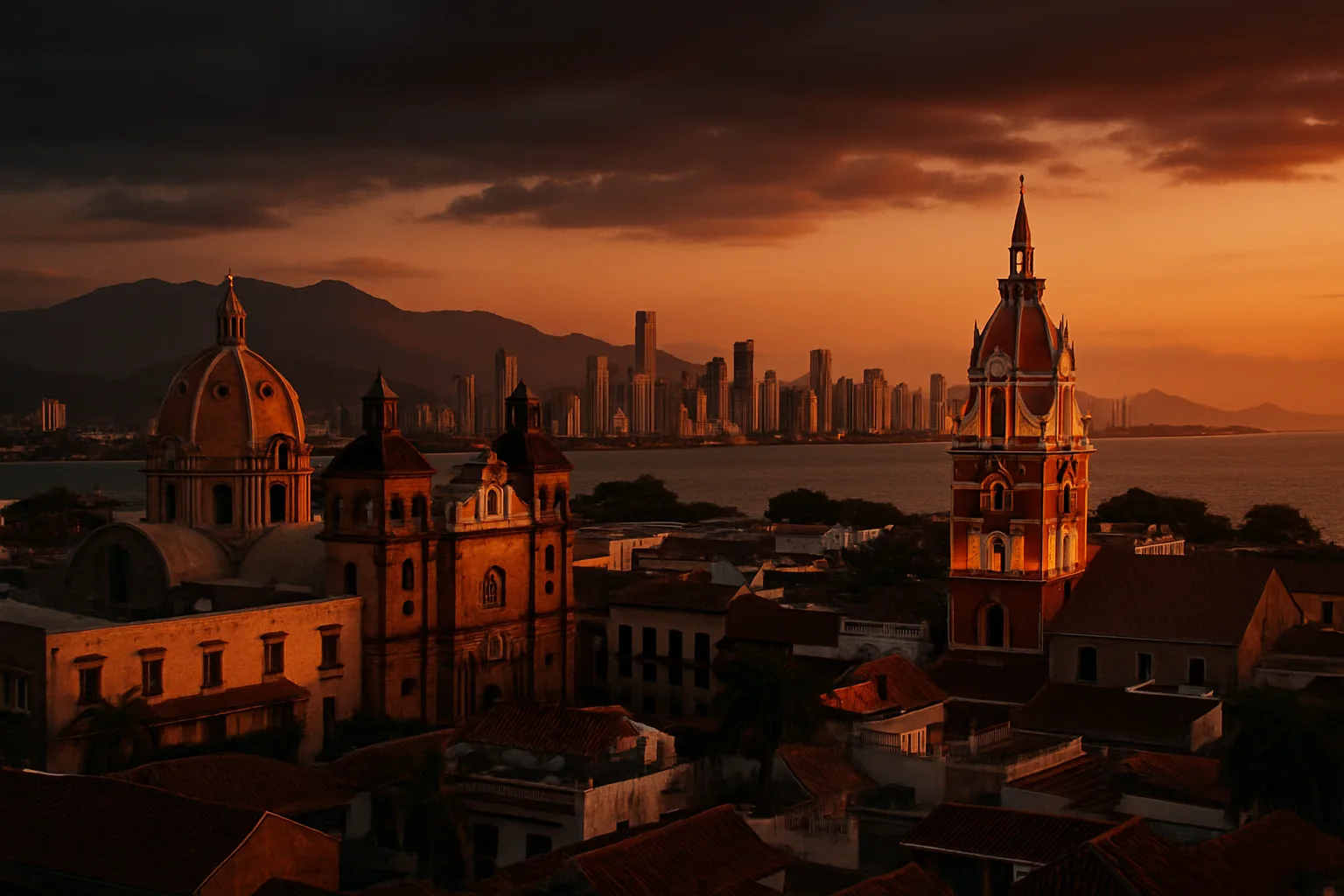
Overview
Colombia is located in the northwestern corner of South America, the only country on the continent with coastlines on both the Pacific Ocean and the Atlantic (via the Caribbean Sea). With a population of approximately 52 million people, it is the third most populous country in Latin America after Brazil and Mexico. The capital, Bogotá, sits on an Andean plateau at an elevation of 2,640 meters, making it one of the world's highest capitals.
The Colombian passport ranks 31st globally, offering visa-free access to 119 countries and territories, including the Schengen area (Europe), the United Kingdom, and most Latin American nations. For citizens from other nations, this represents a significant level of travel freedom – among the most competitive in the region.
After decades of instability, Colombia has undergone a remarkable transformation since the early 21st century. The economy has developed into a diversified base including tourism, coffee, petroleum, fresh flower exports, and a growing technology sector. Cost of living is considerably lower than North America or Europe, while healthcare quality meets international standards in major cities.
Geography & Climate
Colombia covers 1,141,748 km², bordering Venezuela and Brazil to the east, Peru and Ecuador to the south, and Panama to the northwest. The terrain is remarkably diverse, ranging from the high Andes mountain system with three parallel cordilleras (Occidental, Central, and Oriental), to Amazon lowlands, the Llanos grasslands, and tropical coastlines.
Climate in Colombia varies more by elevation than latitude. Bogotá, situated on a high plateau, enjoys a cool climate year-round (14-19°C) without distinct seasons. Medellín at a lower elevation (1,495 m) is nicknamed "the city of eternal spring," with ideal temperatures of 22-28°C. Caribbean coastal cities like Cartagena and Barranquilla are hot and humid year-round (28-32°C), similar to tropical Southeast Asian climates.
The country experiences two rainy seasons (April-May and October-November) interspersed with dry periods, though rainfall distribution is uneven. The Amazon and Pacific regions are among the wettest places on Earth, while the Guajira peninsula in the north is arid.
Colombia possesses the world's second-highest biodiversity (after Brazil), with over 1,900 bird species – more than all of North America and Europe combined. From the Amazon rainforest to desert, from snow-capped peaks to coral reefs, this geographic richness creates tremendous opportunities for ecotourism and scientific research.
Historical Development
Before Spanish arrival, the territory of Colombia was home to numerous indigenous civilizations, most notably the Muisca people on the Cundiboyacense plateau (where Bogotá now stands) and the Tayrona culture in the Caribbean region. The legend of El Dorado – the mythical golden city – originated from Muisca ceremonial practices.
In 1499, explorer Alonso de Ojeda became the first European to set foot on Colombian territory. In 1538, Gonzalo Jiménez de Quesada founded Santa Fe de Bogotá. During 300 years of Spanish rule, this region was part of the Viceroyalty of New Granada, serving as an important administrative and cultural center of the Spanish empire in South America.
The independence struggle began in the early 19th century under the leadership of Simón Bolívar. In 1819, following victory at the Battle of Boyacá, Gran Colombia was established, encompassing present-day Venezuela, Ecuador, and Panama. This federation dissolved in 1831, leaving Colombia (which retained Panama until 1903).
The 20th century witnessed multiple internal conflicts. La Violencia (1948-1958) claimed over 200,000 lives. This was followed by prolonged conflict with guerrilla organizations FARC and ELN, as well as drug trafficking organizations. The 2016 peace agreement with FARC marked a crucial turning point. Over the past two decades, Colombia has achieved significant improvements in security, economic growth, and international standing.
Culture & People
Colombians are renowned as some of Latin America's friendliest and most open-minded people. Communication culture is direct and enthusiastic – quite different from Vietnamese reserve and indirectness. Greetings involving hugs or cheek kisses (between women) are common even at first meetings.
Colombian Spanish is considered the clearest and most easily understood in the region, particularly in Bogotá. Foreign Spanish learners often praise the distinct pronunciation, lack of elision common in Argentina, and measured pace compared to Chilean Spanish. For Vietnamese speakers, learning Spanish can be easier than English due to phonetic clarity similar to Vietnamese (distinct vowels, few final consonants).
Music is the soul of Colombian culture. Cumbia, vallenato, salsa, champeta – each region has its distinctive sound. Barranquilla hosts the world's second-largest carnival after Rio de Janeiro. Dancing salsa is considered an important social skill among Colombians.
Colombian literature has made significant global contributions, most notably Gabriel García Márquez, Nobel Prize winner for "One Hundred Years of Solitude," which shaped the magical realism literary movement. Fernando Botero's distinctive paintings and sculptures featuring voluptuous figures are cultural icons.
Coffee is more than an export product – it is woven into culture. The Coffee Triangle region (Eje Cafetero) comprising Caldas, Risaralda, and Quindío is UNESCO-recognized as a World Heritage Site. Ironically, Colombians typically drink diluted coffee (tinto) during the day, quite different from Vietnam's strong, concentrated coffee tradition.
Economy & Opportunities
Colombia's economy has a GDP of approximately $340 billion (2023), ranking fourth in Latin America. The economy is diversified across several key sectors:
Agriculture & Traditional Exports:
- Coffee: Colombia is the world's third-largest producer of Arabica coffee
- Cut flowers: world's second-largest exporter, primarily to the US
- Bananas, palm oil, sugarcane
Mining:
- Crude oil and coal remain significant export commodities
- Gold and emeralds (Colombia produces 70-90% of the world's emeralds)
Services & Technology:
Bogotá and Medellín are emerging as technology hubs. Medellín, once the world's most dangerous city (1990s during Pablo Escobar's era), has transformed into "Latin America's Silicon Valley," attracting startups and international tech talent.
Tourism:
The fastest-growing sector. Cartagena (preserved colonial city), Tayrona (national park), and Caño Cristales (the "river of five colors") attract millions of international visitors.
Opportunities for Foreigners:
- Import-export: bridge between Latin America and Asia
- Real estate: prices remain low relative to the region, especially in tourism cities
- English/Asian language instruction: high demand, competitive salaries for foreign teachers
- Remote work: low costs, stable internet in major cities, convenient time zone for US collaboration
However, the economy faces challenges: high inequality, unemployment around 10%, and dependence on commodity prices.
Residency Programs
Colombia offers a Visa M investment residency – granting temporary residency status to investors in real estate or business ventures. The program costs considerably less than comparable options in Portugal, Spain, or Caribbean nations.
The process is relatively streamlined compared to regional standards. After five years of residency status, investors may apply for permanent residency (residencia permanente). The program is particularly suited for those with business interests in Latin America seeking a regional base at reasonable cost.
IMPORTANT NOTE: The Colombian government has not officially published specific minimum investment thresholds for this program, and recent changes to requirements may have occurred. QuocTich.com DOES NOT CURRENTLY ACCEPT APPLICATIONS FOR THIS CATEGORY at the present time. If you are interested in Colombian residency, we recommend contacting immigration lawyers in Colombia directly or specialized consulting firms focused on the Latin American market for the most current and accurate information.
Beyond investment residency, Colombia offers other visa categories including work visas (with employment contract), marriage visas, retirement visas (for those with pension income equivalent to three times Colombia's minimum wage), and a recently introduced digital nomad visa for remote workers.
Real Life: Costs, Healthcare, Education, Transportation
Cost of Living:
Colombia offers significantly lower costs compared to many developed nations, particularly for housing and international education:
| Item | Bogotá | Medellín | Comparison |
|---|---|---|---|
| One-bedroom apartment rent, city center | $400-600 | $350-500 | Mid-range |
| One-bedroom apartment rent, suburbs | $250-400 | $200-350 | Budget-friendly |
| Local restaurant meal | $3-5 | $3-5 | Very affordable |
| Unlimited 4G monthly plan | $15-25 | $15-25 | Reasonable |
| Monthly public transit pass | $40 | $35 | Moderate |
A family of three can live comfortably on $1,500-2,000/month in Medellín, $1,800-2,500 in Bogotá. Meat, dairy, and cheese are considerably less expensive than developed nations. Local vegetables are inexpensive, but Asian groceries are scarce and costly.
Healthcare:
Colombia's healthcare system ranks 22nd globally (WHO), significantly above many countries. It operates on two parallel tracks:
- Public: available to all residents, reasonably good quality but with lengthy wait times
- Private: international standards, many JCI-accredited hospitals, costs approximately one-third to one-half of US prices
Medical tourism is booming. Cosmetic surgery, dental work, and other procedures attract patients from the US and Europe. Private health insurance for families ranges from $150-300/month depending on age and coverage level.
Education:
The public system is free but uneven in quality. Most foreign residents choose private or international schools:
- Spanish-language private schools: $200-500/month
- International schools (bilingual or IB curriculum): $500-1,200/month
- Premium international schools (Colegio Nueva Granada, Colegio Anglocolombia): $1,500-2,000/month
Tuition is substantially lower than international schools in major Asian cities.
Quality public universities like Universidad Nacional are free or nearly free but extremely competitive for admission. Private universities such as Universidad de los Andes and Universidad Javeriana meet regional standards, with tuition of $3,000-8,000/year.
Transportation:
Bogotá has an extensive BRT system (TransMilenio) but suffers from overcrowding during peak hours. Medellín features both a subway system (Metro) and cable cars serving hillside neighborhoods – Colombia's best public transportation network. Cali has the MIO system, similar to TransMilenio.
Ride-sharing apps including Uber, Didi, Cabify, and InDriver function well with low fares (5 km approximately $2-4). Many foreigners forgo car ownership due to chaotic traffic and parking challenges.
Domestic flights are affordable: Bogotá-Medellín roundtrip costs $40-80 if booked in advance. Avianca, LATAM, and Viva Air are major carriers.
Safety:
Security has improved markedly but vigilance is necessary. Avoid high-risk areas, do not display valuables, be cautious of online scams and organized theft. Expat neighborhoods in Bogotá (Zona Rosa, Usaquén, Chapinero Alto) and Medellín (El Poblado, Envigado, Laureles) are relatively safe. Crimes targeting visitors consist primarily of petty theft and phone snatching, with violent incidents being rare.
Who Should Consider This Country
Well-Suited For:
Business owners/investors conducting operations in Latin America: If you have or wish to develop business in South America, Colombia offers an ideal hub. Geographic location, time zone alignment, regional business culture, and reasonable costs make it attractive.
Digital nomads and freelancers: Low costs, reliable internet (100 Mbps at approximately $30-40/month), abundant coworking spaces, and substantial expat communities in Medellín and Bogotá. The new digital nomad visa provides legal clarity.
Retirees on limited budgets: $1,500-2,000/month provides comfortable living with quality healthcare. Medellín's climate is ideal for seniors. However, cultural adjustment, Spanish proficiency, and distance from Vietnam require consideration.
Latin American culture enthusiasts: If you enjoy music, dancing, open people, and vibrant lifestyle – Colombia is exceptional. Year-round festivals, diverse nature, and rich cuisine create an engaging environment.
Families seeking bilingual education: International schools cost less than comparable Asian institutions, and children naturally acquire Spanish (the world's second-most spoken language) in an immersive environment.
NOT Well-Suited For:
Those requiring stable business environment and transparent legal frameworks: Colombia still has bureaucratic complexity, corruption persists, and regulations change unpredictably. Those accustomed to Singapore's efficiency, Germany's precision, or even Chile's relative order will find frustrations.
Those unable or unwilling to learn Spanish: Outside expat enclaves and premium services, English is extremely limited. Banking transactions, government interactions, medical consultations – most require Spanish competency. Daily life becomes difficult without at least intermediate proficiency.
Those dependent on Asian cuisine: Vietnamese and Asian ingredients are scarce and expensive. Colombian food culture emphasizes fried and grilled dishes with fewer vegetables. The minimal Vietnamese community (only a few hundred) means no Vietnamese neighborhoods or restaurants.
Those prioritizing absolute safety: Despite improvements, Colombia has higher crime rates than many nations. Constant vigilance is necessary; you cannot relax as you might in Singapore or Japan.
Those sensitive to humidity and insects: Many Colombian regions are humid with abundant mosquitoes and dengue, Zika risks in lowlands. Those unaccustomed to tropical climates will struggle; only Bogotá (cool but rainy) offers respite.
In summary, Colombia appeals to adaptable, adventurous individuals comfortable with cultural adjustment and willing to trade certain conveniences and safety assurances for low costs and unique Latin American living experiences.