Cambodia – A Nearby Neighbor with Relocation and Business Opportunities
Overview
Cambodia is a neighboring country to the west of Vietnam, sharing a land border of over 1,100 kilometers. With a population of approximately 17 million and the capital city of Phnom Penh, this nation carries both the ancient Khmer cultural heritage and rapid economic development over the past two decades.
The Cambodian passport ranks 73rd globally, offering visa-free access to 53 countries – lower than the Vietnamese passport (currently offering visa-free access to approximately 54–57 countries depending on timing). This means that if you are already a Vietnamese citizen, obtaining Cambodian citizenship will not meaningfully improve your international travel rights and may even limit access to certain destinations.
Cambodia attracts Vietnamese citizens primarily because of its geographic proximity (approximately 250 km from Ho Chi Minh City to Phnom Penh), low cost of living and business operations, and relatively straightforward legal environment for foreign investment. Many Vietnamese businesses have expanded into Cambodia in garment manufacturing, agriculture, construction, and services.
Geography & Climate
Cambodia lies entirely within the tropical monsoon climate zone, bordered by Thailand (to the west and northwest), Laos (to the northeast), Vietnam (to the east and southeast), and the Gulf of Thailand (to the southwest). Its area is approximately 181,000 km² – larger than southern Vietnam but smaller than Vietnam as a whole.
Main geographical features:
- Central plains: surrounding Tonlé Sap Lake (the largest freshwater lake in Southeast Asia) and the Mekong River. This is a fertile agricultural region producing rice, corn, and rubber.
- Highlands and mountains: the Cardamom and Elephant ranges to the west, and the Ratanakiri and Mondulkiri plateaus to the northeast – with mineral extraction, rubber, and cashew cultivation.
- Coastline: approximately 440 km along the Gulf of Thailand, with port cities such as Sihanoukville (also called Kampong Som).
Climate: monsoon rains from May to October (southwest monsoon winds), dry season from November to April. Average temperatures range from 25–35°C year-round, similar to southern Vietnam. The rainy season in Cambodia can be quite humid, with potential flooding in low-lying areas near Tonlé Sap.
For Vietnamese citizens, the Cambodian climate is not unfamiliar. Hot weather persists year-round, rarely dropping below 20°C at night.
Historical Background
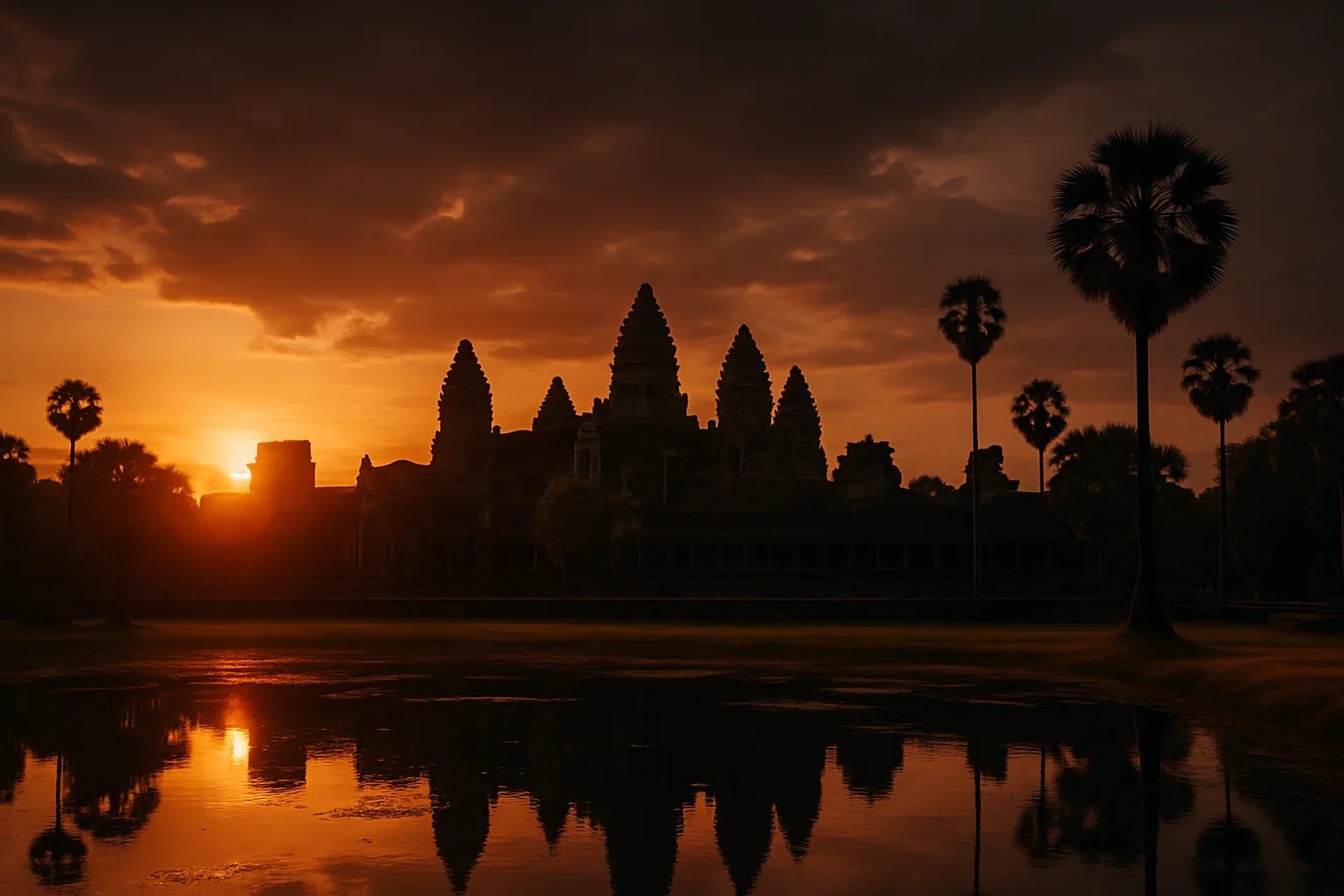
Cambodia is the inheritor of the powerful Khmer Empire, which flourished from the 9th to 15th centuries, with its most notable historical legacy being the Angkor Wat temple complex near Siem Reap – a symbol of combined Buddhist and Hindu architecture, recognized by UNESCO as a World Heritage Site.
Key historical milestones:
| Period | Event |
|---|---|
| 9th–15th centuries | Angkor Empire at its height, controlling most of Indochina |
| 16th–19th centuries | Decline, conflict with Siam (Thailand) and Đại Việt |
| 1863–1953 | French colonial rule, part of the French Indochina federation |
| 1953 | Independence under King Norodom Sihanouk |
| 1975–1979 | The Khmer Rouge regime – one of the 20th century's greatest humanitarian tragedies, claiming approximately 1.5–2 million lives |
| 1979–1989 | Vietnam-backed overthrow of the Khmer Rouge, establishment of the People's Republic of Kampuchea |
| 1993–present | Constitutional monarchy, multi-party system (nominally), ruled stably by the Cambodian People's Party |
Vietnam-Cambodia relations have a long, complex history of both cooperation and tension. Today, the two countries maintain neighborly relations, with significant trade and investment activities across the border.
Culture & People
Approximately 95% of Cambodia's population is ethnic Khmer, speaking the Khmer language (with its own script derived from the Pallava script of India). The remaining population includes the Vietnamese diaspora (approximately 5% of the population, mainly residing in Phnom Penh, Kampong Cham, and the Tonlé Sap region), Sino-Cambodians, Cham Muslims, and highland minorities.
Religion: Theravada Buddhism is the state religion, profoundly influencing lifestyle, festivals, and architecture. Most Cambodian men have served as monks at least once in their lifetime. There are also small communities of Cham Muslims and Catholics.
Language: Khmer is the official language. English is increasingly common among youth and in tourism and business sectors. Vietnamese is widely used within the Vietnamese diaspora community. French, once prevalent during the colonial period, is now spoken by few young people.
Communication culture: Cambodians tend to be gentle, polite, and respectful toward elders and religion. The traditional greeting is the sampeah (palms pressed together in front of the chest), similar to the Thai wai or the Buddhist prayer gesture in Vietnam. The pace of life is slower than in more developed ASEAN countries such as Thailand or Malaysia.
Cuisine: influenced by India, China, and Vietnam. Common dishes include amok (fish curry steamed in banana leaves), nom banh chok (Khmer noodle soup), kuy teav (tapioca noodle soup – of Chinese-Vietnamese origin), and prahok (fermented fish paste). Vietnamese residents in Cambodia readily adapt to local cuisine, as many ingredients and flavors are similar.
Economy & Opportunities
Cambodia is a lower-middle-income economy with a per capita GDP of approximately USD 1,600–1,800 (2023), lower than Vietnam (approximately USD 4,000). However, it has maintained average annual growth of 7% over the past two decades – among the fastest-growing economies in the region.
Main economic sectors:
- Garment and textiles: comprising approximately 80% of export revenues, primarily exported to the EU and the United States. Many factories are operated by Chinese, Vietnamese, and South Korean investors.
- Agriculture: rice, rubber, cashews, cassava, and corn. Cambodia is a major rice exporter (among the world's top 10).
- Tourism: Angkor Wat and the beaches of Sihanoukville attract millions of visitors annually (pre-COVID-19). This sector is recovering after the pandemic.
- Construction and real estate: Phnom Penh has seen strong investment from China, particularly in high-rise buildings, condotels, and casinos (mainly in Sihanoukville).
- Financial services and telecommunications: developing sectors with participation from multinational corporations.
Opportunities for Vietnamese businesses and individuals:
- Low labor costs: minimum wage in the garment sector is approximately USD 200 per month, lower than Vietnam (though Vietnamese wages are rising faster).
- Foreign investment incentives: Cambodia allows 100% foreign ownership in many sectors, import duty exemptions on raw materials, and profit tax holidays of 3–9 years depending on location.
- Geographic proximity to Vietnam: facilitates management from Vietnam and cross-border goods transportation.
- Strong trade relations: Vietnam is among Cambodia's top 5 trading partners.
- Services for the Vietnamese diaspora: education, healthcare, restaurants, and legal consulting have steady demand.
Risks to consider: underdeveloped legal system, widespread corruption, and unstable infrastructure in many provinces.
Relocation & Residency Programs
Cambodia offers citizenship-by-investment or government contribution programs, but we do not accept applications for this program.
Important caveat: the Cambodian passport is less valuable than the Vietnamese passport for international travel on certain routes. The Cambodian passport currently offers visa-free access to 53 countries, while the Vietnamese passport offers access to approximately 54–57 countries. If your primary objective is to enhance international travel rights, this is not a suitable solution. You may lose visa-free access to certain ASEAN or Asian countries where the Vietnamese passport currently provides benefits.
This program is more suitable for those who:
- Already operate a long-established business in Cambodia and wish greater convenience in land ownership or business operations (as certain sectors restrict foreign ownership).
- Need a second nationality for personal reasons (family, property) but do not prioritize international travel.
- Wish to maintain cultural and geographic ties to Vietnam while leveraging Cambodia's tax or business policies.
Costs, specific conditions, and processing times have not been clearly disclosed and vary by case. Much information circulating online about this program lacks transparent legal foundation. You should seek direct consultation from a Cambodian lawyer or competent government agencies before making any decision.
Alternative residence options (not involving citizenship):
- Business visa (E-visa, Business visa): easy to obtain, renewable multiple times, costing approximately USD 35 per month or USD 300 per year. Suitable for those wishing to stay long-term for business or work.
- Retirement visa: for those aged 55 and above, costing approximately USD 300 per year, requiring proof of stable retirement income.
- Work permit: requires an employment contract with a Cambodian company that will serve as sponsor.
In summary, Cambodia is not an ideal destination if you are seeking a second citizenship to enhance global travel rights. Consider alternative CBI/RBI programs offering stronger passports if that is your primary objective.
Living Reality: Costs, Healthcare, Education, and Transportation
Cost of Living
Cambodia is 10–20% less expensive than Vietnam for many items, though imported goods (electronics, automobiles, luxury items) may be more expensive due to tariffs.
Estimated monthly living costs in Phnom Penh (USD, 2024):
| Expense Category | Cost (USD) |
|---|---|
| One-bedroom apartment (city center) | 400–700 |
| One-bedroom apartment (suburban area) | 250–400 |
| Utilities (electricity, water, internet) | 50–80 |
| Food (cooking at home + occasional dining out) | 200–350 |
| Transportation (motorbike, fuel, or tuk-tuk) | 50–100 |
| Entertainment, sports | 50–150 |
| Total (1 person) | 1,000–1,800 |
Compared to Ho Chi Minh City or Hanoi, rental costs in Phnom Penh are comparable or slightly lower. Street food is very inexpensive (USD 1–2 per meal), but Western or imported restaurants cost about the same as in Vietnam.
Healthcare
Cambodia's public healthcare system remains weak, lacking equipment and trained personnel. Foreigners and affluent Cambodians typically use private hospitals or travel to Thailand or Vietnam for medical care.
International hospitals in Phnom Penh:
- Royal Phnom Penh Hospital
- Sunrise Japan Hospital
- Raffles Medical Phnom Penh
Consultation costs: USD 30–80 per visit. Major surgeries, cancer treatment usually require travel to Bangkok or Ho Chi Minh City. International health insurance is highly recommended for long-term residents.
Education
The public education system uses Khmer and is of limited quality. Foreigners and wealthy Cambodian families typically choose international schools.
Popular international schools in Phnom Penh:
- International School of Phnom Penh (ISPP) – tuition approximately USD 15,000–25,000 per year.
- Northbridge International School Cambodia (NISC) – USD 12,000–22,000 per year.
- Zaman International School – USD 8,000–15,000 per year.
Tuition is slightly higher than international schools in Vietnam but with fewer options. Many Vietnamese diaspora families send their children to school in Vietnam or opt for Vietnamese-English bilingual schools.
Transportation
Domestic: road transportation is primary; major highways have been improved. Long-distance buses are inexpensive (USD 5–10 for long journeys) but low-quality. Many people use personal motorcycles or rental vehicles. There is no extensive domestic passenger rail network.
International: Phnom Penh (PNH) and Siem Reap (REP) airports have flights to Bangkok, Singapore, Kuala Lumpur, Ho Chi Minh City, Hanoi, Seoul, and Guangzhou. Fares are comparable to or slightly higher than from Vietnam due to Cambodia's smaller airport capacity and limited competition.
Visa-free destinations for Cambodian passport holders:
- ASEAN: visa-free short-term stay in most countries (Myanmar has recently restricted entry).
- Asia: South Korea, Japan, China, and Taiwan require visas.
- Europe: Schengen zone requires a visa.
- Americas: The United States and Canada require visas.
As noted, if you are a Vietnamese citizen, switching to a Cambodian passport provides no advantage for international travel and may even be less convenient.
Security & Living Environment
Phnom Penh and Siem Reap are relatively safe for foreigners, though theft and robbery rates are higher than in Hanoi or Ho Chi Minh City. Care should be taken with bags and phones on the street. Corruption in government agencies is common, complicating administrative processes and legal disputes.
Air quality in Phnom Penh is moderate; during the dry season, dust is abundant. Tap water quality is not safe for direct consumption; bottled or filtered water is recommended.
Who Should Consider This Country
Suitable for:
- Entrepreneurs with existing or planned business expansion in Cambodia: particularly in garment manufacturing, agriculture, construction, and services. Geographic proximity to Vietnam simplifies management and costs are low.
- Those wishing to live near Vietnam while leveraging Cambodia's tax and investment policies: some businesses choose Cambodia as their regional headquarters due to lower tax rates and simpler procedures (though less transparent).
- Those with family and property already established in Cambodia: many Vietnamese migrated to Cambodia starting in the 1980s–1990s and are now settled; they may seek citizenship for convenience in land ownership or citizen benefits.
- Those needing a second nationality for specific personal reasons (for example, avoiding military service, managing complex inheritance issues) without prioritizing international travel.
- Those preferring a slower pace of life, low costs, and proximity to nature: areas like Siem Reap, Kampot, and Kep have small expat retiree communities living peacefully at very low cost.
NOT suitable for:
- Those seeking a strong passport for global travel freedom: the Cambodian passport is weaker than or equal to the Vietnamese passport and opens no new opportunities. If this is your goal, consider Caribbean CBI programs (Dominica, St. Lucia, Grenada) or European options (Malta, Portugal) offering visa-free access to 140–180+ countries.
- Those requiring world-class healthcare and education: Cambodia lags far behind Thailand, Malaysia, and Singapore. International school tuition is high but quality does not match Bangkok or Kuala Lumpur standards.
- Those uncomfortable with an opaque legal environment: Cambodia has many gray areas in law, corruption, and weak intellectual property protection. If you value clear rule of law, this is not an ideal location.
- Those desiring modern infrastructure and services: Phnom Penh is developing rapidly but remains far behind Hanoi or Ho Chi Minh City in public transportation, telecommunications, and government services.
- Those expecting long-term political stability by Western democratic standards: Cambodia is effectively a one-party state with restricted freedom of speech and press.
In short, Cambodia is a practical choice for those already committed to or with specific economic interests in the country, particularly Vietnamese businesses expanding into the market. However, if you are seeking a second citizenship to improve quality of life, international travel rights, or legal transparency, you should carefully explore alternative options before investing time and money in Cambodia.
Disclaimer: All information in this article is for reference purposes only, based on publicly available data and the practical experience of the Vietnamese community in Cambodia. Immigration policies, investment regulations, and tax laws are subject to change. For an accurate assessment of your individual situation, please consult with a certified immigration consultant or licensed lawyer in Cambodia.