Overview
Antigua and Barbuda is a two-island nation in the eastern Caribbean, part of the Leeward Islands group. With an area of 442 km² and a population of approximately 94,000, the capital St. John's is located on the island of Antigua.
The country markets itself with an easy-to-remember number: 365 beaches — one for each day of the year. While promotional in spirit, the figure reflects geographic reality: Antigua's coastline is highly convoluted with numerous sheltered bays, creating countless small sandy coves.
Within the Caribbean CBI program group, Antigua has two genuinely distinctive features worth serious consideration:
First, it is the only program in the region with a residency requirement — 5 days within the first 5 years. Superficially inconvenient, but in reality an asset: it prevents Antigua's passport from being dismissed as "purely purchased citizenship" by third-country immigration authorities.
Second, Antigua offers the University of the West Indies Fund, a contribution mechanism designed specifically for large families — priced per family unit rather than accumulated per individual as with standard options.
Geography & Climate
Antigua is the main island, with low hilly terrain, mostly limestone and raised coral, highest point only 402 m. Few rivers or streams, minimal forest — significantly drier than Grenada or Dominica.
Barbuda lies approximately 50 km to the north, nearly completely flat, sparsely populated, famous for pink sand beaches and the western hemisphere's largest frigatebird sanctuary.
Tropical dry climate, 25–31°C year-round, with constant trade winds. Rainfall is lower than many other Caribbean islands — Antigua regularly faces freshwater shortages and depends on seawater desalination.
Hurricane risk — stated plainly and specifically: In September 2017, Hurricane Irma, Category 5, swept through Barbuda and destroyed approximately 95% of structures on the island. The entire Barbuda population was evacuated to Antigua — the first time in modern history that the island was completely unpopulated. Reconstruction has taken years and remains ongoing.
Antigua sustained significantly lighter damage but remains in the hurricane belt. If purchasing property, ask specifically about structural standards, construction date, and most importantly disaster insurance — Caribbean insurance costs have risen substantially since 2017.
Historical Development
Arawak, then Kalinago peoples inhabited the islands before Columbus named Antigua in 1493 after a church in Seville.
The English occupied the islands from 1632 and maintained control nearly continuously — unlike many Caribbean islands that changed hands repeatedly between English and French powers. This explains why Antigua's culture and institutions bear a distinctly English mark, more thoroughly than most.
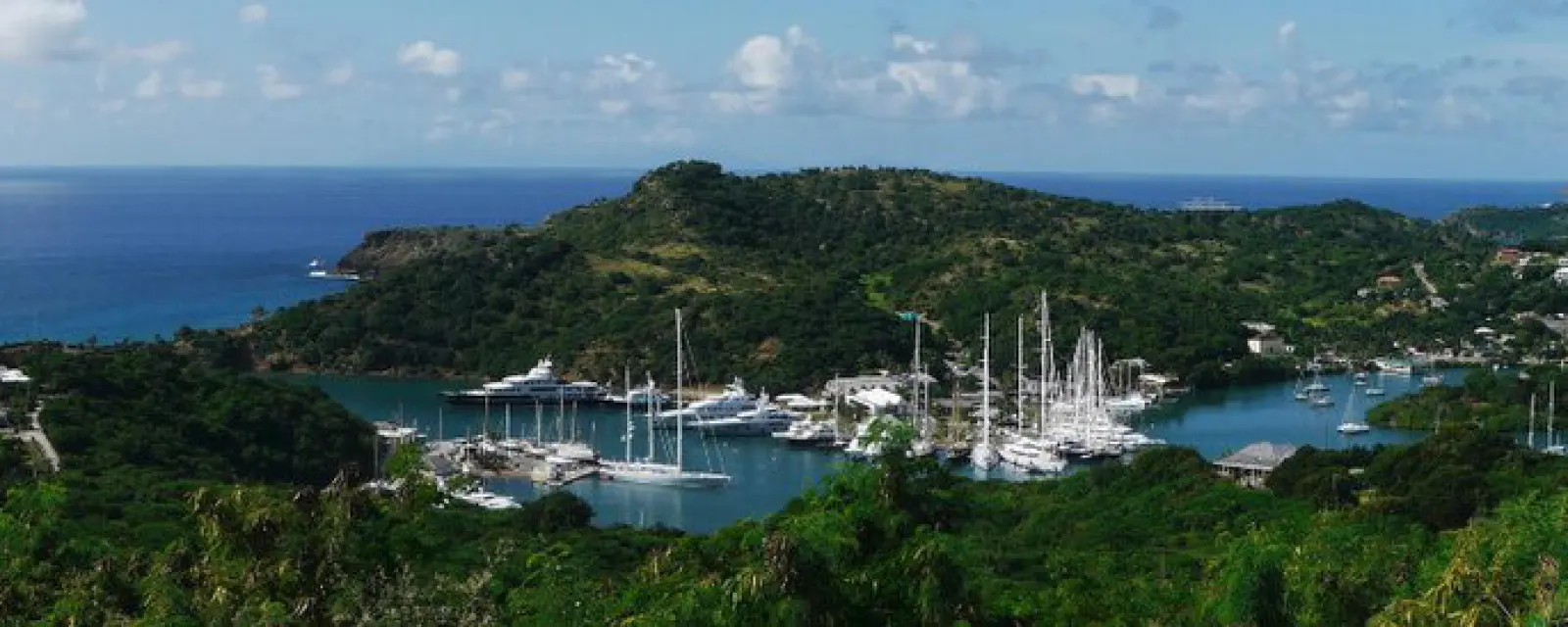
Naval significance is a defining feature: English Harbour on Antigua's southern coast is a deep, sheltered anchorage — the Royal Navy's premier Caribbean base. Nelson's Dockyard — the preserved sailing-era naval yard still in operation — is now a UNESCO World Heritage Site. Admiral Horatio Nelson was stationed here.
Colonial economy centered on sugar and enslaved labor. Slavery was abolished in 1834.
Independence on November 1, 1981, as a constitutional monarchy within the Commonwealth, inheriting the English common law legal system.
Culture & People
English is the official language, used throughout government, education, and commerce. Residents speak Antiguan Creole in daily life.
Society reflects a blend of Afro-Caribbean heritage with strong English institutional influence. Anglicanism and evangelical Protestantism predominate. Cricket is a point of national pride — Antigua produced legendary West Indies cricketers, including Sir Viv Richards. The stadium bearing his name draws cricket enthusiasts from worldwide.
The largest festival is Carnival in late July and early August, commemorating the abolition of slavery.
Sailing culture is distinctly prominent. Antigua Sailing Week ranks among the world's largest yacht racing events, and English Harbour hosts luxury yachts from around the globe. This creates a year-round international resident community, particularly seasonal, unlike most other small islands.
No substantial Vietnamese community exists.
Economy & Opportunities
Tourism dominates GDP — luxury resorts, yachting, and cruise ship calls at St. John's. Antigua positions itself in the premium Caribbean segment.
Marine services are a specialized niche: repairs, maintenance, logistics for larger vessels. English Harbour and Falmouth Harbour are leading yacht service centers in the region, creating skilled technical year-round employment.
Financial services and citizenship investment programs contribute meaningfully to government revenue.
International education: Antigua hosts a campus of the University of the West Indies and several schools serving North American students, creating steady rental housing demand.
Currency is the East Caribbean Dollar (XCD), pegged at 2.70 XCD = 1 USD.
No personal income tax, no inheritance tax, no capital gains tax for non-residents. Important caveat: this does not automatically exempt you from tax obligations in Vietnam or your actual place of residence.
Residency Programs
The program has operated since 2013. Main options include:
National Development Fund (NDF) contribution — a non-refundable donation to the national development budget.
University of the West Indies (UWI) Fund — Antigua's unique option, designed for families of six or more. Priced per family rather than per individual, and includes one year of scholarship at the University of the West Indies for one family member. For multi-generational families, this typically delivers substantial cost savings compared to other pathways.
Real estate investment in approved development projects, subject to minimum holding periods.
Business investment approved by government.
Applications include spouse, dependent children, and parents and grandparents subject to statutory conditions.
The 5-Day Residency Requirement — Understood Correctly
This is Antigua's distinguishing feature among all Caribbean CBI programs: citizenship grantees must be physically present in Antigua for a combined total of 5 days within the first 5 years.
Many consultants frame this as a burden. Viking Global Group sees it differently: 5 days across 5 years is virtually no hardship — one family vacation covers it. In exchange, this requirement genuinely helps Antigua's passport maintain stronger credibility with third-country immigration officials, as it proves genuine connection to the issuing nation.
As Caribbean CBI programs face mounting international scrutiny, this is an asset, not a liability.
Antigua passport visa-free access: Visa-free or port-of-entry access to most of Europe including the Schengen area, the United Kingdom, Russia, Singapore, Hong Kong, and numerous Asian, African, and Latin American countries.
Antigua has no E-2 treaty with the United States — citizens must apply for U.S. visas through standard channels.
On specific figures: contribution amounts per fund, real estate thresholds, due diligence fees, and processing times change with regulation; OECS nations have coordinated increases to minimum thresholds from 2024 onward. Consult the current rates table on this page or speak with a specialist.
Life in Practice
Cost of living is notably higher than Vietnam and above average for the Caribbean due to premium positioning. Imported goods are expensive. Freshwater and electricity are two significant expenses — Antigua faces water scarcity relying on desalination, and electricity runs on imported diesel.
Healthcare: Sir Lester Bird Medical Centre in St. John's is the primary facility, alongside several private clinics. Complex cases typically transfer to the United States or Trinidad. International health insurance is mandatory for long-term residents.
Education: Public schools teach in English following the Caribbean CXC/CSEC curriculum. Small private and international schools exist. The University of the West Indies campus in Antigua awards degrees recognized throughout the Commonwealth.
Travel: V.C. Bird International Airport is one of the eastern Caribbean's strongest air hubs, with direct flights to New York, Miami, Atlanta, Toronto, London, and many neighboring islands. This is a genuine advantage over smaller islands.
From Vietnam there are no direct flights — at least two connections required, totaling 24–30 hours. Time difference is 11 hours.
Who Should Consider Antigua & Barbuda
Well suited if you:
- Have a large family — the University of the West Indies Fund is priced per family, often delivering significant savings versus per-person accumulation
- Value passport authenticity — the 5-day residency requirement prevents your passport from being dismissed as "purely purchased" in an increasingly scrutinizing international environment
- Travel frequently and need strong air connectivity — Antigua's airport connects better than peer small Caribbean islands
- Are interested in yachting and maritime activities — Antigua has genuine marine service infrastructure
- Want a second passport for convenient visa-free travel in Europe and the UK, without relocation
Not well suited if:
- Your goal is operating a business in the United States — Antigua lacks an E-2 treaty; consider Grenada
- You need frequent China access — Grenada has visa-free arrangement with China; Antigua does not
- You absolutely refuse any travel to the island, even 5 days across 5 years
- You are risk-averse about hurricanes — Barbuda was 95% destroyed by Hurricane Irma in 2017; regional insurance costs have risen significantly
- You require advanced medical specialists on-island, or want an established Vietnamese community
- You expect real estate appreciation and quick liquidity — the market is small with low turnover
This article provides foundational reference information. Regulations governing investment, fees, and application requirements change over time. Please consult with a Viking Global Group specialist before making a decision.