Overview
Samoa holds a rank-35 passport reaching 115 destinations without a prior visa — a high placing among Pacific island states. Its population is around 220,000, the capital is Apia, and the currency is the Samoan tala (WST).
Samoa has no citizenship or residence programme by investment.
But the article is worth reading for three things, and the third is among the strangest facts in the entire field of citizenship:
✅ One — Samoa holds a DEDICATED migration quota to New Zealand, a mechanism very few countries have.
🔴 Two — 81% of Samoan land is customary land, which cannot be sold, not even between Samoans.
📌 Three — next door sits American Samoa, the ONLY place on earth producing "US nationals" who are not US citizens.
🔴 The Samoan Quota to New Zealand — the actual mechanism
New Zealand operates the Samoan Quota — a dedicated immigration category for Samoan citizens, with roughly 1,100 places a year, selected by ballot among valid registrations. Those drawn who meet the employment, health and character requirements receive residence in New Zealand.
Separately, several other Pacific island states use the Pacific Access Category, a comparable mechanism with smaller numbers.
State the limits clearly, because this is easily embellished:
📌 The quota is for SAMOAN CITIZENS. No route exists by which a foreigner moves to Samoa and accesses it. And Samoan citizenship, as set out below, is chiefly by descent.
📌 It is a ballot, not an entitlement. Selection is a matter of probability, and the places are few relative to demand.
A piece of history still unresolved
Samoa was administered by New Zealand from after the First World War until 1962. During that period, a body of Samoans were, in law, New Zealand citizens.
In 1982, a Privy Council decision (then New Zealand's final court) confirmed this for those born between 1924 and 1949. New Zealand promptly passed legislation in 1982 removing that status from most of the group.
📌 The matter has not closed: in recent years New Zealand has revisited and debated restoring citizenship to that 1924–1949 cohort and their descendants under defined conditions. This is a changing area — anyone potentially affected should check the rules currently in force with New Zealand immigration rather than relying on older reporting.
Across this library, it is the clearest illustration of a point made in the Micronesia article: a right conferred by statute or treaty is a right that statute can take back. In Micronesia it was welfare entitlements; here it was citizenship itself.
🔴 American Samoa — the strangest citizenship status anywhere
The Samoan archipelago was divided in 1899: the western portion went to Germany, then to New Zealand, and became independent Samoa; the eastern portion became American Samoa, still an unincorporated territory of the United States.
Here is what matters, because nowhere else in the world works this way:
🔴 People born in American Samoa are "US nationals" — but NOT "US citizens".
What that means in practice:
- ✅ They hold US passports and may live and work in the United States without limit.
- 🔴 But they cannot vote in federal elections, cannot stand for many offices, and are ineligible for employment requiring citizenship.
- 📌 To become full US citizens they must naturalise like foreigners — while already holding a US passport.
They are the only group in the world in this position. Every other US territory — Puerto Rico, Guam, the US Virgin Islands, the Northern Marianas — produces US citizens.
📌 Why is American Samoa different? In substantial part because Samoans there wish it to remain so: the current status shields the customary land system and the matai structure from US constitutional provisions on equal protection and property, which could force land open. Litigation seeking recognition of citizenship has been brought, and the American Samoan government opposed it for that reason.
Within this series, this is the most valuable illustration of a single proposition: "holding a country's passport" and "being that country's citizen" are not always the same thing. Anyone hearing a pitch built on a passport, without asking what status accompanies it, should remember this case.
Geography & climate
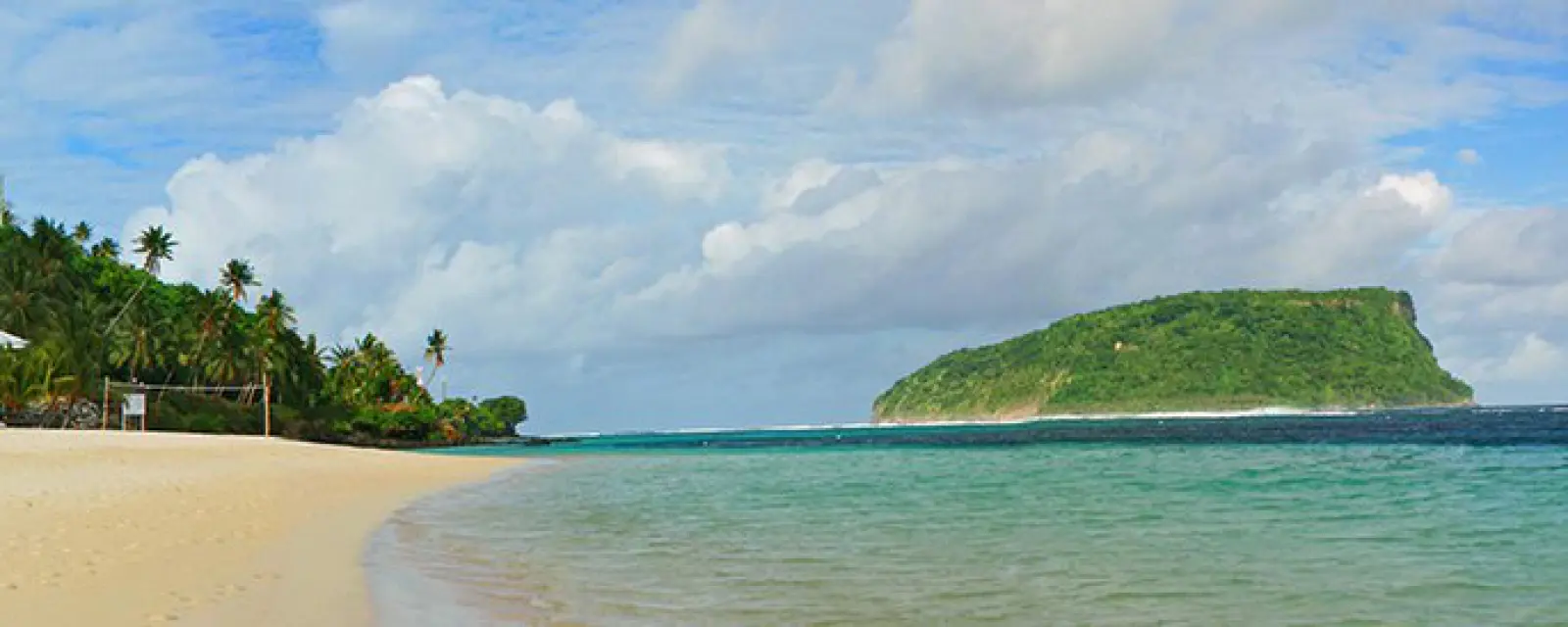
Samoa comprises two main islands — Upolu (home to Apia and the international airport) and Savai'i — plus several smaller ones. These are volcanic islands, not coral atolls: mountains, rainforest, waterfalls and fertile soil. Savai'i has seen volcanic activity in recent historical times.
The climate is tropical with a wet season roughly November to April, and Samoa lies within the South Pacific cyclone belt. Cyclones Ofa (1990) and Val (1991) caused severe damage.
📌 Unlike Tuvalu, Kiribati or the Marshall Islands, Samoa does not face loss of territory to sea-level rise — the terrain is high. Its climate risk is cyclones, landslides and tsunami, not disappearance. The 2009 tsunami, which killed hundreds across Samoa and American Samoa, is a severe reminder.
Two changes Samoa made that the world remembers
1. Switching which side of the road to drive on, 2009. On 7 September 2009 Samoa moved from driving on the right to driving on the left — one of very few countries ever to do so, and effectively the only one to move in that direction in modern times. The reason was practical: to import cheap used cars from New Zealand, Australia and Japan rather than expensive ones from the United States.
2. Jumping the date line, 2011. Samoa eliminated 30 December 2011 entirely — that day did not exist in Samoa — moving from the eastern to the western side of the International Date Line. The reason was equally practical: Samoa had been 21 hours out of step with Australia and New Zealand, so Apia's working days fell on its partners' weekends. After the change, Samoa shares dates with its principal trading partners.
📌 Both are worth remembering because they say the same thing about small states: when trade depends on a handful of countries, you adjust your traffic laws and your calendar to match.
History
Polynesians settled Samoa some three thousand years ago, and Samoa is regarded as one of the cradles of Polynesian culture.
Late nineteenth-century rivalry between Germany, Britain and the United States produced the partition of 1899. The west went to Germany; after the First World War it passed to New Zealand under a mandate.
The New Zealand administration carries one grave stain: the 1918 influenza pandemic entered Samoa via an unquarantined ship and killed roughly a fifth of the population. That event, together with the non-violent Mau independence movement, shaped relations between the two countries for decades. New Zealand issued a formal apology in 2002.
Samoa became independent on 1 January 1962 — the first Pacific island nation to gain independence in the modern era, opening the path for the region.
Economy
Samoa's economy rests on four sources, none of them heavy industry:
1. Remittances. The Samoan communities in New Zealand, Australia and the United States outnumber the resident population, and transfers home constitute a very large share of household income. This is an economy where migration quotas and remittances are directly linked — those who leave under the New Zealand quota are those who send money back.
2. Agriculture and fisheries. Coconut, taro, banana, cocoa, tuna. Fertile volcanic soil is a genuine advantage over coral atolls.
3. Tourism. Moderate in scale, drawn mainly from New Zealand, Australia and Samoans abroad visiting family.
4. Development assistance. From New Zealand, Australia, Japan and multilateral bodies.
Samoa graduated from the UN's least-developed-country category in 2014 — a milestone very few Pacific island states have reached.
As always: tax obligations here do not replace those in your country of residence.
Culture & people
Samoan and English are both official; English is used in administration, education and commerce.
Fa'a Samoa — "the Samoan way" — remains a living framework of social organisation. At its centre is the matai system: each extended family holds one or more matai, title-holders who administer the family's land and represent it in the village council. 📌 Institutionally notable: only matai title-holders may stand for most parliamentary seats — a political structure unlike any other country's.
🔴 Customary land accounts for roughly 81% of the national territory. It belongs to extended families, is administered by matai, and cannot be sold — not even between Samoans. Foreigners cannot buy land in Samoa; they may only lease under legally permitted mechanisms.
Samoa shares this with Palau, the Marshall Islands, Micronesia and Tuvalu, but here the proportion is higher and the structure tighter. Anyone planning around buying land should stop at the first step.
Society is bound closely to the church, and obligations to church and extended family are a real component of household budgets.
There is essentially no Vietnamese community in Samoa.
Immigration routes
No investment programme.
Categories existing in law include employer-sponsored work permits, residence through marriage, and small-scale business investment assessed case by case. In a market of 220,000, realistic opportunity is limited.
Citizenship
Chiefly by descent. Naturalisation for foreigners exists but requires a long residence period and case-by-case assessment; numbers are very small.
🔴 To repeat: the New Zealand quota is for Samoan citizens. If anyone offers you "Samoan citizenship to reach New Zealand", stop — it is the same pattern as "Palauan citizenship for US access" and "Micronesian citizenship for US access" warned against in earlier articles.
Everyday life
Living costs are moderate by Pacific standards — lower than Palau or the Marshall Islands because domestic agriculture is stronger, though imported goods remain expensive.
Healthcare: a national hospital in Apia; specialist cases transfer to New Zealand or Australia. International health insurance with medical evacuation cover is mandatory.
Education: a public system in English and Samoan; the National University of Samoa is in Apia, and the University of the South Pacific maintains a campus here. Higher study usually means New Zealand or Fiji.
Connectivity: Faleolo International Airport on Upolu has direct services to Auckland, Sydney, Brisbane, Nadi and Honolulu — markedly better connected than Micronesia, the Marshall Islands or Tuvalu elsewhere in this library.
Internet: substantially improved by submarine cable connections from the mid-2010s.
Safety: serious crime is low.
🔴 Risks to know: annual tropical cyclones, tsunami (2009), and the 2019 measles epidemic, which killed dozens of children after immunisation coverage fell — a severe public-health event and a reminder of how thin health systems are in small island states.
Who should consider Samoa
It may fit if:
- You have Samoan family — the most realistic route by far.
- You work in development assistance, tropical agriculture, fisheries or public health in the Pacific with a specific project.
- You want a slower Pacific life with good air connections and accept never owning land.
Not a fit if:
- 🔴 You are offered "Samoan citizenship to reach New Zealand": the quota is for Samoan citizens, citizenship is chiefly by descent, and there is no investment programme. A fraud indicator.
- You want to buy land: 81% is customary land that cannot be sold, and foreigners cannot buy land at all.
- You need a substantial labour market or specialist healthcare.
But the article is worth reading even if you never go to Samoa, for the two lessons it carries: citizenship conferred by statute can be removed by statute (1982), and holding a country's passport does not necessarily make you its full citizen (American Samoa). Both apply far beyond Samoa.