Overview
The Marshall Islands holds a rank-38 passport with 111 destinations reachable without a prior visa. It is a central Pacific island nation of around 42,000 people.
As explained in the Palau article, it is one of three countries holding a Compact of Free Association (COFA) with the United States:
✅ Marshallese citizens may live, work and study in the United States indefinitely without a visa. Substantial Marshallese communities exist in the US, particularly in Arkansas, Hawaii and Oregon.
But this article carries a more instructive point of its own, one that adds to a pattern already visible across this series:
🔴 The Marshall Islands DID operate a passport-sale programme in the 1990s, and had to terminate it.
And the reason is the part worth reading: the compact with the United States itself became the pressure point. Because Marshallese citizens hold the right to enter and reside in the US, selling citizenship to foreigners meant selling a route into the United States — and that could not coexist with the very compact creating that right.
This exactly repeats the logic set out in the Moldova article:
When a country combines privileged access to a large market with the sale of citizenship, that access becomes the pressure point. Moldova's programme closed because of its Schengen visa-free access. The Marshall Islands' closed because of its US residence rights. The same mechanism, two regions, two decades apart.
Adding Seychelles (forced to abandon under international pressure), Nauru (UK revocation), and St Vincent (refusing to create one at all), there are now five cases — enough to call this a rule rather than a series of incidents.
The Marshall Islands currently has no citizenship-by-investment programme.
Geography & climate
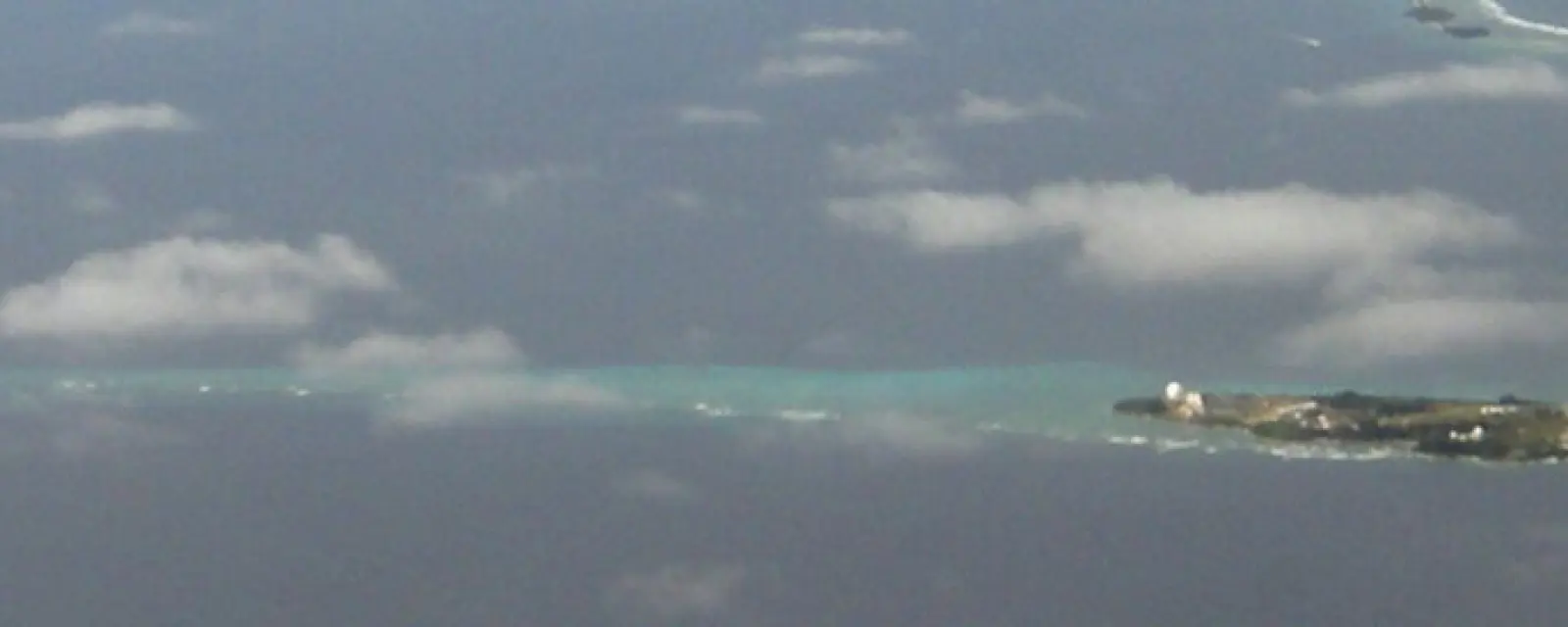
The Marshall Islands comprises more than a thousand islands and islets arranged into 29 atolls and 5 solitary islands, spread across a very wide area of the central Pacific.
The capital, Majuro, holds most of the population, alongside Ebeye island.
🔴 This is among the countries most severely threatened by sea-level rise. Average elevation is only about two metres above sea level, and most of the land is narrow strips along atoll rims. Tidal flooding has occurred repeatedly, and groundwater faces salinisation risk.
This is not a distant scenario: the Marshallese government has been among the strongest voices at international climate conferences for decades, and the country has published long-term adaptation plans including raising land levels.
The climate is tropical, hot and humid year-round, outside the main typhoon belt but still exposed to extreme weather.
🔴 The nuclear testing legacy — history that must be stated
This is the country's most consequential historical chapter, and anyone researching seriously should know it.
After the Second World War the Marshall Islands formed part of the US-administered Trust Territory of the Pacific Islands. Between 1946 and 1958, the United States conducted 67 nuclear weapons tests at Bikini and Enewetak atolls.
Among them was Castle Bravo in 1954 — the largest nuclear test the United States ever conducted, with a yield far exceeding predictions, spreading contamination to inhabited islands and to a Japanese fishing vessel.
The consequences persist:
- Residents of several islands were displaced and many communities have never been able to return — Bikini remains unsafe for permanent settlement.
- Health consequences have been documented across generations.
- The Runit Dome on Enewetak — where contaminated material was buried under a concrete cap — is a recurring subject of concern regarding deterioration and sea-level rise.
This is stated as historical fact. It is necessary to understand the country's relationship with the United States, and why climate and environmental questions carry particular weight here.
Culture & people
Marshallese and English are both official, and English is widely used in education, administration and business — no new language to learn.
Traditional society is matrilineal, with land rights passing through the maternal line. Traditional clan and chiefly systems retain genuine authority, particularly over land — as in Palau.
Marshallese have a powerful maritime tradition: stick charts, used to teach the patterns of swells and currents between islands, are among the most distinctive navigation systems ever recorded.
A large Marshallese community lives in the United States — a direct consequence of the Compact, and of displacement from nuclear testing.
The Vietnamese community in the Marshall Islands is very small.
Economy & opportunity
The economy rests on four sources:
- Compact assistance from the United States.
- Fishing licence fees — a very large exclusive economic zone rich in tuna.
- Remittances from the US community.
- Ship registration — and this is little known: the Marshall Islands operates one of the world's largest ship registries. A great many international commercial vessels fly the Marshallese flag. The registry is administered through an office abroad and provides steady revenue.
Local employment opportunities for foreigners are very limited — a market of 42,000. Positions typically relate to maritime affairs, fisheries, development assistance and specialist services.
Currency: the US dollar, so no exchange risk.
Living costs are high — a small, remote island group importing almost everything.
As always: tax obligations here do not replace those in your home country.
Immigration routes
No citizenship-by-investment programme — as noted, the old scheme ended with no successor.
The routes:
- Work permits — employer-sponsored; a very small market.
- Residence through business activity — a framework exists for foreign investment, with sectoral restrictions.
- Residence through marriage to a citizen.
On land ownership
As in Palau and much of the Pacific: land rights are tightly bound to traditional clan systems and are not open to foreign ownership. Leasing is the available form, and establishing who has authority to lease can be complex, because it involves lineage rather than administrative registration alone.
Anyone considering any land transaction here needs a local lawyer and needs to understand the traditional rights structure beforehand, not afterwards.
Citizenship
Naturalisation for foreigners exists in law but is very limited and rare, with residence requirements and a discretionary decision. Rules on holding multiple nationalities should be checked specifically at the time of applying — as the Bosnia article noted, "country X allows dual citizenship" is always too short a statement to rely on.
And the most important point, repeated from the outset: the right to live and work in the United States under the Compact is not something that can be bought. The programme that once sold it was closed, and the compact is why.
If anyone offers you a Marshall Islands passport as a route into the United States, that is a serious warning sign.
Everyday life
Living costs are high; imported goods are expensive and supply depends on shipping schedules.
Healthcare: local facilities are limited. For specialist cases the standard approach is flying to Hawaii, Guam or the Philippines. International health insurance with medical evacuation is effectively mandatory.
Education: an English-language public system with very limited choice. Students typically continue abroad, and Compact rights make studying in the United States practical for Marshallese.
Connectivity: limited air routes, mainly via Guam, Honolulu and regional islands. Travel to Southeast Asia is a very long multi-leg journey.
Internet: limited and expensive; unsuitable for bandwidth-dependent work without verifying conditions first.
Safety: serious crime is low.
Fresh water: dependent on rainfall and desalination; droughts have caused severe shortages. This is a real living condition to know.
Very small scale: 42,000 people means every choice is clearly limited, and the sense of isolation is real.
Who should consider the Marshall Islands
A good fit if:
- You work in maritime affairs, ship registry, fisheries, or development assistance and climate research — the areas where this country has a genuine role.
- You already have ties to the country or the region.
Not a fit if:
- 🔴 You are offered a Marshall Islands passport as a route into the United States: the passport-sale programme ended in the 1990s, and the compact with the US is precisely why it had to close. This is a serious warning sign.
- You intend a land transaction without understanding the traditional clan-based rights structure.
- You need a labour market, healthcare, education or internet at even a normal country's minimum.
- You are making multi-decade asset plans without accounting for sea-level risk in a country averaging around two metres of elevation.