Overview
Palau holds a rank-40 passport with 108 destinations reachable without a prior visa. It is a western Pacific island nation of around 18,000 people — and Ngerulmud, its capital, is the least populous capital city in the world.
But that figure of 108 destinations entirely fails to capture what this passport's greatest value actually is:
✅ Palauan citizens may live, work and study in the United States indefinitely WITHOUT a visa.
This is not visa-free tourism. It is the right to reside and work on US soil, with no time limit, no employer sponsorship, and no green card queue. It comes from the Compact of Free Association (COFA) between Palau and the United States.
Judged by "what does a passport actually open", this is among the most valuable passports in the world — and almost no ranking reflects that, because rankings count only short-stay visa-free entry.
But the counterweight must be stated immediately, and it is decisive:
🔴 Palau's constitution restricts citizenship largely to descent — naturalisation for foreigners is effectively non-existent in practice.
🔴 And foreigners cannot own land in Palau — also a constitutional matter, not a policy admitting exceptions.
Stated plainly to save your time: the right to live and work in the United States described above is not something obtainable by moving to Palau. It belongs to Palauans. This article explains the mechanism because it is worth understanding, and because understanding it correctly guards against misleading offers.
Palau has no citizenship-by-investment programme.
The Compact of Free Association — what this mechanism is
Since this is the most worthwhile part, set it out clearly.
Three Pacific countries — Palau, the Marshall Islands and Micronesia — hold individual compacts with the United States under the Free Association model. The core content is similar:
- Citizens of these three countries may enter, reside, work and study in the United States indefinitely without a visa.
- In return, the United States assumes defence responsibility for the three and holds certain military access rights.
- The three receive financial assistance under the compacts, renegotiated periodically.
- The three use the US dollar, with special postal, aviation and service arrangements.
This is a rare legal structure: these countries hold full sovereignty and UN membership, yet their citizens hold rights in the United States that citizens of most countries need years to obtain.
Two practical caveats:
- This is a residence and work right, not US citizenship. COFA migrants in the US do not automatically hold federal voting rights and certain other entitlements; rules on benefit access have changed over time.
- The compacts are renegotiated on a cycle, and terms can be adjusted. This is not an immutable right.
Within this series, the COFA mechanism is the clearest illustration of a point made in the Jamaica and Guatemala articles: a passport's real value lies in what it allows you to DO, not merely in how many countries it lets you VISIT.
Geography & climate
Palau lies in the western Pacific, east of the Philippines and north of Indonesia, comprising around 340 islands, only a few of which are inhabited.
Most of the population lives in Koror, the largest town and economic centre. The administrative capital, Ngerulmud, on Babeldaob island, was purpose-built and has very few residents.
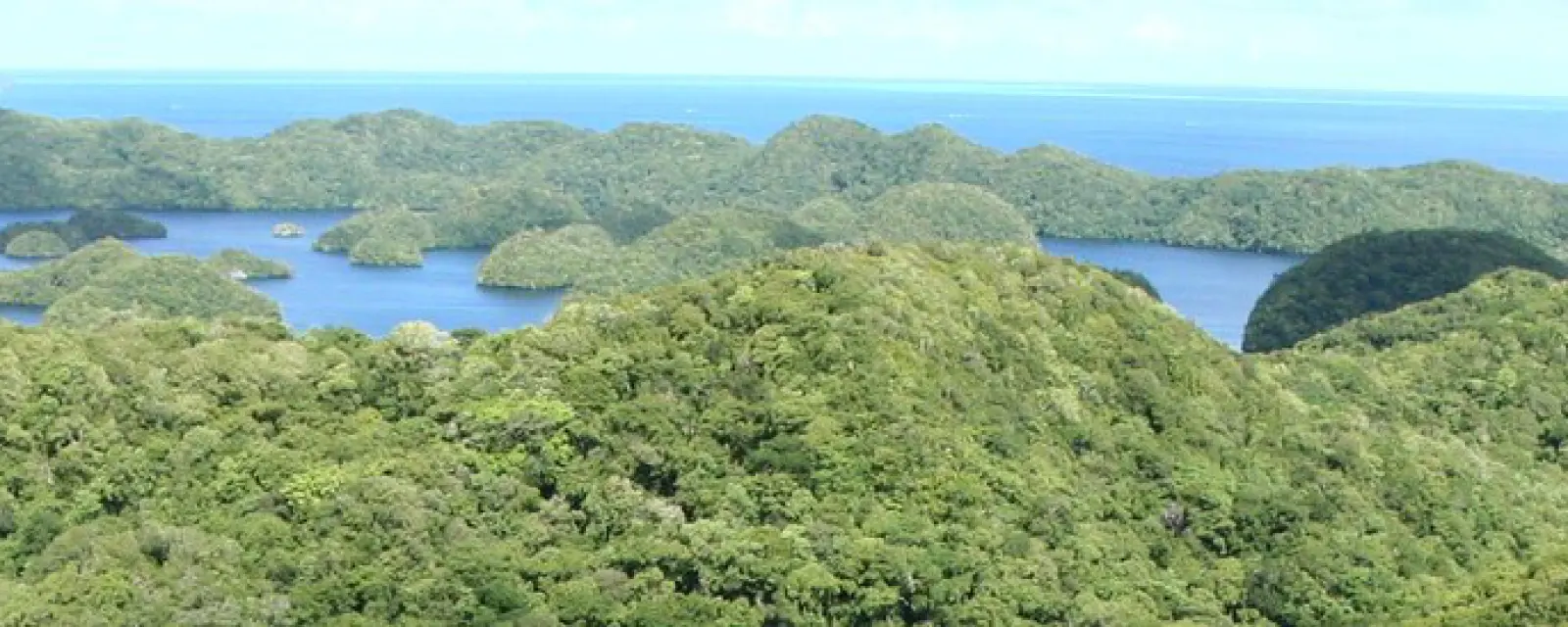
The Rock Islands — mushroom-shaped forested limestone islets rising from turquoise water — are UNESCO-listed and Palau's defining image.
The climate is tropical, hot and humid year-round with heavy rainfall. It sits outside the main typhoon belt relative to the Philippines and Japan, though storms can still have effects.
Palau is world-renowned for diving — ranked by many bodies among the planet's finest, with reef ecosystems and Second World War wrecks.
The country also leads on marine conservation: Palau established a marine sanctuary covering most of its exclusive economic zone, banning commercial fishing across a vast area — one of the world's largest such commitments proportionally. Palau was also the first country to ban certain sunscreens harmful to coral.
History
Palau has been inhabited for thousands of years, with a traditional matrilineal society — women's role in the inheritance of land and titles still carries influence today.
In modern times Palau passed successively to Spain, Germany, then Japan after the First World War. During the Second World War, Peleliu island saw one of the fiercest battles of the Pacific theatre.
After the war, Palau formed part of the US-administered Trust Territory of the Pacific Islands under United Nations mandate.
Palau became independent in 1994 — among the world's most recently independent countries — signing the Compact of Free Association with the United States at the same time.
One notable detail: Palau's 1979 constitution included a nuclear-free provision, and this extended negotiations with the United States over more than a decade across multiple referendums, until a resolution was found. It is a rare example of a very small country holding to a constitutional principle under negotiating pressure.
Culture & people
Palauan and English are both official languages, and English is widely used in education, administration and business. No new language to learn is a clear advantage.
Society is small and closely knit, with traditional clan and chiefly systems still holding genuine authority alongside modern state institutions — particularly on land matters.
There is a substantial foreign workforce relative to the population — chiefly from the Philippines, Bangladesh, China and Nepal — in construction, tourism and services.
The Vietnamese community in Palau is very small.
Economy & opportunity
The economy rests on three sources:
- Tourism — mainly upmarket dive tourism from East Asia. The largest sector and also the most volatile.
- Fishing licence fees — selling access to its vast maritime zone.
- Compact assistance from the United States.
For foreigners, opportunity concentrates in tourism, diving, hospitality, construction and certain specialist roles. A market of 18,000 is extremely small, and preference for Palauan workers is clear.
Currency: Palau uses the US dollar, so there is no exchange risk for those earning in US dollars — the same feature as Timor-Leste, the Marshall Islands and Micronesia in this series.
Living costs are high — a small, remote island importing almost everything.
As always: Palauan tax obligations do not replace those in your home country.
Immigration routes
No investment programme. The routes:
- Work permits — employer-sponsored and tied to a position. Effectively the only door, with residence status tied to the job.
- Residence through investment or business activity — a framework exists for foreign investment, chiefly in tourism, but with substantial sectoral and ownership restrictions.
- Residence through marriage to a Palauan citizen.
🔴 On land ownership
This must be stated clearly because it bears directly on any investment plan:
Foreigners cannot own land in Palau. Land ownership is constitutionally reserved to Palauan citizens. The available form is long-term leasehold, with terms set by regulation — and in practice, many land questions here involve the traditional clan system, not merely administrative registration.
Anyone offered a Palauan property project should insist on clarity about exactly what right is on offer, for how long, who the actual lessor is, and what happens at expiry — and use an independent lawyer.
Citizenship
As stated at the outset: Palau's constitution restricts citizenship largely to descent, and there is no ordinary naturalisation route open to foreigners as there is in other countries in this series.
That means the right to live and work in the United States under the Compact is not something obtainable by moving to Palau and waiting out a residence period. For a country of 18,000, tight control over citizenship is understandable as policy — each new citizen represents a very large proportional share.
If anyone offers you "Palauan citizenship for US access", stop and check very carefully. This is precisely the kind of offer this article exists to warn against.
Everyday life
Living costs are high given import dependence and remoteness.
Healthcare: local facilities are limited for a very small country. For specialist cases the standard approach is flying to the Philippines, Taiwan or Guam. International health insurance with medical evacuation is effectively mandatory — the general rule for every small island in this series.
Education: an English-language public system with very limited choice. Students typically go abroad for university, and Compact rights make studying in the United States practical for Palauans.
Connectivity: the international airport serves Guam, Manila, Taipei, Seoul and a few other points. Travel to Vietnam usually connects through Manila or Taipei — not far by Pacific standards.
Internet: improved through submarine cable but still a constraint; remote workers should verify conditions first.
Safety: very high, with very low crime.
Very small scale: 18,000 people means everything — goods, specialised services, schools, careers, social life — has clear limits. The sense of isolation is real.
Who should consider Palau
A good fit if:
- You work in dive tourism, hospitality or marine conservation — where Palau holds a genuine world position and has demand for foreign expertise.
- You want a period of work somewhere English-speaking, US-dollar-based and very safe, accepting the very small scale.
- You are investing in tourism and clearly understand this is long-term leasehold, not ownership.
Not a fit if:
- 🔴 You are seeking Palauan citizenship to gain US residence and work rights: the constitution restricts citizenship to descent and no ordinary naturalisation route exists for foreigners. This is a stopping point.
- 🔴 You are offered "Palauan property to buy": foreigners cannot own land; insist on clarity about the lease term and who the actual lessor is.
- You need a labour market or service choice at even a normal country's minimum.
- Your family needs specialist medical care, or your children need schooling options.
- You need reliable internet for work and have not verified conditions on the ground.