Overview
The Maldives holds a rank-46 passport with 86 destinations reachable without a prior visa. It is an archipelago of roughly 1,200 coral islands in the Indian Ocean with around 520,000 people.
Most people know the Maldives as an upmarket holiday destination. But on citizenship and settlement there is one thing that must be said before anything else, because it is decisive and almost no migration guide states it:
🔴 The Constitution of the Maldives provides that a person who is NOT Muslim may not become a citizen of the Maldives.
This is not an administrative rule that can be waived, nor a policy a stronger application can overcome — it is a constitutional provision. It is among the rarest citizenship conditions anywhere in the world.
For most readers, the implication is clear: the route to Maldivian citizenship is closed. This article therefore focuses on what is genuinely achievable — working and residing — and on what to know before committing money or signing a contract.
Two further points up front:
🔴 Foreigners cannot own land. A 2015 constitutional amendment did permit freehold ownership with very large investment plus land reclamation conditions — but that provision was repealed in 2019. What remains is long-term leasehold. If you read anywhere that "you can buy land in the Maldives", that describes a rule no longer in force.
🔴 This is the world's lowest-lying country, with most of its land less than a metre above sea level. Sea-level rise here is not a distant scenario but an existential issue the government has raised at international forums for decades.
The Maldives has no citizenship-by-investment programme.
Geography & climate
The Maldives lies in the Indian Ocean south-west of Sri Lanka and India, comprising some 26 natural atolls holding more than a thousand small islands, of which roughly 200 are inhabited and around 150 are resorts.
It is the world's most geographically dispersed country — a tiny total land area spread across a vast expanse of sea. Movement between islands depends on seaplanes and speedboats, which is a genuine cost and constraint in daily life, not just for tourists.
The capital, Malé, occupies a small island and is among the most densely populated cities on earth — virtually the entire island is built over. In response, the Maldives reclaimed land to create the artificial island of Hulhumalé, raised higher above sea level as a climate adaptation measure. Population is gradually being moved there.
The climate is tropical monsoon, warm year-round with two monsoon seasons. Being near the equator, cyclones are rare compared with many island regions — but correspondingly, the principal risk here is sea level and erosion, not storms.
History
The archipelago has long sat on the maritime routes linking Arabia, India and Southeast Asia, and that position brought Islam to the Maldives in the twelfth century, replacing the Buddhism practised before. That conversion shaped the country's identity, law and social structure to this day — and is the context for the constitutional provision noted above.
The Maldives had brief periods under Portuguese and Dutch influence, then became a British protectorate from the nineteenth century.
Independence came in 1965, and it became a republic in 1968.
The economic turning point came in the 1970s, when the first resort opened and the Maldives developed its "one island, one resort" model — each resort occupying an entire island, separate from inhabited islands. The model has been commercially very successful and is also how the country reconciles an international tourism industry with its domestic social framework.
Politically, the Maldives moved to multi-party politics in 2008 under a new constitution, and has since seen electoral transfers of power alongside periods of turbulence. Noted as fact.
Culture & people
The official language is Dhivehi, written in the Thaana script — a distinct writing system running right to left, used only in the Maldives.
English is widely used in tourism, business, healthcare and higher education. For those working in hospitality, English is sufficient for work.
Islam is the state religion, with concrete consequences for daily life that need stating plainly so you can decide:
- 🔴 Alcohol is prohibited on inhabited islands. It is served only at resorts — which is precisely why the one-island-one-resort model exists. This means life for resort staff and life on inhabited islands are two quite different frameworks.
- Dress and public conduct rules on inhabited islands are strict, entirely unlike the beach imagery of tourism advertising.
- Public practice of other religions is restricted by law.
Newcomers are often surprised by the gap between "the tourists' Maldives" and "the Maldives people live in". The two barely intersect.
There is a large foreign workforce — chiefly from Bangladesh, India, Sri Lanka, Nepal and the Philippines — in construction, resorts and services. The Vietnamese community is small, mainly in upmarket hospitality.
Economy & opportunity
Tourism dominates the economy — among the highest shares of GDP anywhere. The Maldives positions itself at the top of the market, a deliberate strategy: fewer visitors, higher spend, less environmental pressure.
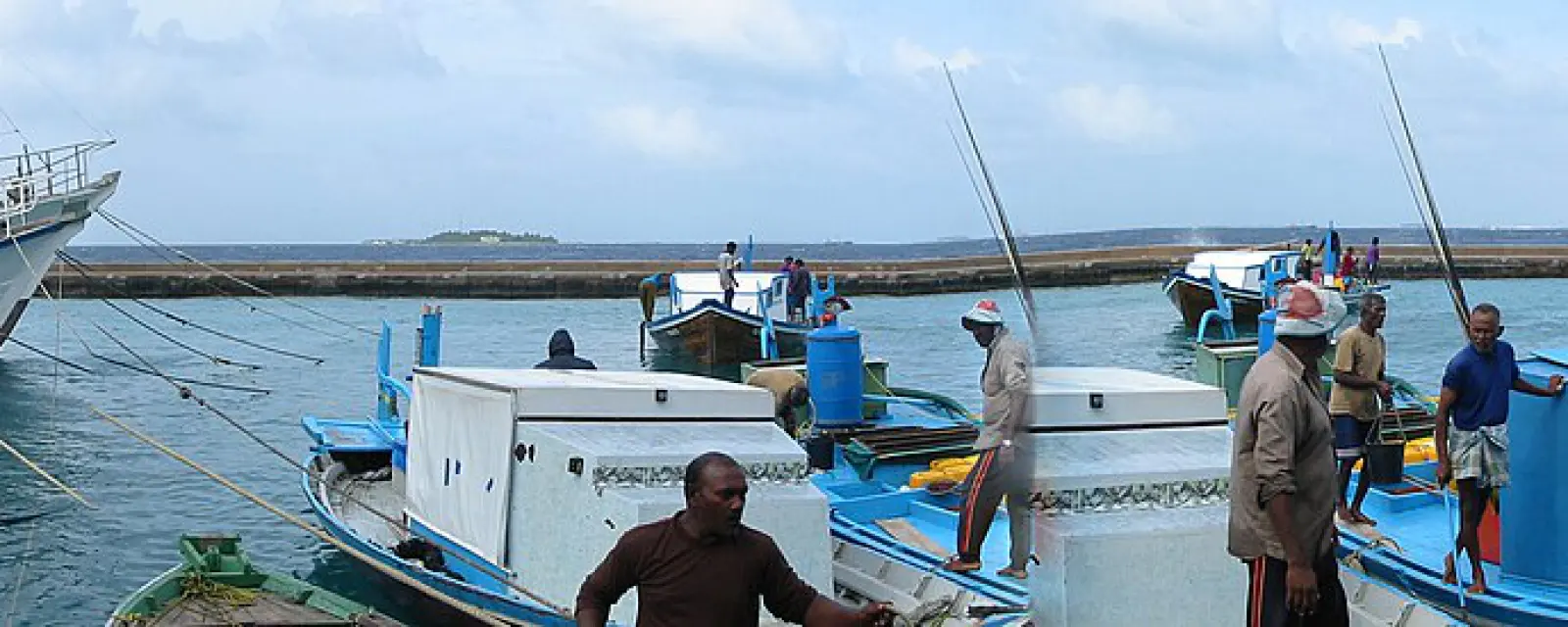
The second pillar is fishing, particularly tuna — and the Maldives is noted for using pole-and-line methods more sustainable than purse seining.
Near-total dependence on one industry is a clear risk, as the pandemic period demonstrated: when tourism stopped, the economy contracted sharply.
For foreigners, opportunity lies almost entirely in hospitality and resorts — management, food and beverage, spa, diving, guest services. There is genuine demand for staff with international experience.
One practical point about working life: resort staff usually live on the island where they work, on long contract cycles followed by long leave. This has an upside — living costs are nearly eliminated — but also a weight: living and working on the same small island for months at a stretch, with little private space and far from family. Many find the first year fascinating and the third year tiring. Ask carefully about leave cycles and accommodation before signing.
As always: Maldivian tax obligations do not replace those in your home country.
Immigration routes
No investment programme. The routes:
- Work permits — employer-sponsored and tied to a specific job. Effectively the only door. Losing the job means losing the right to stay.
- Residence through investment activity — a framework exists for foreign investment in tourism and certain sectors, usually as island or land leases with operating licences. This is a leasing and business relationship, not ownership and not permanent residence.
- Residence through marriage to a Maldivian citizen.
On land ownership — repeated because it is widely misunderstood
Foreigners cannot own land in the Maldives. The 2015 constitutional amendment that opened freehold to very large investment with reclamation conditions was repealed in 2019.
What exists is long-term leasehold, with terms and conditions set by regulation. Anyone offered "Maldivian property to buy" should ask precisely what right is on offer — ownership or lease, for how long, and what happens at expiry.
Citizenship
As stated at the outset: the constitution provides that a non-Muslim may not become a citizen.
Beyond that condition, naturalisation also requires long residence, Dhivehi ability and other conditions, with a discretionary decision. But for most readers of this article, the first condition is already the stopping point.
We state this directly because knowing early serves you better than spending years before discovering the path does not exist.
Everyday life
Living costs are high — a small archipelago importing almost everything, plus inter-island transport costs. Malé is particularly expensive relative to local incomes.
Housing in Malé: cramped and expensive given extreme density. Hulhumalé has newer and more spacious supply.
Healthcare: facilities in Malé are the country's best, but for specialist cases the standard approach is flying to India, Sri Lanka or Singapore. On outer islands provision is very limited — particularly important if you work at a resort on a remote island. International health insurance with medical evacuation is effectively mandatory.
Education: schools operate in Malé and Hulhumalé; international options are limited. Families with children generally do not choose the Maldives as a long-term base for this reason.
Transport: between islands by seaplane or speedboat — significant cost, weather-dependent. Velana International Airport near Malé serves India, Sri Lanka, the Gulf, Southeast Asia and Europe. Travel to Vietnam usually connects through Singapore, Bangkok, Kuala Lumpur or the Gulf.
Safety: serious crime is low.
🔴 Long-term risk: this is the world's lowest-lying country. Sea-level rise, coastal erosion and coral bleaching — which directly affects the tourism industry — are issues the Maldivian government has raised at international climate conferences for decades. Any plan measured in decades should account for this.
Who should consider the Maldives
A good fit if:
- You work in upmarket hospitality and resorts — management, food and beverage, spa, diving — and want a period of international work with living costs near zero while on a resort island.
- You invest in or operate within tourism and clearly understand this is a long-term lease, not ownership.
- You are targeting a few years to build experience and savings, not settlement.
Not a fit if:
- 🔴 You are aiming at citizenship: the constitution provides that a non-Muslim may not become a citizen. This is a stopping point, not a barrier a stronger application can overcome.
- 🔴 You are offered "Maldivian property to buy": foreigners cannot own land; the 2015 freehold provision was repealed in 2019. Ask precisely how many years of lease are on offer.
- Your family needs stable schooling or regular medical care.
- You would struggle living and working on the same small island for months — ask carefully about leave cycles before signing.
- You are making multi-decade asset plans without accounting for sea-level risk in the world's lowest-lying country.