Overview
Lithuania holds a rank-9 passport with 159 destinations reachable without a prior visa. It is a member of the European Union, part of Schengen, and has used the euro since 2015. It is the largest of the three Baltic states, with around 2.8 million people.
Two things deserve stating immediately, one favourable and one not:
Favourable: Lithuania has quietly become one of the European Union's largest fintech licensing hubs. Its central bank actively issues electronic money institution and payment institution licences, with faster processing and lower costs than traditional financial centres. As a result, hundreds of fintech companies use Lithuania as their gateway to the EU single market. If you work in this field, that is valuable information.
🔴 Unfavourable, and decisive: Lithuania does NOT permit dual citizenship for naturalised citizens. Those naturalising must renounce their original nationality. This is not a new rule nor one gradually loosening — a referendum to relax it failed to reach the required voter threshold, so the legal framework stands.
For anyone weighing Lithuania, therefore, the practical question is exactly as with Estonia: not "how long" but "is giving up my original nationality acceptable". If not, aim to stop at EU long-term residence — which still permits living, working and travelling indefinitely without giving anything up.
And as across most of the EU: Lithuania has no residence or citizenship by investment.
Geography & climate
Lithuania lies on the eastern Baltic coast, bordering Latvia to the north, Belarus to the east and south, Poland to the south-west, and Russia's Kaliningrad exclave to the west.
The terrain is low, with extensive forest and lakes. The coastline is short but includes the Curonian Spit — a narrow sand peninsula roughly 98 km long separating sea from lagoon, UNESCO-listed and the country's most distinctive landscape.
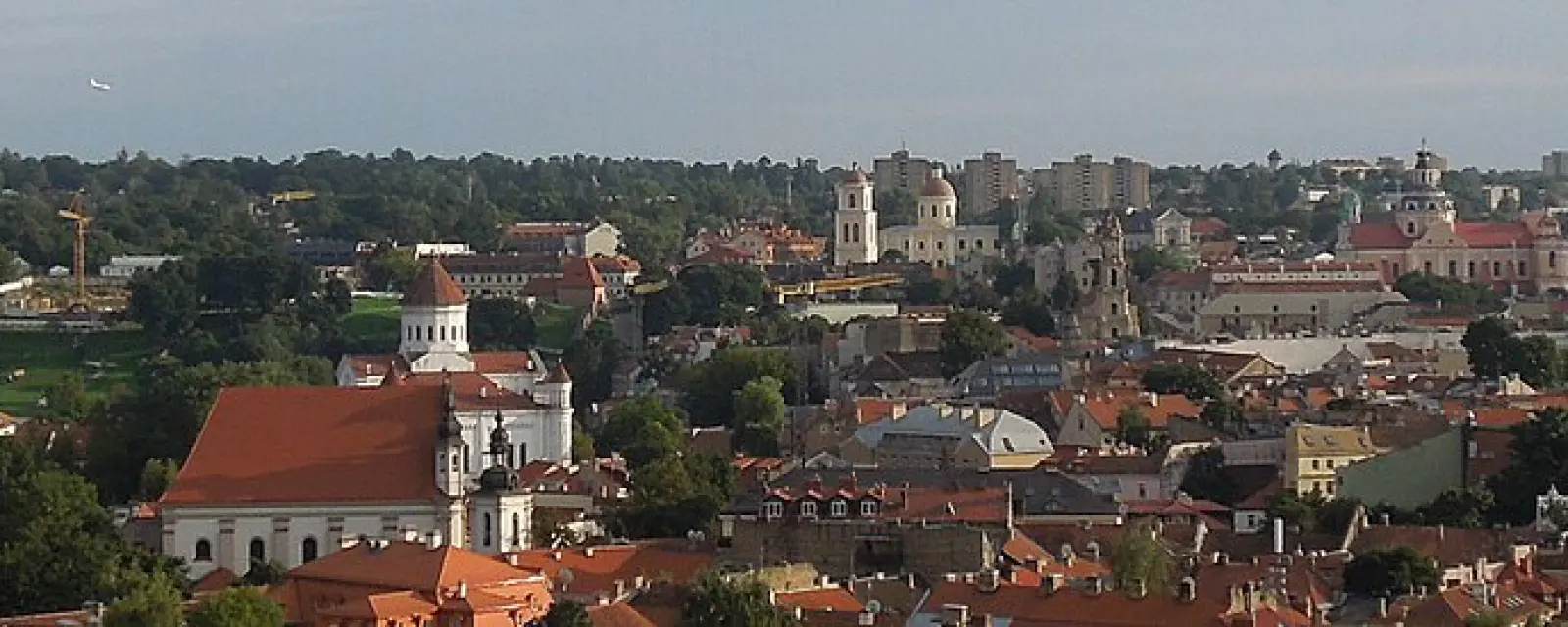
The capital, Vilnius, has one of Central and Eastern Europe's largest Baroque old towns, UNESCO-listed. Kaunas is the second city and served as temporary capital between the world wars. Klaipėda is the sole seaport.
The climate is continental with maritime influence: cold snowy winters with short days; mild, pleasant summers with long ones. The same climatic band as Latvia and Estonia.
History
Lithuania has a past its present size does not suggest: the Grand Duchy of Lithuania in the fourteenth and fifteenth centuries was among Europe's largest states, stretching from the Baltic almost to the Black Sea. Union with Poland formed the Polish-Lithuanian Commonwealth, which lasted until the late eighteenth century.
Lithuania was also the last country in Europe to adopt Christianity, in the late fourteenth century — several centuries after the rest of the continent.
After the Commonwealth's partition, Lithuania fell under the Russian Empire. It declared independence in 1918, then, like the other Baltic states, was annexed by the Soviet Union in 1940, occupied by Germany, and returned to Soviet control.
One milestone stands out: Lithuania was the first republic to declare separation from the Soviet Union, on 11 March 1990 — before the USSR dissolved. With Latvia and Estonia it took part in the Baltic Way of 1989.
Before the Second World War, Vilnius was a major European centre of Jewish culture, known as the "Jerusalem of the North"; that community was destroyed in the Holocaust. This context matters for the citizenship restoration route described below.
Lithuania joined the EU and NATO in 2004 and adopted the euro in 2015.
Culture & people
Lithuanian is a Baltic language, alongside Latvian — the only two surviving in that group. It is among the Indo-European languages that preserve the most archaic features, and linguists study it to understand Proto-Indo-European. For learners, that means complex grammar and seven noun cases.
English is common in Vilnius, among the young and in technology; less so in the regions.
Lithuanian society shares the Baltic characteristics: reserved with strangers, family-oriented, closely attached to nature and forest. Catholicism plays a deeper cultural role than in the other two Baltic states — Lithuania is the only majority-Catholic one, and the Hill of Crosses near Šiauliai is a national symbol.
The population is declining through low birth rates and emigration to Western Europe, as in Latvia. For newcomers the upside is that the housing market is not under pressure.
The Vietnamese community in Lithuania is very small.
Economy & opportunity
Fintech is the standout, as noted. Beyond it: IT services and shared service centres for multinationals — Vilnius and Kaunas host many; laser technology, where Lithuania holds a surprisingly large position in the global scientific laser industry; life sciences and biotechnology; logistics through the port of Klaipėda; furniture and wood processing; and food.
Lithuania's economy has grown quickly and consistently over two decades, visibly narrowing the living-standards gap with Western Europe.
Wages sit below Western Europe but costs are correspondingly lower, and personal income tax is moderate by European standards.
As always: Lithuanian tax obligations do not replace those in your home country.
Immigration routes
No investment programme exists. The genuine routes:
- Temporary residence permit for employment — requiring a contract; occupations on the shortage list are processed more favourably and exempt from the labour market test.
- EU Blue Card — for highly qualified workers meeting a salary threshold.
- Startup Visa — for founders of innovative businesses, assessed by an expert committee on the idea and the team rather than capital.
- Residence through lawful business activity — establishing and running a genuine company, with requirements on capital, operations and jobs created. Not an investment programme — no capital threshold buys a permit.
- Study — low fees by Western European standards, with English-taught programmes and a post-graduation period to find work.
- Family reunification.
Citizenship restoration by descent — the overlooked route
Lithuania provides for restoration of citizenship to descendants of those who held Lithuanian citizenship before 15 June 1940 and lost it, along with their descendants.
What makes this route distinctive: those restoring citizenship under it MAY keep their existing nationality — an exception to the dual-citizenship prohibition described at the start.
It will not apply to most readers, but it deserves mention because it is highly valuable to those who qualify, particularly families of Litvak Jewish origin who left before or during the Second World War. If your family has a Lithuanian branch, check this route before any paid option.
Permanent residence and citizenship
Permanent residence typically follows five years of continuous lawful residence, with a Lithuanian language certificate and knowledge of the Constitution.
Citizenship requires ten years of lawful residence, holding permanent residence, a Lithuanian language exam, an exam on the Constitution, lawful income and a clean record.
🔴 And as stated at the outset: renunciation of the original nationality is required, except in narrow categories such as restoration by descent.
Everyday life
Living costs are low by EU standards — comparable to Latvia, slightly below Estonia. Vilnius is the country's most expensive city but comfortable against any Western European capital.
Housing: the market is not strained, with accessible rental and purchase prices. A genuine advantage over Ireland, the Netherlands or Austria.
Healthcare: a public system with compulsory insurance; private care is widespread and far cheaper than in Western Europe.
Education: free public schooling in Lithuanian. International schools exist in Vilnius but with limited choice.
Digital infrastructure: Lithuanian internet is among Europe's fastest and cheapest — a genuine plus for remote workers.
Transport: Vilnius is compact and easy to move around. Air links to Western Europe run through Vilnius and Kaunas.
Winter is long, cold and dark — the same challenge as Latvia and Estonia.
Small scale: 2.8 million people means a narrow labour market; losing a job leaves fewer alternatives than in a large country.
Regional security: bordering Belarus and Kaliningrad is a factor many families weigh. Lithuania is a NATO and EU member; consider it on the evidence.
Who should consider Lithuania
A good fit if:
- You work in fintech — this is where the region's best licensing ecosystem and talent pool sit, and the clearest reason to choose the country.
- You work in IT, lasers, life sciences or logistics.
- You want a low-cost EU base with excellent internet infrastructure, working remotely.
- Your family has a Lithuanian branch predating 1940 — check the restoration route first, as it is both faster and lets you keep your existing nationality.
- You are content to stop at EU long-term residence rather than citizenship.
Not a fit if:
- 🔴 You want a Lithuanian passport while keeping your original nationality: you cannot through ordinary naturalisation, and the referendum to change this failed to reach threshold.
- You are looking for an investment programme: Lithuania has none.
- You need a broad labour market: 2.8 million people is a real limit.
- Your family would struggle with long, dark winters.