Overview
Iceland holds a rank-9 passport with 159 destinations reachable without a prior visa, with around 380,000 people.
The legal position first: Iceland is NOT in the European Union, but is a member of the European Economic Area (EEA) alongside Norway and Liechtenstein, and is in Schengen. It participates in the EU single market without EU membership — an Icelandic residence permit allows Schengen travel but does not confer the right to live and work in EU states as a member state's permit does.
Iceland has no residence or citizenship by investment.
Three things stand out about this country:
✅ Citizenship after seven years of residence, with dual nationality permitted — shorter than Estonia (eight years), Slovenia and Switzerland (ten), and without the renunciation demanded by Estonia, Lithuania or Slovenia. The barrier is the Icelandic language.
✅ Electricity is almost entirely renewable — geothermal and hydro. This is not a target but the current state, and it has real economic consequences discussed below.
🔴 Volcanic risk is present, not historical. Since 2021 the Reykjanes peninsula — home to the international airport and close to the capital — has entered a new eruptive cycle after roughly eight centuries of quiet. In late 2023 the town of Grindavík was fully evacuated and heavily damaged. Eruptions have continued since. This is a fact that belongs in any decision, not decorative colour.
Geography & climate
Iceland lies in the North Atlantic just below the Arctic Circle, astride the Mid-Atlantic Ridge — where the North American and Eurasian plates pull apart. That position produces everything characteristic of the island: volcanoes, hot springs, geysers, and abundant geothermal energy.
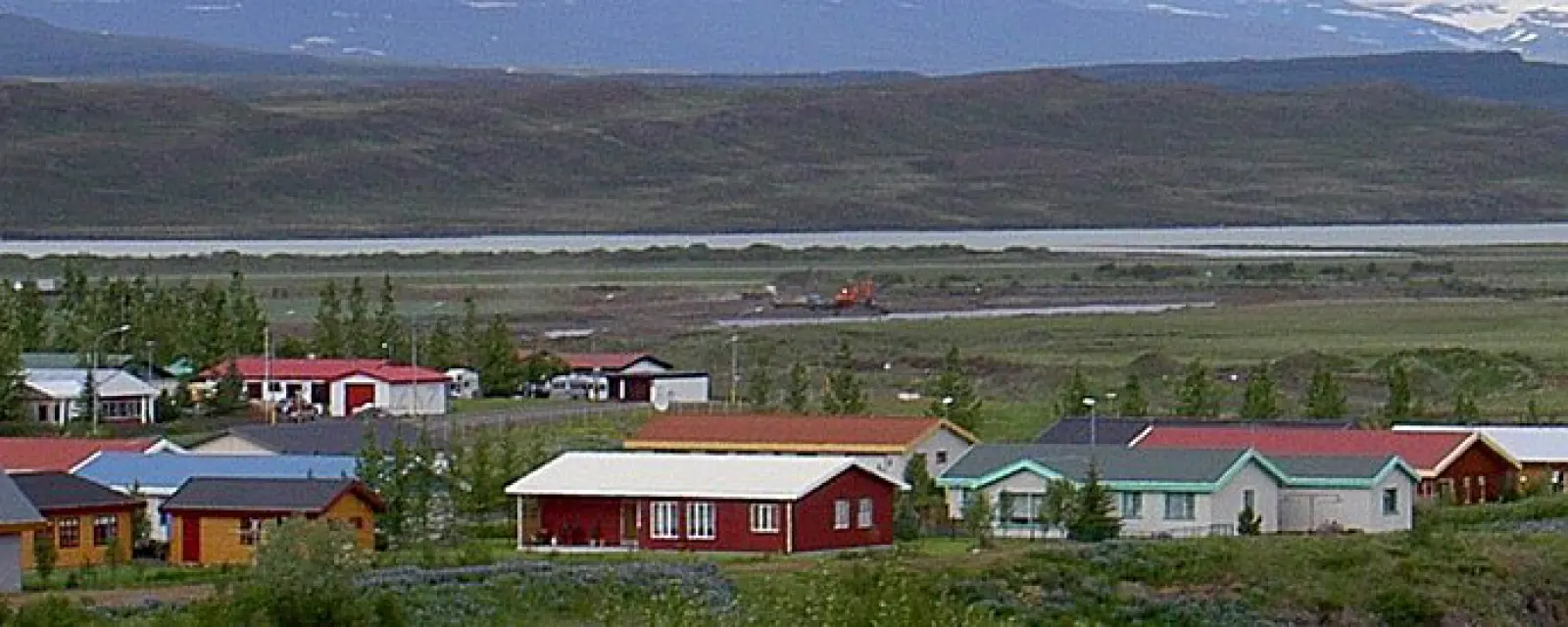
The terrain comprises a barren interior highland, glaciers — Vatnajökull is among Europe's largest — and a deeply indented coast. Most people live along the coast, and roughly two-thirds of the population is concentrated in the greater Reykjavík area.
The climate is milder than the name suggests, thanks to the North Atlantic current: Reykjavík winters hover around 0°C, rarely as severe as Moscow or inland Canada at similar latitudes. But the wind is fierce and the weather changes constantly — that, rather than temperature, is what newcomers find hardest to adjust to.
Light is a genuine challenge: December gives Reykjavík only four to five hours of daylight; June brings near-continuous light. The body clock takes time to adapt.
History
Iceland was settled from the late ninth century by Norse and Celtic peoples. In 930 they established the Alþingi — regarded as among the world's oldest parliaments still functioning.
Iceland later came under Norway and then Denmark for centuries. These were hard times: a harsh climate, volcanic eruptions causing famine, and trade monopolies limiting development.
Iceland gained full independence in 1944, while Denmark was under German occupation.
Two recent events shaped today's Iceland:
The 2008 financial crisis. Iceland's three major banks — grown to many times the size of the economy — collapsed almost simultaneously. Relative to national scale this was among the most severe banking collapses in modern history. Iceland imposed capital controls that lasted until 2017, and took a different path from many countries: it did not use public funds to rescue the banks wholesale, and prosecuted several banking executives.
The tourism boom from around 2010. Ironically the initial spur was the 2010 Eyjafjallajökull eruption that paralysed European aviation — and put Iceland's name across the world. Tourism became the new economic pillar, filling the gap the banks left.
Culture & people
Icelandic is the official language, with a rare characteristic: it is among Europe's most linguistically conservative. Rather than borrowing foreign words, Icelanders coin new ones from old roots — computer, telephone and helicopter all have purpose-built native words rather than transliterations. The result: Icelanders today can read thirteenth-century sagas almost without translation.
For learners that means complex grammar with four noun cases, and vocabulary unlike anything you already know — no shortcut through international loanwords as with German or Dutch.
English is spoken very well and very widely. But Icelandic is a citizenship requirement, and a practical condition for integration outside tourism and technology.
One cultural detail worth knowing: Icelanders traditionally use patronymics rather than surnames — a child of Jón is Jónsson or Jónsdóttir. The phone book is ordered by first name. Naturalising foreigners are no longer required to adopt an Icelandic name — that rule was abolished in 1996, though older information still circulates.
Society is small, close-knit, with among the world's highest gender equality, and exceptionally safe — Iceland has topped global peace rankings for years. The country has no army.
The Vietnamese community in Iceland is very small.
Economy & opportunity
Four pillars:
- Fisheries — the traditional sector, with Iceland well regarded for sustainable fisheries management.
- Tourism — the major pillar since 2010, with annual visitor numbers many times the population.
- Aluminium smelting — surprising for an island with no bauxite, but the logic is clear: smelting is enormously electricity-intensive, and Iceland has cheap, abundant renewable power. Ore is shipped in, aluminium shipped out. A textbook example of cheap energy being an export advantage in itself.
- Data centres — same logic: cheap clean power, and a cold climate cutting cooling costs.
For foreigners, opportunity concentrates in tourism and hospitality, IT, engineering, healthcare and nursing, and fish processing. A market of 380,000 is very narrow — losing a job leaves few domestic alternatives.
Living costs are among the world's highest. Almost everything is imported; eating out, goods and services are all very expensive. Wages are high but largely offset.
As always: Icelandic tax obligations do not replace those in your home country.
Immigration routes
No investment programme. The genuine routes:
- Work-based residence permits for skilled workers — requiring a contract, and for non-EEA nationals, proof that no EEA candidate could be recruited. This is the largest practical barrier.
- Permits for specialists in shortage fields — easier where the country has genuine need.
- Study — English-taught programmes available with low public university fees, and a post-graduation job-search period.
- Residence through business activity — establishing and running a genuine company.
- Family reunification.
Citizenship
The standard conditions: seven years of continuous lawful residence — shorter for spouses of Icelandic citizens and for Nordic citizens — plus an Icelandic language test, proof of means of support, no tax arrears, and a clean record.
✅ Iceland has permitted dual citizenship since 2003 — naturalising does not require renouncing your original nationality under Icelandic law. Information predating that is out of date.
This is what makes Iceland easier than Estonia, Lithuania or Slovenia: the barrier is language and time, not a trade-off of nationality.
Everyday life
Living costs are very high — a matter for serious budgeting rather than something economising can absorb.
Housing: the Reykjavík market is tight and prices have risen sharply with population growth and short-term tourist letting absorbing rental supply. This is the most common practical difficulty for newcomers.
Heating and electricity: an unexpected advantage — thanks to geothermal energy, heating costs in Iceland are unusually low compared with other Nordic countries. Hot water comes straight from the ground. Outdoor geothermal pools open year-round in every town are a genuine part of daily life.
Healthcare: universal public provision of good quality; but for highly specialised cases the patient numbers are too small to sustain deep sub-specialties locally, so transfers to mainland Scandinavia are routine.
Education: free public schooling in Icelandic. International school options are very few — a consequence of scale.
Transport: car-dependent outside Reykjavík; there is no railway anywhere in the country. The ring road around the island is the main route, and winter weather can close it.
Safety: among the highest in the world.
Nature: glaciers, waterfalls, hot springs, winter aurora — what keeps many people despite the costs.
🔴 Volcanoes: repeated because it is the most important fact to have changed in recent years. The Reykjanes eruptive cycle that began in 2021 continues, and the town of Grindavík has been evacuated. Iceland has among the world's best monitoring and response systems, and life in Reykjavík remains largely normal — but families considering a move should follow current information from the Icelandic Meteorological Office and weigh location choice carefully.
Who should consider Iceland
A good fit if:
- ✅ You want a rank-9 passport after seven years while keeping your original nationality — and accept learning a difficult language.
- You work in tourism and hospitality, IT, engineering, healthcare or nursing and can find an employer.
- You value absolute safety and nature over urban amenities and low costs.
- You work in renewable energy, geothermal or data centres — where Iceland has a genuine edge.
Not a fit if:
- You need a broad labour market: 380,000 people is a real limit, and losing a job leaves few alternatives.
- You need moderate living costs: this is among the world's most expensive countries.
- 🔴 Your family cannot accept volcanic risk as a present factor — the Reykjanes cycle is ongoing, not history.
- Your family would struggle with four to five hours of winter daylight and year-round strong winds.
- You assume an Icelandic permit allows working across the EU — it does not; Iceland is in the EEA, not the EU.