Overview
Barbados holds a rank-16 passport with 144 destinations reachable without a prior visa — stronger than many far larger countries. It is an island nation of around 280,000 people in the eastern Caribbean.
The first point must be stated plainly, because this is where confusion is most common:
🔴 Barbados has NO citizenship-by-investment programme. People see "Caribbean island" and assume an investment passport — but the five Caribbean countries offering that are St Kitts and Nevis, Antigua and Barbuda, Dominica, Grenada and St Lucia. Barbados is not among them, and never has been.
Barbados took a different path: building its position as a reputable international business and financial services centre, and keeping naturalisation standards strict to protect exactly that reputation. This is a deliberate policy choice, not an oversight.
But Barbados does have two genuine residency doors, and both are little discussed:
- A special entry and residence permit — for high-net-worth individuals or qualifying investors. This is a real residence-by-financial-means route, similar in nature to Swiss lump-sum taxation, though the mechanism differs.
- The Welcome Stamp — a twelve-month remote work visa launched in 2020 and among the world's first of its kind. Barbados was ahead of Croatia and much of Europe on this.
And one notable advantage: ✅ Barbados permits dual citizenship.
Geography & climate
Barbados sits at the eastern edge of the Caribbean, set apart from the Lesser Antilles chain and projecting into the Atlantic.
That position creates a practical difference worth noting: Barbados lies off the main Caribbean hurricane track, so direct hurricane strikes are considerably less frequent than on many neighbouring islands. This does not mean absolute safety — storms can still arrive, and climate risk is rising — but it is a real difference between islands and belongs in any comparison.
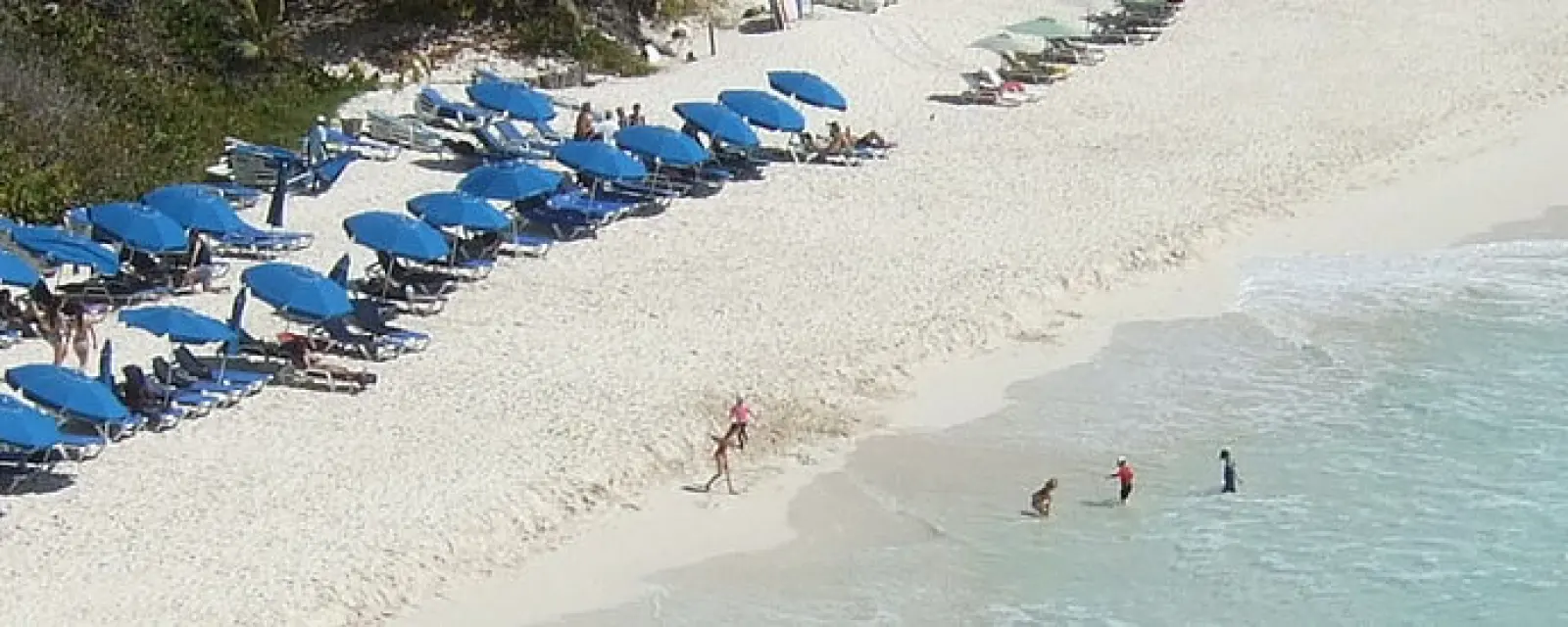
The island is relatively flat compared with the region's volcanic islands, built on coral limestone with extensive underground caves. The west and south coasts have calm sandy beaches; the east faces Atlantic surf.
The capital, Bridgetown, with its historic district and garrison, is UNESCO-listed.
The climate is tropical and warm year-round, with dry and wet seasons. Steady trade winds make temperatures more comfortable than the thermometer suggests.
History
Barbados was a British colony from the seventeenth century and one of the longest continuously held — it never changed hands between European powers as many islands did. That is why the British imprint runs deeper here, from the legal system and education to cricket.
The colonial economy rested on sugar and slavery, and that history shaped today's demographic and social structure. It is a history Barbadian society addresses directly.
Barbados gained independence in 1966.
And one very recent milestone many sources have not caught up with: on 30 November 2021, Barbados became a republic, removing the British monarch as head of state and electing its own president. Barbados remains a Commonwealth member. Any article describing it as a Commonwealth realm with the Queen as head of state is out of date.
Culture & people
English is the official language and the language of education, administration and business. In daily life people speak Bajan, an English-based creole — unfamiliar at first but quickly navigable for English speakers.
This is a major advantage: no new language to learn.
Barbados has a very high literacy rate and a strong educational tradition — a legacy of investment in public education after independence.
Society is stable and orderly, with good safety by regional standards. Barbadians have a reputation for courtesy, somewhat more reserved than on other Caribbean islands, and attentive to formality — the British influence remains visible.
Cricket is the national sport to a near-devotional degree. Rum has a long history here — Barbados is regarded as its birthplace.
There is virtually no Vietnamese community in Barbados.
Economy & opportunity
Two pillars: tourism — largely upmarket, from the UK, US and Canada — and international business services, including captive insurance, wealth management and cross-border corporate services.
The second pillar explains why Barbados chose not to sell citizenship: it maintains a network of tax treaties and a legal reputation it must protect, and an investment passport programme would put that reputation at risk — as some other countries have discovered.
Beyond those: rum and beverages, small-scale agriculture, and an emerging technology sector.
On currency: the Barbados dollar is pegged to the US dollar, and the rate has been stable for a long period. This reduces exchange risk for those earning in US dollars.
On costs, plainly: this is a small island importing most goods, so living costs are high — food, vehicles and electricity are all expensive. This is not the inexpensive Caribbean many imagine.
As always: Barbadian tax obligations do not replace those in your home country.
Immigration routes
Special entry and residence permit
For high-net-worth individuals or qualifying investors — for instance those owning Barbadian property above a defined level, or investing in local business.
A notable feature: the permit's duration depends on the applicant's age — those above a certain threshold receive a considerably longer-term category than younger applicants.
Understand its nature correctly: this is a residence right, not citizenship, and not a passport-sale programme. It resembles Swiss lump-sum taxation in the audience it serves, though the mechanism is entirely different.
Specific thresholds and conditions change with current regulations — consult the latest version rather than trusting a figure in an older article.
The Welcome Stamp — remote work visa
Launched in 2020, this was among the world's first remote work visas — Barbados moved ahead of Croatia, Estonia and much of Europe.
It is for those working remotely for employers or clients outside Barbados, with income above a prescribed threshold and health insurance. Valid for twelve months, renewable.
Two things to know:
- This time is not a path to permanent residence or citizenship. It is a temporary stay visa.
- Holders are not taxed in Barbados on foreign-earned income — but as in every comparable case, that does not end your obligations where you are tax resident.
Other routes
- Work permits — requiring an employer and proof that no Barbadian could be recruited; the market is small, so this is a narrow door.
- Residence through marriage to a Barbadian citizen.
- Immigrant Status (permanent residence) — after a number of years of continuous lawful residence.
Citizenship
Naturalisation generally requires a number of years of lawful residence, most of it physically present in Barbados, together with sufficient knowledge of civic life and duties, and a clean record. A descent route also exists for those with Barbadian parents or grandparents.
✅ Barbados permits dual citizenship, so naturalising does not require renouncing your original nationality under Barbadian law.
Everyday life
Living costs are high — as noted, this surprises many. Budget on actual island prices rather than a general impression of the Caribbean.
Healthcare: public and private facilities exist, of reasonable quality by regional standards, but highly specialised cases usually mean flying to the United States. International health insurance including medical evacuation is necessary, not optional — the general rule for every small island.
Education: a strong public system by regional standards, taught in English; private schools exist, and the University of the West Indies has a campus here.
Connectivity: the international airport has direct flights to the UK, US, Canada and regional islands — better connected than most Caribbean islands. But travelling to Asia is a long journey requiring at least two connections.
Internet: good by regional standards and adequate for remote work — the Welcome Stamp would be meaningless otherwise.
What to prepare for: a slower island pace, administration that can take time, and small scale, meaning limited choice in goods, specialised services and career opportunities. A sense of isolation is real for those used to large cities.
Who should consider Barbados
A good fit if:
- You work remotely for foreign clients and want to try a year in the Caribbean on clear terms — the Welcome Stamp was built exactly for that.
- You hold substantial assets and want a stable, English-speaking base with a British-style legal system and a US-dollar-pegged currency.
- You value that Barbados permits dual citizenship.
- You are comparing Caribbean islands and treat hurricane risk as a criterion — the position off the main track is a real difference, though not a guarantee.
Not a fit if:
- 🔴 You are seeking a Caribbean investment passport: Barbados has none, and this is a policy choice rather than a procedural gap. For that objective, look at St Kitts and Nevis, Antigua and Barbuda, Dominica, Grenada or St Lucia.
- You expect a Caribbean island to be inexpensive: costs here are high.
- You need to find local employment: the labour market is very small and prioritises Barbadians.
- Your family needs regular specialist medical care.
- You take the Welcome Stamp expecting it to lead to permanent residence: it does not.