Overview
Egypt holds a rank-74 passport with 52 destinations reachable without a prior visa. That is a weak figure, and it must be stated immediately to avoid misunderstanding: almost nobody buys Egyptian citizenship for easier travel.
So why does the programme exist, and why do people buy it? For one very specific reason, and this article exists chiefly to explain that reason accurately.
Egypt is on the list of countries holding a treaty of commerce and navigation with the United States that qualifies for the E-2 visa. The E-2 permits citizens of a treaty country to enter the United States to direct a business in which they have invested, bringing a spouse and minor children, and is renewable without a fixed limit for as long as the business operates.
Many countries — including Vietnam — are not on the E-2 treaty list. Nationals of those countries who want the E-2 route must therefore hold citizenship of a treaty country. That is the entire reason Egypt appears in conversations about moving to the United States, alongside Grenada and Türkiye, the two better-known doors.
Egypt's advantage within that group is usually a lower investment level. But before treating that as a benefit, several things must be checked:
- US rules for the E-2 may require a minimum period of holding the citizenship before applying, and the treaty list and its conditions are determined by the United States and can change. Verify current US requirements — do not rely on a sales pitch.
- The E-2 is a non-immigrant visa. It is not a green card and does not by itself lead to US permanent residence. Confusing the two is a fundamental error.
- Egypt's programme conditions change relatively often — amounts and routes have been revised several times. Consult the programme page for a current table rather than trusting a figure in an older article.
In short: the value of Egyptian citizenship lies in the door it opens elsewhere, not in itself. Anyone buying without a clear E-2 plan has usually bought the wrong product.
Geography & climate
Egypt occupies the north-eastern corner of Africa, with the Sinai Peninsula in Asia — making it a transcontinental country. It borders Libya, Sudan, Israel and the Gaza Strip, with the Mediterranean to the north and the Red Sea to the east.
Most of the territory is desert. Almost the entire population lives along the Nile and its delta — a narrow ribbon covering a few percent of the land but holding nearly all of its 112 million people. It is one of the world's most unevenly distributed populations.
The Suez Canal, linking the Mediterranean to the Red Sea, is among the world's most important shipping routes and a major source of foreign currency.
The capital, Cairo, with a metropolitan population above twenty million, is the largest city in Africa and the Arab world. Egypt is building a new administrative capital east of Cairo to relieve pressure.
The climate is desert: hot and dry, with very hot southern summers and a milder Mediterranean coast. Rainfall is negligible outside the northern coastal strip.
History
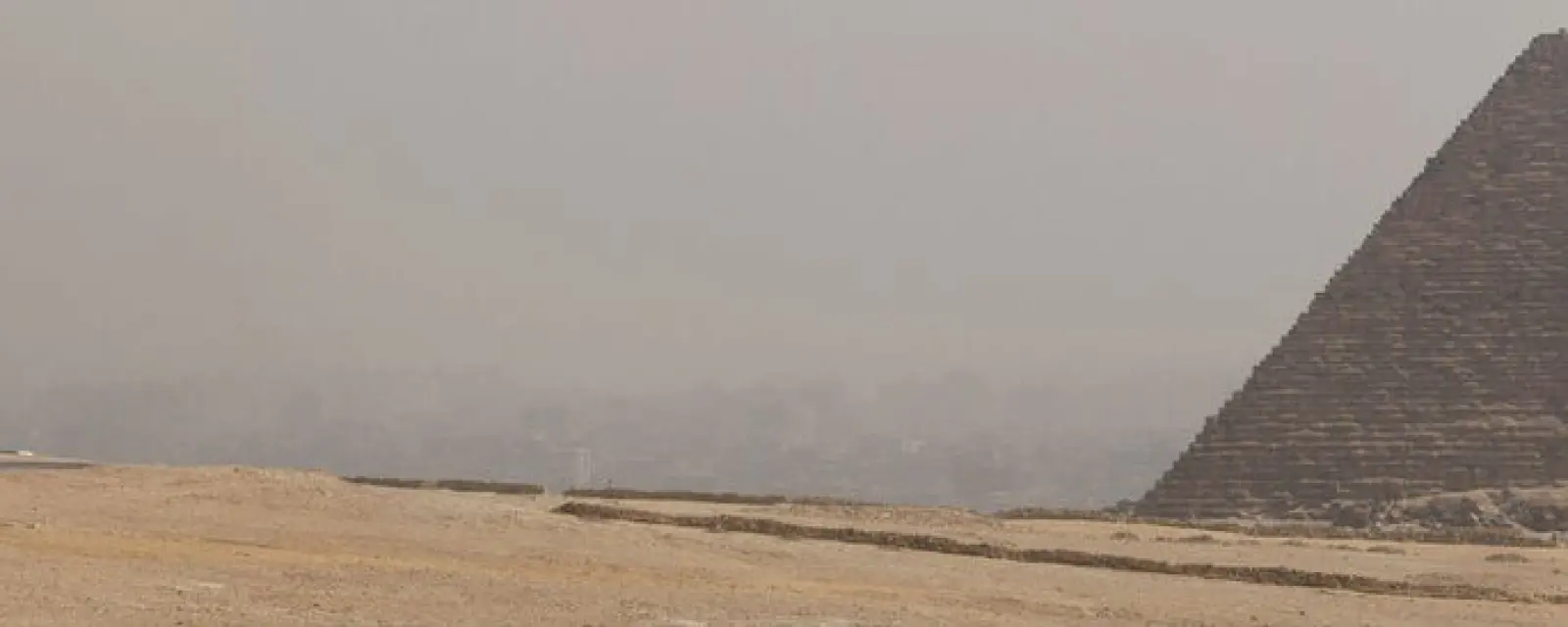
Egypt is one of the world's longest continuous civilisations — a centralised state along the Nile formed around 3100 BC. The Giza pyramids, Karnak and the Valley of the Kings date from this era.
Layers followed: Persian rule, Ptolemaic Greek rule with Alexandria as the ancient world's scholarly centre, Rome, and then the Islamic conquest of the seventh century, which shaped language and religion to this day. Then came Islamic dynasties, Ottoman rule, and a British protectorate from the late nineteenth century.
Egypt gained nominal independence in 1922 and became a republic after the 1952 revolution. Nationalisation of the Suez Canal in 1956 was a defining regional event of the twentieth century.
Recent history includes wars with Israel, the 1979 peace treaty, and political upheaval from 2011.
Culture & people
Around 112 million people — the most populous Arab country and third most populous in Africa.
The official language is Arabic, used in its Egyptian dialect in daily life. That dialect is understood across the Arab world thanks to the reach of Egyptian cinema and music through the twentieth century — Cairo was the Arab world's Hollywood.
The majority are Muslim, alongside a long-established Coptic Christian community of roughly a tenth of the population — one of the world's oldest Christian communities.
English is common among the educated, in tourism and in business in Cairo and Alexandria.
Egyptians are known for humour and openness; family culture is strong and social life dense.
For resident foreigners, the familiar areas are New Cairo, Zamalek and Maadi in Cairo, along with Red Sea towns such as Hurghada and El Gouna.
Economy & opportunity
Egypt's economy rests on tourism, the Suez Canal, remittances from Egyptians working in the Gulf, natural gas, agriculture and a substantial manufacturing sector.
But the risk side must be stated plainly, because it bears directly on investors: the Egyptian pound has undergone several sharp devaluations in recent years, alongside high inflation and periods of foreign-currency scarcity.
This has three practical consequences for programme applicants:
- Assets priced in local currency can lose value in dollar terms even as nominal prices rise.
- The property route carries more currency risk than a one-off contribution.
- Repatriating funds requires careful study of current foreign-exchange rules.
None of this rules Egypt out, but it is reason not to treat the sum paid as a profit-seeking investment. Count it as the cost of obtaining what you actually need — citizenship that opens the E-2 route — rather than as a property deal.
As always: Egyptian tax obligations do not replace those in your home country.
Immigration routes
Citizenship by investment
Egypt runs one of the few citizenship-by-investment programmes outside the Caribbean that remains open. It offers several routes, typically including:
- Purchase of qualifying real estate;
- A non-refundable contribution to the state treasury;
- A bank deposit for a prescribed term, returned afterwards;
- Establishing or investing in a business in Egypt.
Egypt permits dual citizenship, and family members may be included. Processing usually runs from several months to under a year.
Conditions and amounts for each route have been revised several times — this programme changes relatively often, so check the current table before deciding and before transferring anything.
Residence without investment
- Work visas — requiring an employer.
- Residence linked to property ownership — a residence category tied to owning a home, separate from the citizenship programme.
- Family reunification and student visas.
Who should consider Egypt
A good fit if:
- You have a clear E-2 plan for the United States: you have identified the sector, budgeted the capital for the US business, and verified current US requirements including any minimum citizenship-holding period.
- You compare Egypt against Grenada and Türkiye on one table, covering total cost, timeline, programme stability and currency risk — not just the headline investment.
- You treat the outlay as the cost of opening a door, not as an investment expected to return a profit.
Not a fit if:
- You want a strong passport for travel: rank 74 with 52 destinations, this is not the product for that objective.
- You think the E-2 is a green card: it is not. It is a non-immigrant visa, renewable, but not itself a path to US permanent residence.
- You have no concrete US business plan. Buying citizenship first and deciding what to do afterwards is the wrong order, and an expensive one.
- You need an asset that holds value in hard currency: local currency risk here is real and has materialised repeatedly.
The general lesson from this case is worth keeping: some passports are bought not for themselves but for a treaty attached to them. When that is so, the thing needing the closest scrutiny is not the passport but whether that treaty is still in force and whether it applies to your situation.